When Tom Nardacci, CEO of New York State’s Regional Food Bank, considers opportunities for sourcing more food, he sees limits to the amount of food that can be donated, rescued, or government-supplied. He also sees plenty of farms.
That landscape is the reason behind a new strategy putting much more emphasis on farm-sourced food. Like a growing number of food banks, Regional sees a multitude of benefits from working more closely with local farmers (see our story here.)
But the Albany, NY-based food bank is taking the concept even further, viewing farms as critical suppliers of charitable food, as traditional sources of food supply show signs of reaching capacity. “It’s a whole shift in our focus to say, ‘Okay, we need to increase these pounds. Let’s do it through working with farms,’” Nardacci said.
In April, Regional announced an ambitious goal to increase the amount of farm-produced food it distributes over the next three to five years to 30 million pounds annually, up from 19 million currently. That will be more than half the 53 million pounds the food bank distributed in total in each of the last two years. “It’s a huge goal,” Nardacci said.
Helping to reach it are the nearly 10,000 farms in the food bank’s 23-county service area (which stretches from just north of New York City to the Canadian border), according to a survey the food bank recently conducted. About 98% of those are family-owned. “Fundamentally, there’s a lot of opportunity for a food bank like ours,” Nardacci said.
Over the next five years, Regional will invest $25 million to $30 million in things like vehicles, infrastructure and agency-partner improvements, as it seeks to make farms a more central part of its food sourcing.
An initiative known as the service-wide Agriculture Hub will create the infrastructure needed to source, store, pack and distribute farm-fresh food on a local basis. Critical to that effort is a 50,000-square-foot distribution center built last year in the southern part of the food bank’s region through a $25 million capital campaign, adding to the food bank’s main distribution center in Albany.
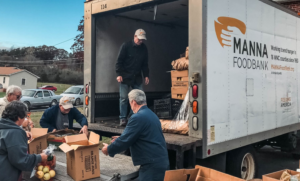
While the southern region includes only six of the counties the food bank serves, it “has a ton of farms,” Nardacci said. “There are 5,000 farms that we weren’t sourcing from because we didn’t have a facility to handle it,” he said. “We would get apples, ship them to Albany, repack them, and send them back.”
Other infrastructure improvements will include adding up to 15,000 more square feet of space to its main 70,000-square-foot facility in Albany, expanding its cooler and freezer capability. And in its northern region, the food bank is working with one of its agency partners to utilize 6,500 square feet of unused space for cooling. The set-up will give Regional a facility in each region and “allow us to do a lot of things, but specifically work with farms, ” Narcacci said.
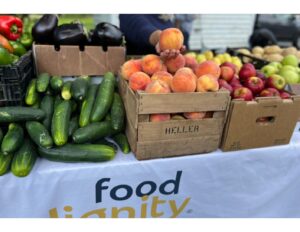
In addition to infrastructure improvements, Regional is also steering its food-purchasing budget toward farm goods. Last year it spent $350,000 to subsidize farmers for the costs they incur to harvest and package food that would otherwise go to waste. It plans to grow that “pick and pack out” budget to $1 million. In addition, it is piloting a micro-purchasing program in which it purchases cases of food from farmers on behalf of local agencies, helping it to build relationships with more of those 10,000 farms. Currently, it only works with 90 farms.
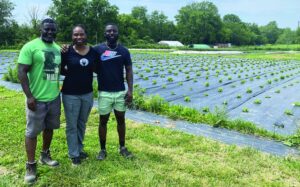
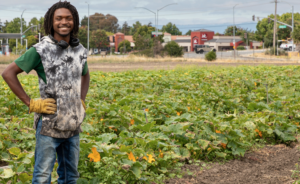
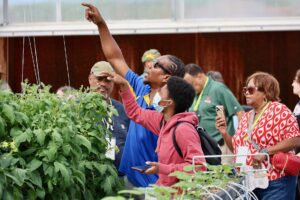
The food bank is always pushing for more state and county funding to support farm-to-food bank initiatives. And it is making investments, such as new greenhouses and high tunnels, in its own 160-acre farm, which is expected to produce about 150,000 pounds of food this year.
Regional’s overall investment in working with farms will be well-spent, in Nardacci’s view, given the many synergies between food banks and farmers. “We have the scale, we have the distribution, we have the logistics, and we know where food can go. It’s just a matter of acquiring and managing those resources.” – Chris Costanzo
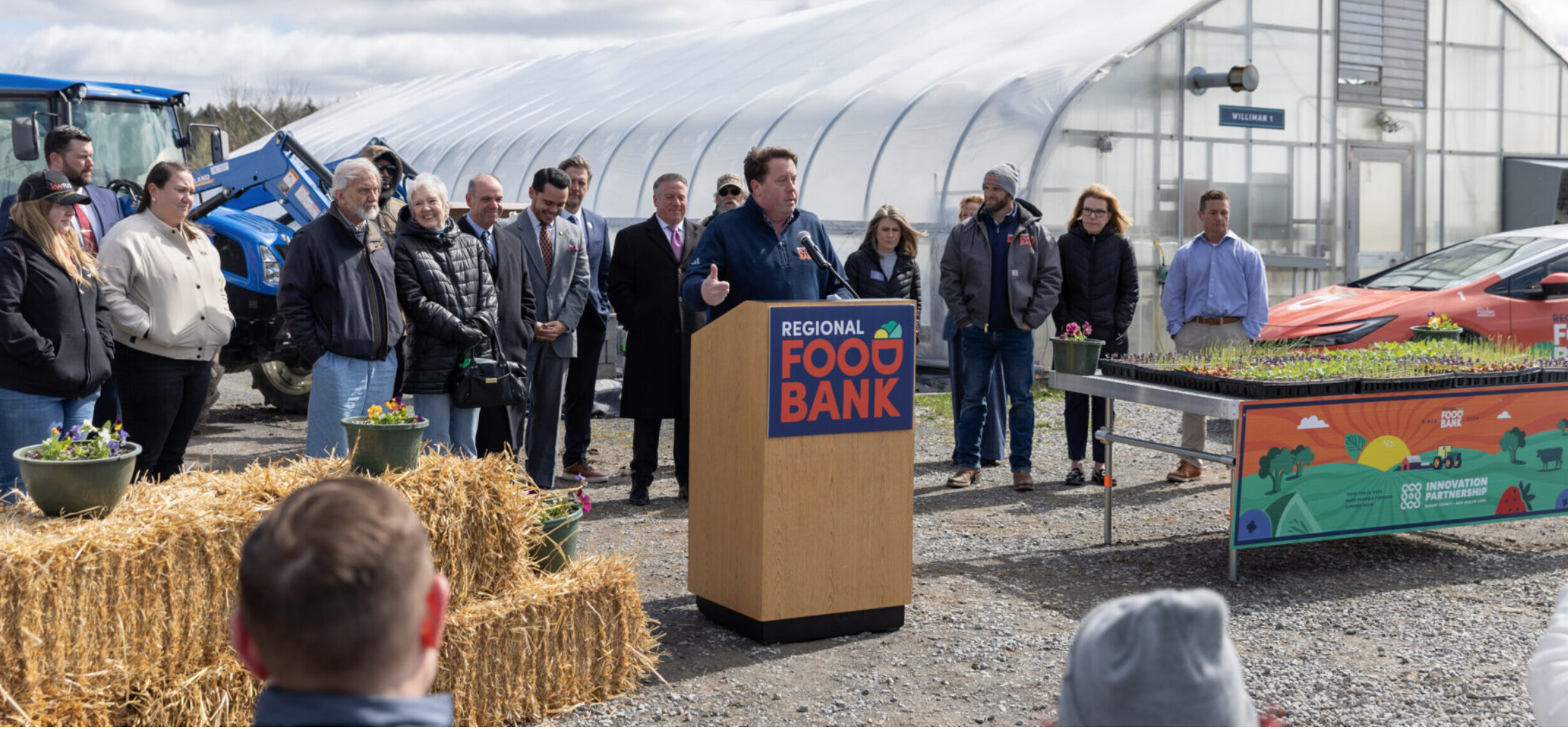
CAPTION FOR PHOTO, TOP: Tom Nardacci, CEO of Regional Food Bank, announces the food bank’s Agricultural Hub.
Like what you’re reading?
Support Food Bank News
This article was made possible by the readers who support Food Bank News, a national, editorially independent, nonprofit media organization. Food Bank News is not funded by any government agencies, nor is it part of a larger association or corporation. Your support helps ensure our continued solutions-oriented coverage of best practices in hunger relief. Thank you!