A new program at Community Food Share of Colorado underscores the value of listening to community members with lived experience of food insecurity.
The program, about to be expanded, never would have come into fruition if not for the input from people living in low-income, low food-access communities. Their viewpoint came through at meetings convened by the food bank in response to SNAP being suspended during the government shutdown.

While many were worried about the impact the SNAP suspension would have on food pantries and community members, a grassroots coalition made up of people with lived experience expressed a different concern. They feared small neighborhood grocers of cultural food would close without the revenue stream provided by SNAP payments.
That information led the food bank to devise a solution that put grocery store owners at the center. “That’s why it’s so important to have these partnerships outside of what you do day by day, because everyone has a different piece of information,” said Kim Da Silva, CEO of Community Food Share. “Bringing those all together can really form powerful relationships and powerful programs within the community.”
Coming up with an appropriate response to the issue took a while. At first the food bank considered purchasing food from the grocers and redistributing it through its partner agencies. But that risked moving the food out of the neighborhood. Ultimately, it decided to create simple paper vouchers community members could use to spend money at their local grocers.
The $25 vouchers were usable at nine grocers, mostly ones selling Hispanic and Latin food. Each store benefitted from $5,000 worth of vouchers, which were distributed at the discretion of nearby partner agencies to community members. In all, the food bank invested $45,000 to distribute 1,800 vouchers.
The plan was hugely successful, with virtually 100% of the vouchers being spent by families at those stores. “It was such a great partnership,” Da Silva said, and affirmed that food banks don’t need to be at the center of acquiring food and redistributing it. “We don’t need to do it all. It’s more like, ‘How can we help our community members get the access they need?’”
The food bank relied on community members to propose the solution to grocers, who were happily incredulous to hear of the plan. To guard against the possibility that families would not redeem the vouchers, the food bank presented the grocers with their $5,000 gift in advance, requiring them to then accept $5,000 worth of vouchers as they were presented. The vouchers were customized to each store, with the food bank handling their printing and distribution.
Community Food Share is not the first food bank to try vouchers. Manna Food Center in Maryland also deployed them to help struggling grocery owners during the pandemic (see our story here). And vouchers in the form of digital purchase cards, such as from IQPay, are finding a wide variety of uses in food banking (see our story here).
Community Food Share is now planning a six-month pilot that hopefully would make the vouchers an ongoing, sustainable program. It estimates there are 30 neighborhood-specific, family-owned stores in its service area that could benefit from vouchers. Community members could use them to purchase spices and other specific ingredients that can be hard to source at a pantry.
The voucher program earned Community Food Share the distinction of being one of six food banks honored at this year’s Feeding America annual conference. It will use its $10,000 award to move the voucher program forward. Said Da Silva, “It’s an idea that took off and we’re so proud of it.” – Chris Costanzo
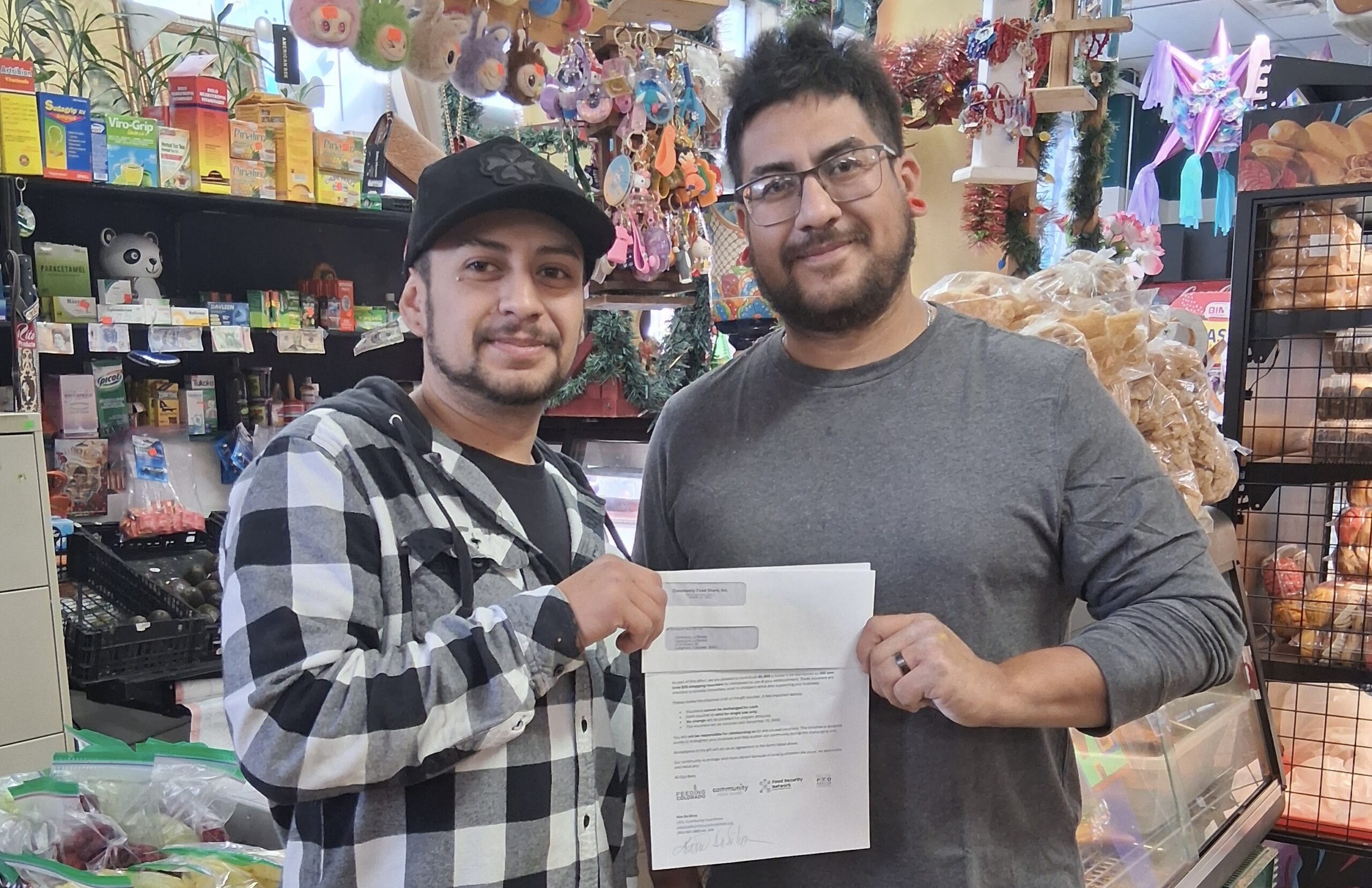
CAPTION FOR PHOTO, TOP: The owners of an immigrant grocery store in Colorado display the $5,000 check that will enable them to accept $5,000 worth of vouchers as payment.
Like what you’re reading?
Support Food Bank News
This article was made possible by the readers who support Food Bank News, a national, editorially independent, nonprofit media organization. Food Bank News is not funded by any government agencies, nor is it part of a larger association or corporation. Your support helps ensure our continued solutions-oriented coverage of best practices in hunger relief. Thank you!