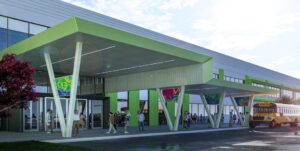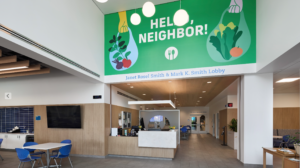
Nearly two years following Hurricane Helene’s destruction, MANNA FoodBank in Asheville, N.C. is rebuilding with resilience in mind.
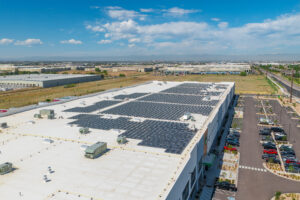
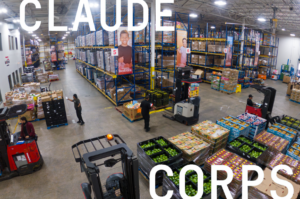
It is one of a growing number of food banks to utilize rooftop solar panels, in this case to power its newly opened facility, which includes 16,500 square feet for cold storage. Going a step further than most food banks, it is also beefing up its resiliency with two solar-powered mobile containers that can act as self-sufficient cooling units during times of disaster.

Known as Cooler Bees, the units are retrofitted shipping containers equipped with solar panels, battery storage and air conditioning. Cooler Bees can be hitched to the back of a truck and be temporarily relocated to provide an extra power source and cold storage space. MANNA FoodBank received its two units in June as gifts from the disaster relief non-profit Footprint Project, which designed them.

For MANNA FoodBank, the solar-powered units arrived long after the damage from Helene was already done. “If MANNA had had these stored somewhere offsite, it would have been a huge resource to us immediately after the storm,” said Micah Chrisman, Director of Marketing and Communications. In the future, the new units can be used as emergency mobile pantries. “They could be easily deployed from our site to the disaster zone,” Chrisman said.
In the aftermath of Helene, MANNA FoodBank used refrigerated trucks to store perishable food items like milk, eggs and produce. The trucks, which the food bank relied on for over a year and a half following the disaster, were diesel powered, costly to refuel, and required a constant rotation of staff through the weekends.
Footprint Project has also deployed its technology in New Orleans and following natural disasters abroad, including a recent energy project in Venezuela, but MANNA FoodBank is one of the only food banks it works with, said Devin Williams, Communications Coordinator at Footprint Project. “We’ve gotten solicitations already from towns in the east part of North Carolina for us to set up a hub there,” he said, and “over the past year, we’ve heard interest from other states.”
The reality is that mobile cold storage powered with solar is a rare technology across the country. That hasn’t stopped other hunger relief organizations from building their own. In 2021, Meals on Wheels People in Portland, Ore. funded its own custom van equipped with solar-powered refrigeration, the first of its kind in the nation. Since then, the vehicle has been a regular member of its fleet, helping the non-profit deliver over 25,000 meals a week to older adults across the Portland-Vancouver metro area. Five years of regular usage has proven that the benefits of mobile solar-power go beyond disaster relief, offering consistent service for everyday operations as well.
In 2019, the organization received a $337,000 grant to upgrade its fleet through Portland General Electric and Oregon’s Department of Environmental Quality via its Clean Fuels Program. In their research of electric vehicles, Meals on Wheels People noticed that cargo vans equipped with solar were being used by European food banks, but “didn’t exist in America yet,” said Kristin Mueller, Senior Administrative Project Manager. The agency decided to build one itself.
With $140,000 of the grant money, the organization purchased a cargo van, which they refitted to support an electric motor, solar panels and a refrigeration system, making the vehicle fully electric and with solar-powered refrigeration. Five years later, “it’s an amazing vehicle to this day, like the amount of money it saves,” said Mueller. It doesn’t rely on gas or need oil changes, so maintenance is mostly tire replacement “because it’s heavier,” she noted. The van has marketing benefits as well. “It has gotten us a lot of attention in the sustainability world,” she said, and a “massive amount of free PR.”
Climate resilience wasn’t the primary reason for building the van in 2021, but Mueller noted that consideration has grown in recent years. “Any decision we make in sustainability also has an element of resilience,” she said. When it comes to an electric van with solar-powered refrigeration, that vehicle has dual usage. “I want something to not just do its one job day to day,” said Mueller, “but I also want it to have another use during a disaster or an emergency or whatever the need is, where I can cool food in that vehicle.”
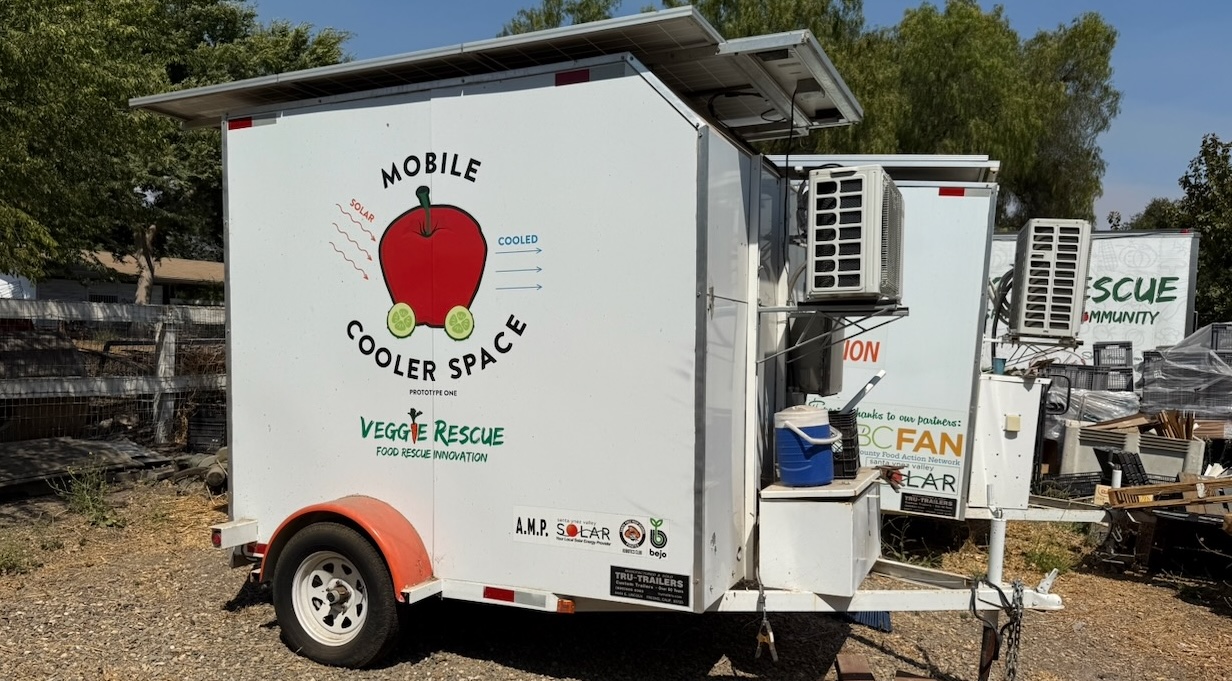
Veggie Rescue, a food rescue group based in Santa Barbara County, Calif., built its own solar-powered cooler in a towable trailer, designing its first prototype over six years ago. Originally created to provide farmers with mobile cold storage for excess produce and to reduce food waste on their farms, Veggie Rescue partnered with the Santa Barbara County Food Action Network in 2020 to fund a second prototype.

The partnership led to the idea of distributing the trailers to nearby food banks as emergency mobile pantries or additional cold storage. “We happen to be a region that is very sensitive to climatic changes,” said Shakira Miracle, Executive Director of Santa Barbara County Food Action Network. “Parallel to food insecurity, we are in a place where fire, flooding, debris flows have literally cut us off from the rest of the country.”
Expanding the project has been challenging. During the peak of the pandemic, Veggie Rescue struggled to get its prototypes to work effectively, highlighting some of the difficulties in creating and distributing this technology on a larger scale. Using solar panels connected to a battery, the trailer was installed with a wall-mounted air-conditioning unit that was rewired “to go below 60 degrees,” said David Roberts, Program Director at Veggie Rescue. Unfortunately, it never got quite cold enough to keep perishables cold for long periods of time.
Still, they haven’t given up. The next trailer prototype is “something that’s in our pipeline,” said Roberts, and with recent advancements in solar and battery storage technology, getting the unit cold enough might be less of a challenge today.
Considering the funding and engineering challenges that come with building a mobile solar-powered cooler, Mueller at Meals on Wheels People understands why the technology is still rare among hunger relief organizations in the U.S. “There are so many unknowns in the world of nutrition, and taking on new technology is an unknown,” she said.
Still, she thinks the investment is worth it. From a marketing perspective, and from a resilience perspective, “it is one of the better decisions we’ve made,” she said. – Sidney Slon
Sidney Slon is a graduate student at the Craig Newmark Graduate School of Journalism at CUNY. He is a 2026 summer intern at Food Bank News, and has previously reported for the New York City News Service, U.S. News and World Report, and City Limits.
Like what you’re reading?
Support Food Bank News
This article was made possible by the readers who support Food Bank News, a national, editorially independent, nonprofit media organization. Food Bank News is not funded by any government agencies, nor is it part of a larger association or corporation. Your support helps ensure our continued solutions-oriented coverage of best practices in hunger relief. Thank you!