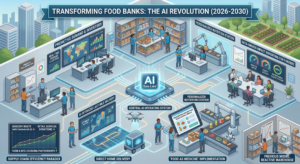
Slowly but surely, artificial intelligence is starting to show up in food bank operations.
The use cases are all over the map. Some food banks are focused on improving personal productivity, while others are addressing food bank-wide efficiency. Some are seeking to upgrade applications used internally, while others are deploying it in client-facing ways. Still others are trying to figure out where they stand philosophically when it comes to AI.
Montgomery County Food Bank
It doesn’t take much to get started. Texas-based Montgomery County Food Bank, for example, began with a series of small, pragmatic AI experiments, and is now part of a national fellowship program hosted by Anthropic, the company behind the popular AI assistant Claude. “Like probably most of us, we dipped our toes in with ChatGPT,” said Scott Burns, President and CEO.

As interest in AI use grew internally, Montgomery County Food Bank secured a free nonprofit license for Claude. Over the last six months, Burns said, the food bank has steadily ramped up its use of the platform across multiple departments.
“The finance team is using it to help create insights into sourcing trends,” Burns said. “And we’ve been using Claude, more recently, as add-ins in Excel, Word, and PowerPoint. Logistics is another emerging focus area. Staff members are currently testing AI applications to optimize truck routing, aiming to reduce driver transit time and cut fuel costs.”
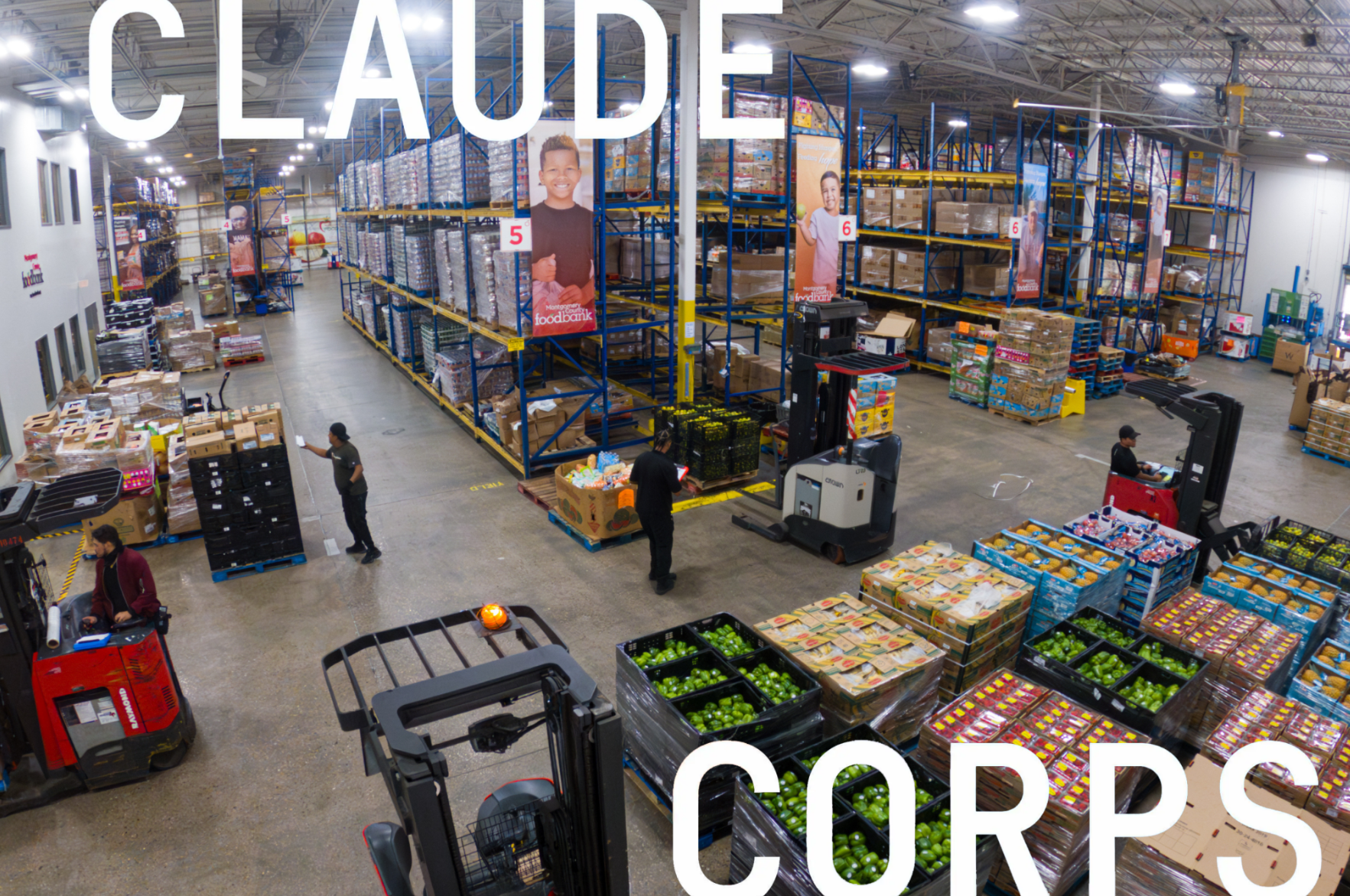
In May, the food bank was selected as one of nine nonprofits across the U.S. to participate in a new initiative called Claude Corps. “Because we were a nonprofit using the Claude platform and had a license for it, Anthropic reached out a few months back and asked if we were interested in participating in this new program,” Burns said.
Claude Corps places early-career AI professionals in nonprofit organizations for a year. During that time, the on-site fellows build practical AI tools tailored to the specific needs of the organization. “We’ll have a couple of Claude Fellows that come in and help us apply these new tools and technologies to challenges that we’re facing today to make us more efficient and effective,” Burns said.

Prior to joining Montgomery County Food Bank, Burns spent more than two decades in corporate leadership, including roles that involved innovation and technology use. Burns said that this background allowed him to recognize the potential for AI to make food bank operations more efficient.
His own use, however, started with off-the-shelf generative AI platforms to tailor messaging and fundraising appeals. “It definitely helped me prepare for conversations with big stakeholders,” Burns said. “AI made it very easy for us to put messaging together that was impactful and met both their strategic pillars and ours.”
Burns emphasized that the tool is meant to complement, not replace, human staff. “There are a lot of human conversations that AI is never going to take over,” he said, adding, “My goal is to be as scrappy as possible. I want to feed as many people as I can as effectively and efficiently as I can, and this is a tool that enables me to leverage the human resources we have to do even more.”
Mid-Ohio Food Collective
At Mid-Ohio Food Collective, AI is moving from being a back-office operational tool to a public-facing resource that clients interact with directly, according to Nick Davis, Chief Innovation Officer at the Columbus, Ohio-based food bank.
Davis oversees a wide portfolio of departments, including IT, data science, and an in-house engineering team responsible for developing FreshTrak, an online platform that helps food banks manage their operations and connect individuals experiencing food insecurity with local resources. “One platform, one customer journey is our aspiration,” Davis said.

Formerly called PantryTrak and originally developed in 2009 as an alternative to paper registration forms at pantries in Ohio, the platform has since been rebranded as FreshTrak and was adopted by the Feeding America network in 2021.
As of 2026, it is used by more than 1,700 food banks, pantries and hunger-relief organizations — about 20% of the Feeding America network — and helps feed approximately 200,000 people daily. “It’s at scale, and we’re growing quickly,” Davis said.
Unlike Feeding America’s other software tools, such as the logistically focused MealConnect, FreshTrak is designed as an end-to-end service insights and client management platform, Davis said. For food banks, FreshTrak manages client intake and compliance, tracks distribution, and provides insights that can help lead to more strategic decision-making. For clients, the platform assists in finding and accessing in-network food pantries, soup kitchens and mobile food distribution sites.
Recently, Davis and his team partnered with a user experience and design agency to overhaul the software, remove barriers and introduce new functionality like a client-facing AI chat function powered by a large language model.
Clients can use the app to speak naturally with the AI in any language and ask questions about health and nutrition. They can even take a photograph of the items they received in a food distribution box, and the AI will instantly generate recipes based on those specific ingredients.
“All of that is extremely thought out from a user experience standpoint, and it feels intuitive,” Davis said. “We really want to make the technology show up in a way that gets that person from what is probably a fairly difficult day to a much more human-centered approach that removes those barriers so they can stabilize faster.”
Behind the scenes, Davis and his team are now working to expand FreshTrak’s functionality. Currently, it can track healthcare referrals and nutrition down to the unit level. The ultimate goal, he said, is to improve the overall health of the people who access services in the Feeding America network.
“Did this person take an apple on Thursday, and what was the net benefit of that vegetable or fruit on their health over time?” Davis said. “That’s really what we’re trying to unlock with the platform.”
Community Nutrition Partnership
Despite its small size, Community Nutrition Partnership has been pretty aggressive in deploying AI. Just over a year ago, the Buffalo, N.Y.-based nonprofit began taking advantage of New York’s Medicaid 1115 waiver to support its mission of increasing access to healthy food and nutrition education. The administrative demands of working so closely with the healthcare industry quickly led it to build its own case management system using AI.
“There are some really cool things that we can be doing with AI,” said Kristie Chamberlain, Co-Founder and Executive Director. “It allows us to be more efficient, to serve more people, and most importantly, offer a much more personalized experience for our customers.”
Using a capacity-building grant of about $20,000, the nonprofit built an all-in-one system that receives referrals, manages customer interactions, sends food orders, handles messaging, makes recommendations, and does reporting. “We also give our customers access because we post our menus there,” Chamberlain said.
Building out the technology was a smooth process, requiring one staff person with a background in technology. “What I’ve learned is that open sourcing and AI has made it so much easier for us to build things ourselves,” Chamberlain said. “It’s super simple, honestly. It’s an open-source platform, and then doing some plugins and some integrations. It was a pretty easy process.”
Gleaners Food Bank of Indiana
At the moment, Gleaners Food Bank of Indiana is taking a two-pronged approach to AI. First, it is building a roadmap that articulates where the food bank is technologically, and where it expects to be in the future, taking into account all the ways AI could improve personal productivity, transactional efficiency, and deep operational change. “The roadmap just says here’s where we are and here’s where we think we want to be,” said Joe Slater, Chief Operations Officer, speaking at Fresh Connect Central’s Power of Partnerships conference last week.
A specific high-priority project for Gleaners is to use AI to make its transportation logistics more efficient. Working with Leaf Software Solutions, Gleaners is using historical data to help it predict expected transportation capacity on upcoming routes. “The algorithm will say, ‘Here’s what the next 12 weeks should look like day by day, given the history of patterns and volumes and route times,’” Slater said.
Better insights will help the food bank support its Gleaners2Go program (more on that program here), in which it works with community partners that have not traditionally distributed food. Because they lack refrigeration, such partners require just-in-time food drops, putting increased pressure on effective transportation. “It’s predicting when we have capacity and when we don’t within transportation, so we can start changing the rules of the game of how we get our fleet more optimized,” Slater said.
Northern Illinois Food Bank
Northern Illinois Food Bank is making sure to lay the proper groundwork before proceeding too far into AI. “We have really started our AI journey talking about the ethical implications of AI, and making sure that we give our team time to talk about and share their views before we decide how we’re going to use it,” said Julie Yurko, President and CEO, also speaking at Fresh Connect Central’s Power of Partnerships conference.
Working through various committees, the food bank has listened and learned together about AI, and from there created a cohort and a policy around AI. Now it is working with Microsoft’s Copilot to explore how the software can offload burdensome or administrative work. “How can it handle some of that so we can be better at building relationships?” Yurko said. “How can AI help us be more human?” – Mike Peterson, with additional reporting by Chris Costanzo
Mike Peterson is a writer, editor, and freelance journalist based in San Diego, California.
Like what you’re reading?
Support Food Bank News
This article was made possible by the readers who support Food Bank News, a national, editorially independent, nonprofit media organization. Food Bank News is not funded by any government agencies, nor is it part of a larger association or corporation. Your support helps ensure our continued solutions-oriented coverage of best practices in hunger relief. Thank you!