For food banks struggling to get resources, the idea of being able to earn some revenue – rather than always rely on government or charitable support – can be attractive.
In Canada, Toronto-based North York Harvest Food Bank is championing this approach, generating between $3 million and $4 million a year in earned revenue, while extending its mission.

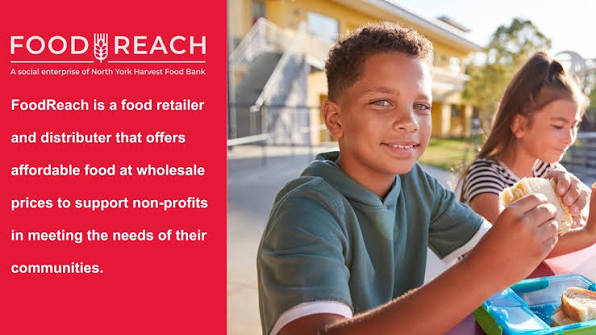
The food bank’s FoodReach business is a social enterprise project that offers nutritious food to local community-based organizations at wholesale prices. Along with affordable food, it offers a host of related logistical services including trucking, warehousing, scheduling, point-to-point shipping, storage, procurement, and delivery.
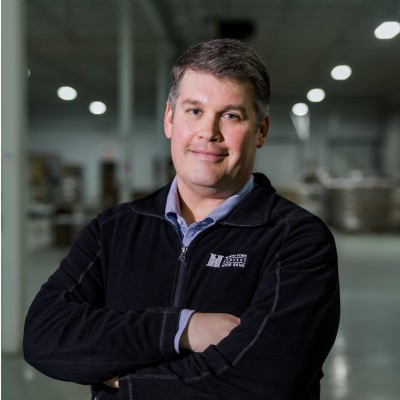
“We think of ourselves as a nonprofit food logistics company,” said Ryan Noble, who is Executive Director of the food bank, as well as CEO of FoodReach.
The business got started by happenstance about ten years ago when a nonprofit operator of low-cost childcare asked if the food bank could help it deliver prepared meals to some of its centers. At first the food bank said no, considering the task outside of its scope. Eventually, it reconsidered. “We thought, ‘How can we use what we were already doing in new ways to unlock new value?’” Noble said.
From that first client, sales have bloomed to just shy of 300 sites purchasing food and logistics services from the food bank in the last year. The business’s double-digit sales growth helps to support the rest of the organization, adding to the $5 million or so that the food bank typically generates annually in fundraising. “It’s not a profit-maximizing venture,” Noble clarified about FoodReach. “We’re trying to provide savings into the community and expand our mission, so sustainability is our goal more than profit generation.”
The food bank continues to distribute donated food to its network of pantry agencies. Its FoodReach unit, meanwhile, focuses on purchased food and getting it to community organizations for, say, their youth or senior programming, or even disaster preparedness. “We’ve been surprised at how many nonprofit organizations are purchasing food even in fairly large amounts at the retail level,” Noble said. “Being able to consolidate that purchasing with the institutional procurement we’re already doing and offer wholesale pricing, or going directly to manufacturers and producers, is huge savings.”
FoodReach’s approach has similarities to other food-bank businesses in the U.S., including Fresh Connect Central from Gleaners Food Bank of Indiana and Project Preserve of Second Harvest Food Bank of Middle Tennessee, both of which operate across the country, serving other food banks and increasingly other types of non-profits. FoodReach, however, has much more of a local focus.
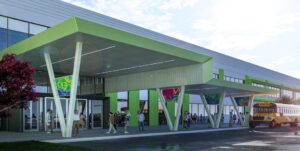
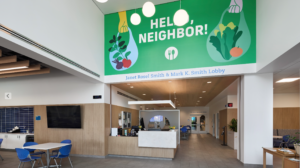
It hopes to bolster the local economy through a new hub it will open in December that will be three times the size of its current facility. The extra space will enable it to bring in small farmers and local businesses, and connect them to institutional contracts to create “very short local supply chains,” said Noble, “which we think are more resilient and will ultimately generate more wealth and more economic activity in the communities that we support.”
FoodReach’s aim to boost the local economy is reflective of a more ambitious type of food banking. In Nobles’s view, food banks are starting to see themselves as “community-based infrastructure,” able to provide physical infrastructure like warehousing and trucks, but also skills like creating partnerships. “Once you start to see yourself in that way, then there is no shortage of like-minded organizations that are looking for the type of value food banks can provide,” he said.
Despite the steady, double-digit growth of FoodReach, there is more demand for its services than it currently has the capacity to support, Noble said. It expects its three-times-bigger facility will generate three times as much economic activity, “and we believe that the market is much larger than that,” he said, clarifying that FoodReach only works with nonprofit, mission-aligned organizations, not private sector companies.
Over time, Noble sees the nature of food banking changing. While rescued and donated food will always be part of the food system, that will decrease as supply chains become more efficient, he said. At the same time, the ability to connect small, local producers into larger institutional markets that they otherwise would not be able to access will be increasingly valued. “We can leverage our infrastructure to create new sources of value,” Noble said, adding, “I do see those networks as the future of food banking.” – Chris Costanzo
Like what you’re reading?
Support Food Bank News
This article was made possible by the readers who support Food Bank News, a national, editorially independent, nonprofit media organization. Food Bank News is not funded by any government agencies, nor is it part of a larger association or corporation. Your support helps ensure our continued solutions-oriented coverage of best practices in hunger relief. Thank you!