Our annual scan of the website advocacy efforts of the top 100 food banks (by revenue) uncovered a trend toward food banks seeking to provide deeper information and assistance related to SNAP.
SNAP outreach has always been a mainstay of food bank advocacy efforts, but those endeavors shifted into higher gear as the impact of the H.R. 1 megabill passed last July has come into clearer focus. With the new law tightening SNAP eligibility requirements, more food banks are doing what they can to ease the uncertainty by providing greater clarity around SNAP, including aids like eligibility screeners, targeted Q&As, and information related to SNAP work requirements and immigration status.
These findings are part of our annual look at how food banks promote advocacy through their digital presence. While advocacy happens mostly “in real life” through conversations and lobbying, our advocacy scan recognizes that food banks can also do a lot to raise advocacy awareness through their websites.
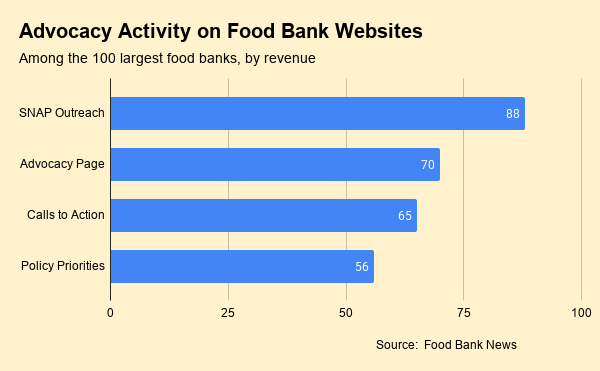
This year we found that 50 out of the top 100 food banks by revenue (as identified by our 2025 Top 300 Food Banks report) are active in all four areas identified as being important to website advocacy, earning them placement on our “High Honor Roll.” These four areas include having SNAP outreach, having an advocacy page, having calls to action related to advocacy efforts, and outlining policy priorities. That’s up from 47 a year ago and only 33 in 2022, the first time we conducted our advocacy scan.
For a detailed look at all the food banks on our High Honor Roll, see our special report, 2026 Advocacy Honor Roll.
SNAP outreach increased significantly since last year’s Advocacy Honor Roll report, with a record 88 food banks having a page or section directly related to SNAP assistance – that’s four additional food banks since 2025.
Given the many changes to SNAP eligibility this year, some food banks made an effort to acknowledge the new landscape. Greater Chicago Food Depository did an exemplary job of overviewing both the new work requirements and immigrant eligibility, as well as informing people of specific actions to take to keep their benefits. Related resources include a link to a state screening tool to help people determine if they are meeting the new work requirements.
The Food Bank of Central and Eastern North Carolina provided an overview of the new work requirements and addressed questions related to SNAP and immigration status in its FAQ. Roadrunner Food Bank acknowledged the changes and provided information on how to take action. Food Bank of Contra Costa and Solano provided a targeted Q&A related to the immigrant and work requirement changes.
In some states, additional SNAP changes have to do with new restrictions on SNAP purchases, such as soda, candy, and various snacks. San Antonio Food Bank relayed the changes relevant to Texas in a flyer posted on its website in both English and Spanish.
Some food banks are fortunate to operate in states that have done a good job of disseminating information about SNAP. At the top of its SNAP page, Connecticut Foodshare trumpets that “Federal SNAP eligibility rules have changed,” and encourages people to click through to a state screening tool that helps determine if they need to meet the new work rules. Similarly, California’s Second Harvest Food Bank of Orange County offers a link to a helpful CalFresh guide that answers many questions related to SNAP and immigrants, which in turn links to a free anonymous immigration screening tool.
Food banks may want to link to EBTCheckup, a site that lets people look up SNAP information by state, such as when benefits are expected to be reloaded, the foods people are able to buy with SNAP in that state, and other SNAP news.
It’s fairly common for food banks to encourage website visitors to reach out to their SNAP assistance staff by calling a number or filling out a form. Feeding Northeast Florida is savvy in posting a QR code to scan. Tarrant Area Food Bank stands out for having a clean and comprehensive appointment booking page that gives people agency in choosing how they would like to interact with the food bank.
A growing number of food banks offer a simple eligibility form right on their websites so people can immediately find out if they qualify for SNAP. Feeding the Gulf Coast and Regional Food Bank of Oklahoma are among those that have turned to the nonprofit mRelief to offer such a form.
The mRelief form at Arkansas Food Bank appears within its useful SNAP Help Center, which also includes a host of information on eligibility, the application process, and QR codes that lead to more help, including a handy app called AR SNAP Companion that lets users find out which foods are no longer eligible for SNAP purchase due to new state laws.
This year we noted the emergence of another tool called SNAP Screener in use at a handful of food banks, including Mid-Ohio Food Collective, which incorporates the form directly onto its website, and Idaho Food Bank, which offers a direct link to the Idaho SNAP Screener page. Originally started as a weekend project in 2020, Co-Founder Ben Molin created SNAP Screener out of what he saw as a need for a free and “reusable resource.” So far, more than 2.5 million people have used SNAP Screener, Molin said.
After SNAP outreach, the most common advocacy feature is a page or section devoted to advocacy. Of the 70 food banks we found to have an advocacy section, most emphasize the need for renewed federal funding or increased state funding for SNAP benefits. The advocacy page of the Food Bank of New Hampshire is entirely devoted to SNAP, including recent legislative updates and a specific message to Congress regarding SNAP. The advocacy section of Seattle-based Food Lifeline stands out for debunking 12 SNAP myths in a highly readable, attractive layout.
Websites were less likely to have calls to action on their advocacy pages (65), which could be something as simple as the contact information for an advocacy coordinator. Even fewer advocacy pages offered details about their policy priorities (56), although instances of both advocacy measures have increased since last year’s report.
As a Canadian institution unable to offer SNAP, Daily Bread Food Bank of Toronto appears on our High Honor Roll as an honorable mention for its wide-ranging approach to advocacy. Unlike many U.S. food banks, Daily Bread does not focus strictly on food-related legislation in its advocacy. As CEO Neil Hetherington notes, “Food insecurity is not a food issue. It’s an income or expense issue, so we want to adjust people’s income.” To that end, Daily Bread is working on passing housing-related legislation, including a tax deduction for renters and a fund to help unsheltered people secure housing.
For more information on our Advocacy Honor Roll, including the full list of food banks on our High Honor Roll for achieving all four website advocacy measures, please see our special report. – Sidney Slon
Sidney Slon is a graduate student at the Craig Newmark Graduate School of Journalism at CUNY. He is a 2026 summer intern at Food Bank News, and has previously reported for the New York City News Service, U.S. News and World Report, and City Limits.
Like what you’re reading?
Support Food Bank News
This article was made possible by the readers who support Food Bank News, a national, editorially independent, nonprofit media organization. Food Bank News is not funded by any government agencies, nor is it part of a larger association or corporation. Your support helps ensure our continued solutions-oriented coverage of best practices in hunger relief. Thank you!