San Francisco Marin Food Bank is asking its state government for a very small amount of money that it expects will have a very big impact.
It introduced a bill late last month that would restore California’s ability to measure statewide food insecurity. Previously, the data was collected as part of a state-level review of health that included six questions related to food insecurity. But those questions fell off the broader survey when federal SNAP-Ed funding got canceled last year.
The food bank’s ask comes in the wake of the federal government also canceling its nationwide annual survey of household food security. The lack of data means that it will be difficult for food banks across the country to assess the coming impact of the government’s $186 billion of cuts to SNAP over the next decade.
San Francisco Marin Food Bank is pushing back with a very specific request for its home state to fund a screening tool aimed at quantifying food insecurity within California. “This is a big policy win if we get this passed,” said Tanis Crosby, Executive Director. “It will have big impacts with very, very small amounts of funding.”
In partnership with a state assembly member, the food bank is asking for $300,000 to fund the inclusion of food insecurity questions in the California Health Interview Survey, the nation’s largest continuous examination of state-level health, which surveys about 25,000 California households each year. If the bill is passed in the 2026 legislative session, it would go into effect in January 2027.
“What we’re advocating for is the ability to measure food insecurity,” Crosby said, noting that the federal government’s attempts to obscure food insecurity by ceasing to measure it make the imperative even greater. “The lack of federal data should be a red siren alert for the movement in America that cares about fighting hunger,” she said.
The funding, to be made available via a two-year pilot, would also broaden the types of households deemed eligible for the food-insecurity screening. Previously, only households earning up to 200% of the federal poverty level were asked the food-insecurity questions. Under the bill, those earning up to 400% of the federal poverty level would also be screened, underscoring the reality that many families earning above traditional poverty thresholds still struggle to afford food because of high living costs.
“The screening tool is already leaving so many people behind,” Crosby said. “So we’re fighting back with good policy so that we can ensure that we are laser-focused on understanding food insecurity, so we can get better at fighting it.”
There’s no question that food banks across the country are emphasizing state-level advocacy as SNAP and other federal cuts begin to go into effect. Last week, Oregon Food Bank President Andrea Williams took to the steps of the Oregon State Capital to lead a rally calling for passage of its anti-hunger package. In California, advocates are seeking an increase of $52 million in permanent funding to support the ability of food banks to purchase food from farms, up from $8 million currently.
San Francisco Marin Food Bank’s approach emphasizes the importance of shining a light on data as a starting point. It is not the only food bank to prize data. Capital Area Food Bank in D.C. and Greater Boston Food Bank are both known for their hefty investments in data and research, and cite numerous benefits from their efforts (see our article here).
Crosby expects the food bank’s bill to be an effective counterpoint to current federal policy. “We can best hold our policymakers to account when we’re able to make visible the harms of policies and the scope of the hunger that these policies are causing,” she said. “So we’ve got to make certain that we hold our leaders accountable with evidence. That’s exactly what this bill will do.” – Chris Costanzo
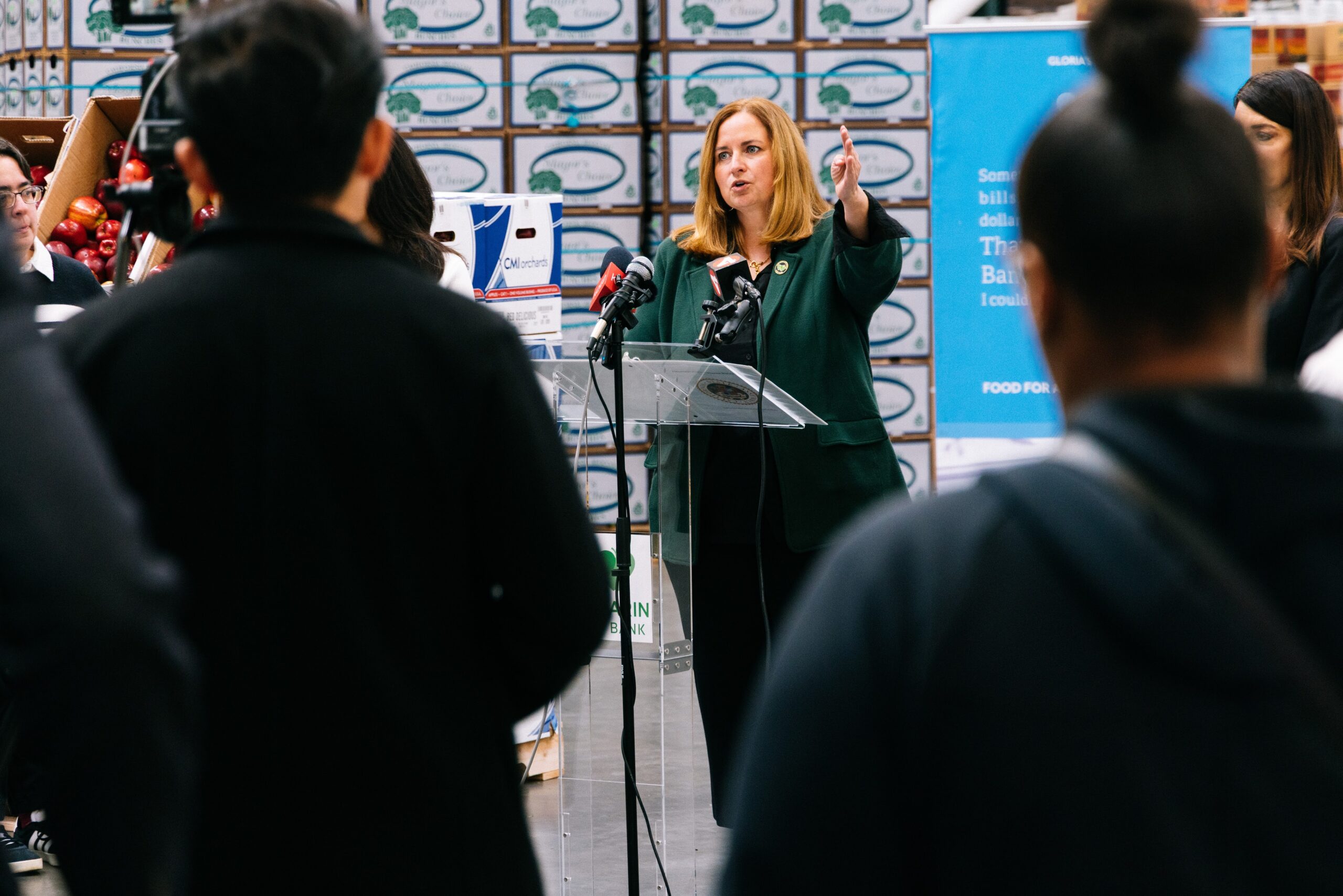
PHOTO, TOP: Tanis Crosby, Executive Director of San Francisco Marin Food Bank, at an event announcing the proposed bill.
Like what you’re reading?
Support Food Bank News