Advocates have always had a long list of ways they would like to see SNAP improved. Maybe make it easier for college students to qualify? Or make it possible to purchase prepared food? Or increase the minimum benefit for seniors?
But in the face of historic cuts to the program, initiatives that once seemed important have now moved way down the priority list. Policies enacted under the administration’s H.R. 1 law already have pushed 5.5 million people off SNAP by making it more difficult for them to qualify. Now the law is coming for state SNAP budgets, reducing federal support for them starting in October 2026, and gearing up for another round of serious cuts in October 2027. For some states, the cuts may be enough to threaten the program’s existence.

SNAP advocates may find navigating the current situation overwhelming, but also clarifying. “Instead of a long list of priorities, right now the central focus is to save the program and keep SNAP in existence,” said Rachel Cahill, Owner and Principal Consultant at Rachel Cahill Consulting, based in Cleveland, OH. “That’s really the most important thing right now.”
A report just released by Mazon, A Jewish Response to Hunger does a good job of explaining the cuts coming to state SNAP budgets. The immediate round takes aim at the everyday costs of running SNAP, such as processing applications, answering phones and training staff. The federal government covered 50% of those administrative costs up until last month, and now is covering only 25%.
That cost shift is a heavy burden. According to a state-by-state analysis in the Mazon report, Arkansas, for example, needs to spend nearly $28 million more each year to cover its administrative costs through 2031, yet its legislature has not appropriated any additional funding. Indiana needs nearly $62 million more per year, but also does not have any additional funding allocated. Such shortfalls will likely result in longer wait times, unanswered calls, and fewer staffers to help families.
For many states, the cuts coming in October 2027 will be even more dire. States will have to pay at least 5% and up to 15% of the cost of the food they distribute through SNAP if their payment error rates are 6% or higher, marking the first time in the program’s history that the federal government has not covered the full cost of the food benefit. For the 44 states that currently have an error rate of more than 6%, remedies include raising taxes, pulling funding from other areas of their budgets, reducing SNAP eligibility, or “potentially withdrawing from SNAP entirely,” according to the Mazon report.
Second Harvest Heartland is among the food banks that have shifted priorities when it comes to SNAP advocacy. Before H.R. 1, a major goal was to expand access, such as by making it easier for older adults to recertify. After H.R. 1, it added the goal of mitigating H.R. 1 harm. All of its efforts right now are going toward that, as well as improving administrative effectiveness. “We’re really having to pause on increasing access because changing rules and adding more complexity into the system right now, doesn’t make sense,” said Robin Manthie, Vice President of Neighbor Impact and Strategic Growth.
H.R. 1 has also catalyzed new partnerships. Second Harvest Heartland formed Partners in SNAP Defense, an ongoing advocacy working group, along with its co-convener The Food Group about a year ago. The new group, with about 100 members including some focused on issues like legal aid and immigration, exists in addition to an already long-standing statewide SNAP advocacy group. “With H.R. 1, we decided we needed a formal group that would have more structure,” Manthie said.

Organizations feeling overwhelmed by not knowing where to start in SNAP advocacy should listen to the community, said Cahill of Rachel Cahill Consulting. Those who help people apply for SNAP generally already know what could be improved, such as answering the phones more quickly, or translating forms into multiple languages, or making the SNAP office accessible to people with disabilities. “There’s so much you can do just at the local level,” Cahill said.
A local focus lets organizations work toward accomplishments that are within the scope of their control. Plus, it builds up grassroots coalition partners and people with lived experience who can speak authentically about their experiences with the program at the state and federal levels when the time comes. “It’s hard to build coalition partners if you’re only focused on the federal level,” Cahill said. “If you give people that strong foundation, that grassroots person with lived experience is absolutely the best advocate you have. But they’re not going to be interested in federal advocacy unless you give them some ways to engage at a more concrete local level.”
San Francisco Marin Food Bank recently scored a big local win with passage of a new law that makes it easier for college students to meet SNAP work requirements. Now, students can meet the requirements simply by virtue of being enrolled in classes at least half-time, a change expected to unlock SNAP benefits valued at more than $420 million for 348,000 students. In keeping with its ongoing practice of using community members as peer navigators, the food bank will deploy students as ambassadors to sign up other students for SNAP. “Even in the face of H.R. 1, we’re just completely laser focused on ‘Where do we still have opportunities in play?’” said Tanis Crosby, Executive Director.
In addition to passing legislation, food banks are focused on making SNAP changes easier for users to navigate. The Community FoodBank of New Jersey, for example, working with the Tepper Foundation, recently introduced a graphically pleasing website, SNAPshotNJ, explaining the new SNAP rules and helping people apply and update their contact information.
Also in New Jersey, Fulfill, which serves two counties in the state, recently initiated a communications blitz through social and news media to encourage people to activate their new chip-enabled SNAP cards before an approaching deadline. (New Jersey is one of only a few states that has addressed SNAP skimming fraud by fortifying the cards with chip technology.) “The stakes go up when somebody can’t use their old card and hasn’t activated their new card, and suddenly their benefits are inaccessible,” said Triada Stampas, President and CEO.
In New York, the West Side Campaign Against Hunger is making it easier for people to meet their work requirements by volunteering at its facilities or community partners. WSCAH registered with New York City to become a verified volunteer site, which helped it increase its volunteer base to about 50. It has also added enough positions to accommodate about 100 volunteers in total, and offers an extra bag of food to volunteers once they complete six hours, said Chenoa Evans, Volunteer Engagement Manager.
Cahill of Rachel Cahill Consulting encouraged food banks to “get in the game” of SNAP advocacy, even if it’s not something they normally do. “Now is the time,” she said. “Even if you’re not ready to do advocacy, learn about SNAP. Understand what the stakes are for your state, and see how you can play a positive role to continue to have it exist in your state.” – Chris Costanzo
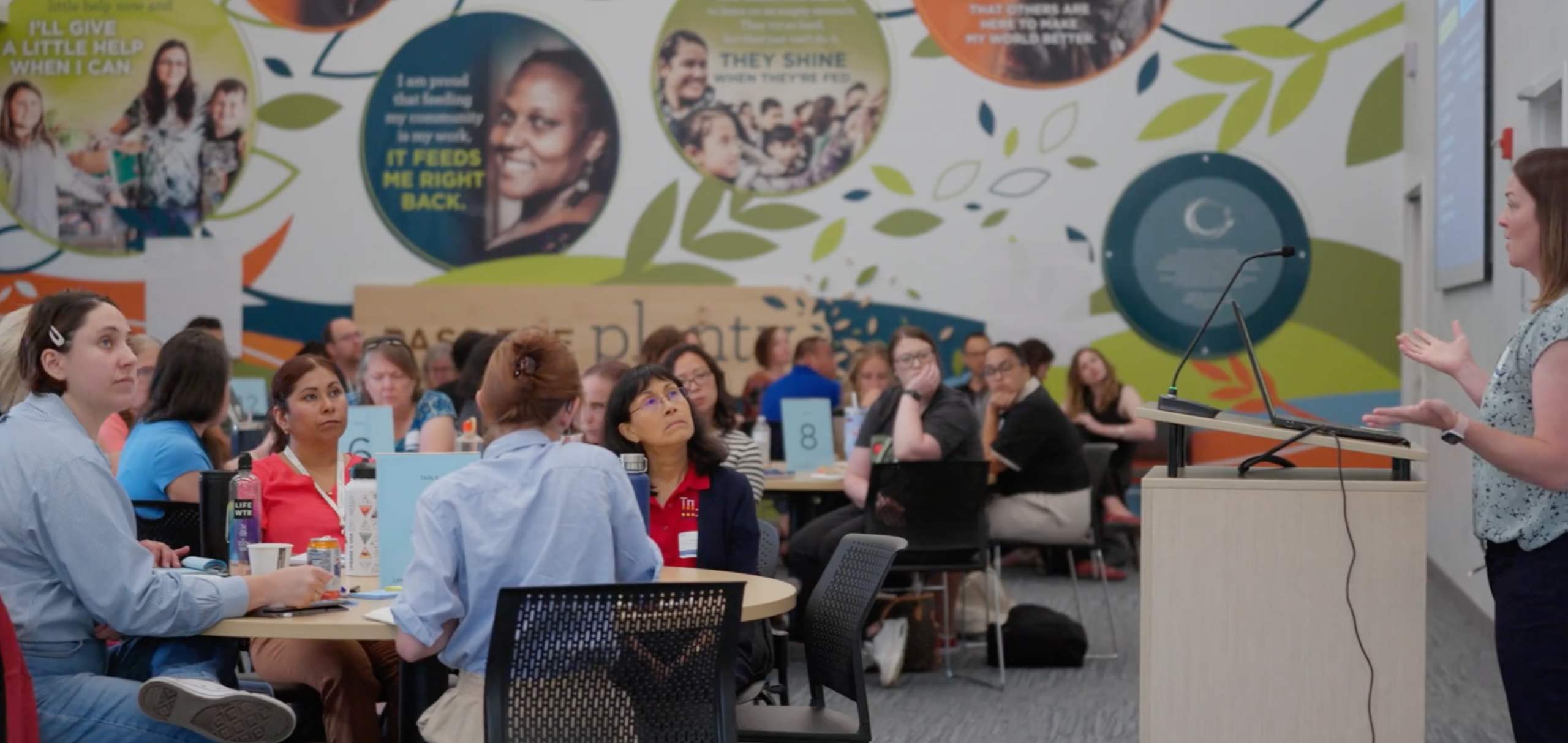
PHOTO, TOP: A convening of SNAP advocates at Second Harvest Heartland.
Like what you’re reading?
Support Food Bank News
This article was made possible by the readers who support Food Bank News, a national, editorially independent, nonprofit media organization. Food Bank News is not funded by any government agencies, nor is it part of a larger association or corporation. Your support helps ensure our continued solutions-oriented coverage of best practices in hunger relief. Thank you!