The idea that people have a “right to food” in the U.S. is starting to gain some footing.
Perhaps the biggest sign is a resolution passed last month in New Jersey declaring that residents in the state have a fundamental right to adequate food. The ruling comes after nine states throughout the country have made lunch meals available to all school kids, no matter their financial need, helping to establish the idea of free meals as a universal right.
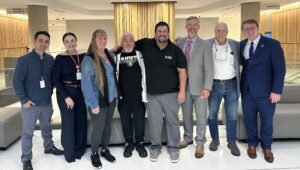
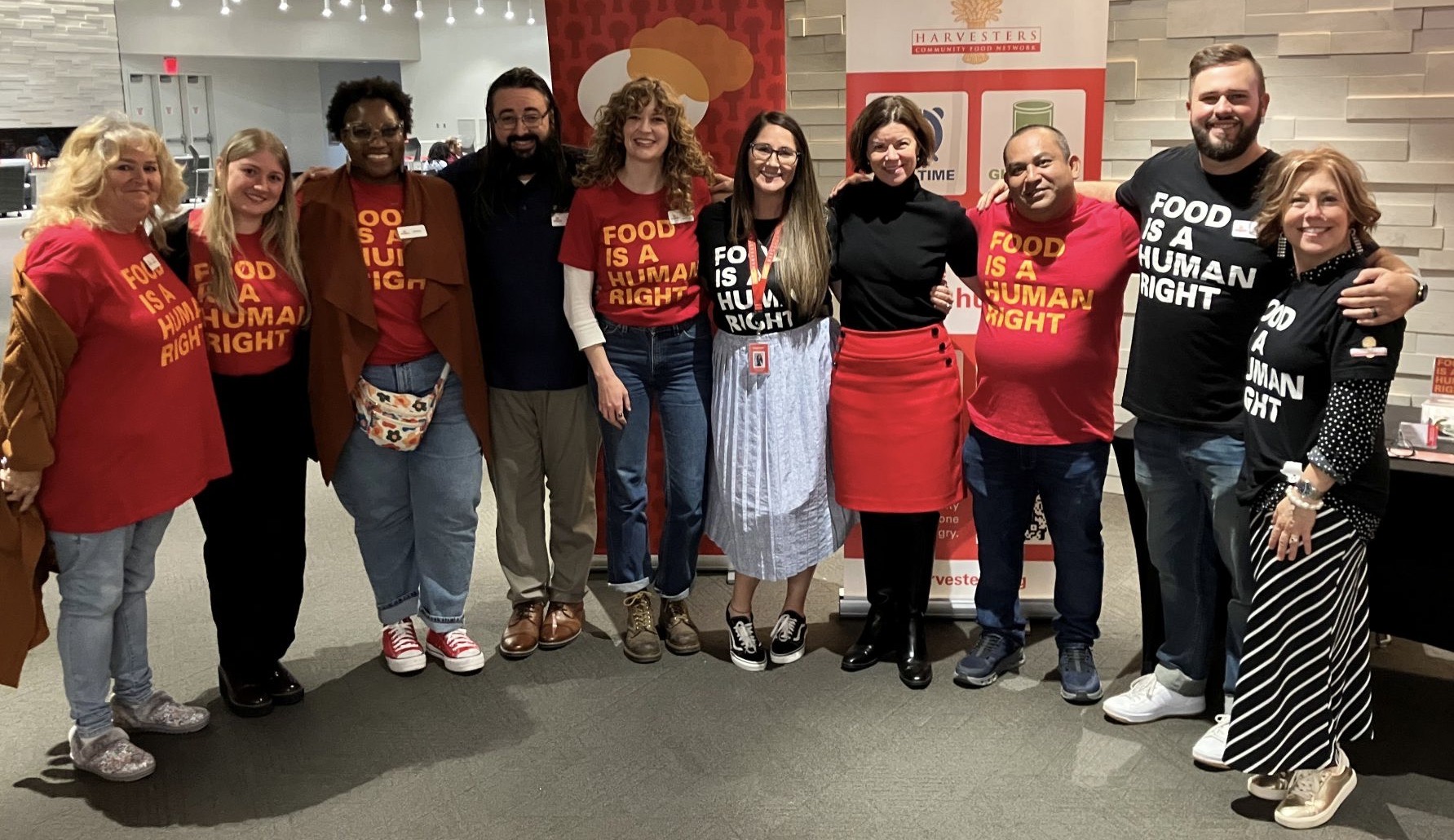
In addition, the National Right to Food Community of Practice, established in 2021 with Northwest Harvest in Seattle serving as fiscal sponsor, has attracted 280 members (about half of them from the hunger relief sector) to its mission of transforming the food system by framing food as a human right. All of these moves have happened alongside smaller but still notable signals, like the employees of Harvesters Community Food Network in Missouri sporting right-to-food t-shirts (see above) at a recent event and selling related merchandise on their website.
The revoking of SNAP benefits for about two weeks during the government shutdown brought greater relevance to the importance of establishing baseline protections related to food access. Confronted with the dismantling of SNAP, surveyed voters said they were overwhelmingly in favor of a basic safety net for food, making right-to-food policies timelier than they have ever been. “What the government shutdown showcased to us is that the safety net system is extremely fragile,” said Regi Young, Executive Director of Alameda County Community Food Bank.

For Alameda County Community Food Bank, now is the time to embrace a rights-based framework in its approach to hunger relief by making justice – rather than charity – the focus of its new strategic plan. “The justice frame is really pertinent right now,” Young noted.
What does it mean for a food bank to adopt a rights-based approach to hunger relief? For many organizations, the right to food may be more intentional than actual, given the difficulty of literally ensuring regular, permanent, unrestricted access to adequate food for all. “The right to food can be a place where food banks might be wanting to go, in terms of advocating for better wages or better benefits, for example. But in practice, it can be really difficult to achieve that when you are working within conditional systems,” said Dr. Kayleigh Garthwaite, Associate Professor at University of Birmingham and author of a new book, Hunger Inc.: Building Solidarity Beyond the Food Bank.
At the same time, a rights-based approach can help propel food banks from thinking of themselves as emergency providers and more as systems advocates. “I think it can help food banks to think more broadly,” Garthwaite said. It may get them to consider measures of success that go beyond pounds of food distributed, such as dignity, choice, or the ability to reduce the need for food banks in the first place, she said.
Alameda County Community Food Bank is beginning its justice journey by recognizing that its biggest asset is not necessarily its ability to distribute food, but to use that strength to nurture relationships. Given that clients have a variety of goals that go beyond food, Alameda County Community Food Bank is seeking to team with community partners in housing, employment, education and health, Young said. “The partnering component is really important because it’s indicating that we are not the solution, but we are part of a solution because we’re tied into this ecosystem,” he said.
Another aspect of its justice plan is to push the boundaries on what a food bank does. Young used the example of SNAP assistance to illustrate his point, noting that helping people sign up for SNAP only became a standard part of food bank operations after years of some food banks pushing that boundary. He sees Alameda County Community Food Bank similarly pushing boundaries in food as medicine by developing stronger relationships in healthcare.
Finally, Alameda County Community Food Bank wants to effect systems change by hatching and incubating big ideas, much like its current effort to strengthen a local, BIPOC-led farm via fiscal sponsorship funding and support. Later this year it will establish a food justice incubator to help it “leverage the collective wisdom of our communities” in support of other big ideas to reimagine the food system, Young said.
The food bank’s localized approach is on target, given the weak status of the right to food at the federal level. The United States is one of only a handful of countries that has not ratified an international covenant related to the right to food, compared to more than 160 countries that have.

But that lack of support at the federal level should not curtail local right-to-food strategies, said Alison Cohen, Director and General Coordinator at the National Right to Food Community of Practice. “We do not need to wait for a legal right to food to exist at the state or federal level before using a rights based approach,” she said during a recent webinar. “With or without a legal right to food, we can work together to frame our actions, advocacy and policy ideas.”
A variety of approaches are already evident. New Jersey, the second state in the country after Maine to get right-to-food language on its books, has been strategic in its approach. Unlike Maine, which passed a constitutional amendment in 2021 guaranteeing the right to food through binding laws (mostly focused on the ability of people to grow, raise and harvest their own food), New Jersey passed a non-binding resolution. Backed by the governor’s signature, the resolution sets guidance for future policy, without carrying the force of law.
The resolution “will become a framework for future action in this field,” said Assemblywoman Shama A. Haider, a sponsor of the legislation, at a recent conference. “This is our opportunity in New Jersey to push forward, to present a policy that can be used across the board,” she said.
Shayla Nunn, the Assemblywoman’s Chief of Staff, clarified in an interview that the sponsors were seeking a measure that would not be heavily debated or seen as extreme. “We really wanted it to be something that people from across the aisle could get behind and see as a positive change,” she said. “That is also why we chose to go with the resolution, so that it could be more of a framework rather than regulation.”
The resolution puts into writing a set of standards that helps people know what to expect in terms of food access, even when changes occur at the highest level of the administration. “The idea is that if something is recognized as a right, then people should have that level of consistency and access, no matter who’s in leadership,” Nunn said, adding that the resolution “will outlast us.”
Whether through legislation or other types of efforts, promotions of the right to food appear to be expanding. In Canada, a hunger relief organization founded in 2012 as Community Food Centres Canada and now with 450 partner agencies, in September officially changed its name to Right To Food. The new name serves to sharpen the organization’s focus on the Canadian federal government and its responsibility to meet citizens’ basic needs, said Jasmine Ramze Rezaee, Director of Policy and Community Action. “Right to food for us wasn’t just a rebrand, but a call to action,” she said. “We’re going to continue providing dignified food programming across the country, but we also are going to lean into the mobilization and the organization piece to build political pressure for policy solutions.”
In Missouri, Harvesters Community Food Network is like a growing number of U.S. food banks in emphasizing access to nutritious food as a human right in its strategic plan. Interim CEO Valerie Nicholson-Watson sees the right to food as a fundamental aspect of being human. “If we deny people food, then what are we doing?” she said, adding, “If people don’t matter, then what’s the point?” – Chris Costanzo
PHOTO, TOP: Employees of Harvesters Community Food Network sporting right-to-food t-shirts at a recent food bank event.
Like what you’re reading?
Support Food Bank News