ICE in Minnesota has not been good for immigrants, nor for efficient food distribution.
The incursion of 3,000 Immigration and Customs Enforcement agents into the state beginning in December 2025 has resulted in the arrest of 4,000 people, according to the administration. It has also forced new methods of food distribution that prioritize the safety of food recipients above all else.
To get food to vulnerable people, Minnesota hunger relief agencies are drawing in part on lessons they learned during Covid, as well as the 2020 George Floyd protests. ICE has brought fear into the equation, adding fresh complexity to distribution patterns. While efficiency may be the standard in normal times, the presence of ICE has dictated the building of food delivery systems with a much greater emphasis on caution and discretion.

“All these systems had to be built from a perspective of vigilance,” said Sophia Lenarz-Coy, Executive Director of Minneapolis-based The Food Group. “And vigilance is so different from efficiency.”
Early on during the surge (which has slowed but not stopped), home deliveries emerged as an important consideration. As ICE moved into the area, visits to food pantries dropped by up to 50% in some places. Food banks and pantries in Minneapolis considered how to execute home deliveries – one of the most logistically challenging forms of food distribution – in ways that would not draw attention. All of this was against a backdrop of new grassroots and mutual aid groups springing up in search of aid and partnership.
Trust became paramount. Partners that may have been new to the food banks, but trusted in the community, including Latino churches, local schools and neighborhood groups, became essential to executing the last mile of the home deliveries. “Making sure that that food hand-off was really coming from a place of trust was important,” said Sarah Moberg, CEO of Minneapolis-based Second Harvest Heartland. “Anywhere that trust existed, we were trying to funnel food to those points so that they could then make that final delivery. It wasn’t just food pantries doing those deliveries. It was faith-based organizations. It was schools and other nonprofits.”
The Food Group’s Lenarz-Coy described three main ways that its partners were approaching delivery. Some already had a home delivery program in place that they could expand. Others had already been working with DoorDash to do deliveries and were able to quickly grow that partnership. And others teamed with agencies that already had delivery figured out, acting as pick-up places for food. “I would say most of our partners, who had seen a dramatic decrease in visits, were able quickly to get even maybe more food out than they had before, through these other methods,” she said.
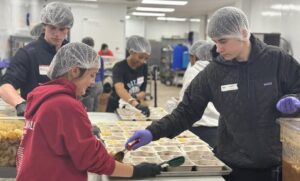
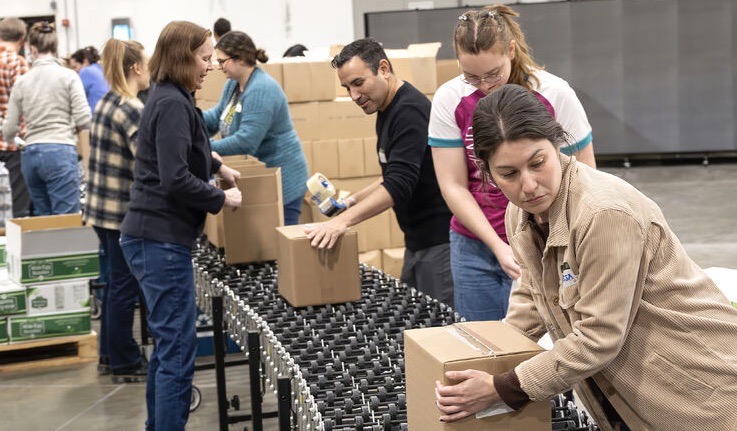
The emergency food boxes that were so prominent during the mass distributions of Covid again made an appearance, this time making their way directly to peoples’ doorsteps. Second Harvest Heartland set up a new assembly line in its warehouse to create them, and estimates it will have built 100,000 of them by early March. Because every delivery incurs a level of risk, it has designed the boxes to ensure several meals for a family. “What ended up at a neighbor’s house was a much larger quantity and could last a much longer period of time,” noted Moberg of Second Harvest Heartland.

The emergence of grassroots aid groups in response to ICE was reminiscent of the George Floyd uprisings, when community food distributions became part of the response to that chaos. Today, hardly any of the George Floyd groups are still doing food distributions, leading The Food Group to be more intentional in its current collaborations. “How can we meet this moment collaboratively, but without just building up all this secondary infrastructure?” said Lenarz-Coy of The Food Group. “How can we connect folks with existing infrastructure?”
One of The Food Group’s solutions was to share its warehouse with a church that has had a massive impact, having registered 30,000 families. With the infrastructure of the church unable to handle such volume, The Food Group is sharing a portion of its warehouse, as well as its freezers, coolers, assembly line and food safety expertise. It is also doing daily drops of food boxes to the church, which is overseeing about 800 home deliveries a day.
The food comes from The Food Group, as well as Second Harvest Heartland, which is making deliveries to The Food Group’s warehouse on behalf of the church. The arrangement plays to everyone’s strengths. “We’re letting people be in their sweet spot,” said The Food Group’s Lenarz-Coy. “You figure out that last mile delivery, which we know has been hard in the hunger relief sector forever, and then let the food part be handled by the food people.”
The warehouse-sharing is a small step toward bringing order to what has been a highly decentralized system by design. Lenarz-Coy noted the deep fear and panic caused by ICE agents doing things like: following volunteers doing food distributions, intimidating people at food pantries, and targeting parents at school pick-ups. “All of that happened,” she said, adding that when such things are happening, “it’s not the time for systemization or efficiency. Actually, a completely decentralized, super grassroots response is the only safe response.”
The Minneapolis food banks had some pieces of advice for other hunger relief organizations that may also find themselves in the path of ICE. Moberg of Second Harvest Heartland advised laying the groundwork now for new partnerships among immigrant community groups. “Who are the connections that you need to have in order to really make this decentralized food distribution work smoothly?” she said. Inventory is also a consideration, she said, noting that the food bank applied a disaster recovery lens to its procurement, bringing in more household items like toilet paper and detergents.
Lenarz-Coy of The Food Group advised pre-planning around food distribution, including preparing food boxes in advance and identifying high-volume food pantries capable of acting as distribution hubs for delivery pick-ups. The food bank also invoked Covid-era staffing arrangements, such as unlimited time off for employees who needed to shelter at home from ICE, or who had family members taken by ICE. “Everyone was impacted as humans and as staff, and we didn’t necessarily anticipate that,” she said.
In retrospect, The Food Group also probably spent too much time learning about standard legal protocols. Given ICE’s bold actions, the food bank’s legalistic approach “seems pretty quaint now,” Lenarz-Coy said, adding, “This is not a legal thing. This is more about protecting the community.” She concluded, “I think we have a complex next few years ahead of us, as we think about getting food to folks who need it.” – Chris Costanzo
PHOTO, TOP: Volunteers at Second Harvest Heartland packed food boxes for families impacted by ICE.
Like what you’re reading?
Support Food Bank News