Creating and implementing a nutrition policy can be a daunting task, but it’s possible to do it step by step, taking advantage of the many tools available to make it easier.
HER Guidelines
The most important of these may be the Healthy Eating Research guidelines. Released in 2020, the guidelines are like the nerve center of a food bank’s nutrition policy. They standardize the process of nutrition ranking, making it possible to identify, measure and improve food offerings, so food banks can set policies and goals, benchmark their progress, and share outcomes with interested partners.
“Everybody in the network knows what the guidelines are now,” said Marlene Schwartz, Ph.D., Director of the Rudd Center for Food Policy and Health at the University of Connecticut, who helped create them. “So I feel like that was a real game changer.” To find out more about the guidelines, see the Rudd Center’s web page here and our article here.
HER Implementation Guide
Certain things about the HER guidelines are very easy to understand. For example, nutrition rankings are expressed in a simple stoplight fashion: green (choose always); yellow (choose sometimes), and red (choose rarely). And certain foods like fresh fruits and vegetables are always ranked green, letting many food banks easily rank half or more of their inventory.
But some of that simplicity goes away with more prepared and processed foods. Just figuring out which category a food goes in can be complicated. Is a vegetable-noodle soup considered a vegetable, a grain, or a mixed dish? Is a fruit popsicle considered a dessert or a fruit?
To overcome such barriers, the Rudd Center recently introduced its HER Implementation Guide. Informed by numerous interviews with food banks, it describes their pain points and best practices, alongside countless tips on how to read and interpret food labels.
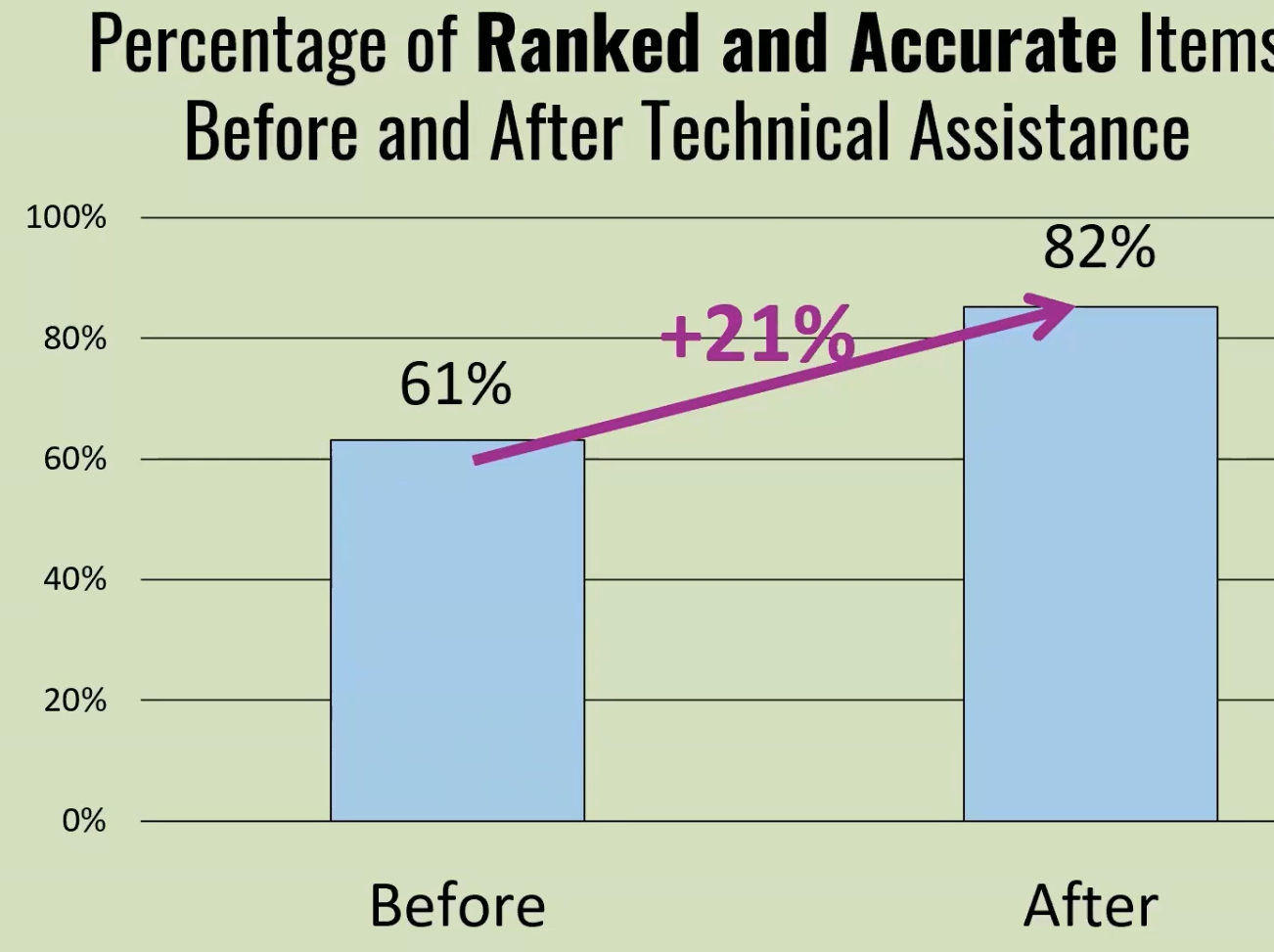
Putting a little effort into using the guide has paid off handsomely for some food banks. Rudd found that food banks that consulted a single page of the 59-page guide (page 30 / “Foods Always Ranked the Same”) saw their percentage of not-ranked items drop by half. In general, food banks that took advantage of the guide saw a 21-percentage point increase in their percent of items correctly ranked (see chart, top). Plus, 88% reported they were more confident in their ability to do the rankings.
WellSCAN
The HER guidelines sort foods into the green, yellow or red rankings based on the amounts of added sugar, sodium and saturated fat present in the food. While all of this information is readily available on a food’s nutrition facts label, it can be labor-intensive to read and calculate each ranking.
That’s why the Rudd Center created a tool called WellSCAN. It lets users input the three nutrition facts or the name of a product (or its UPC code) to automatically receive the green, yellow or red ranking. WellSCAN runs off of the USDA’s Food Data Central repository, which stores the compositions of hundreds of thousands of food items. Even so, the data gets outdated virtually every day as the food industry constantly reformulates products and creates new ones.
So far, 270 users at 89 organizations are using the free WellSCAN tool. Three Square Food Bank, for example, uses it to rank purchased and TEFAP products, said Sheena Skelton, Nutrition Initiatives Manager during a March webinar hosted by More Than Food Consulting. “WellSCAN has been fantastic in terms of just being able to pop that information in there for both of those inventory sources,” she said.
Schwartz cautioned against viewing WellSCAN as a panacea, however. Given constantly changing food formulations, “it will help you rank faster for the items that it works for, but it’s not going to rank all of them,” she noted. She added that the ranked-inventory lists that a food bank creates are stored within WellSCAN, but not connected to the food bank’s inventory system (though they can be exported via an Excel file and uploaded to it).
Nourish
The Nourish system, developed with support from Blue Ridge Area Food Bank, the Federation of Virginia Food Banks and James Madison University, in some ways is very similar to WellSCAN. As with WellSCAN, anyone can go to the Nourish website and use its free nutrition calculator to figure out a food’s ranking based on the three criteria of added sugar, sodium and saturated fat.
What’s different is that Nourish can be integrated with a food bank’s inventory management system, including Ceres and Primarius, said Michelle Hesse, Associate Professor at James Madison University. “We have deep integration with both of those,” she said, which helps to streamline operations and minimize errors when inputting data.
So far, four food banks in Virginia are using Nourish, with a fifth continuing to explore it and one outside of Virginia expressing interest. “We’ve demonstrated really good proof of concept within the state of Virginia,” Hesse said. “Those that implemented Nourish are seeing success with better integrating ranking within their operations, developing more consistency in their standard operating procedures, and it helps them with being able to make firmer statements within their nutrition policies.”
SWAP
The SWAP system, which stands for Supporting Wellness at Pantries, is a way to make all the work that goes into nutrition policies and nutrition rankings come to life on food-pantry shelves. Pantry managers can use various SWAP materials to display food items according to their nutrition rankings. SWAP posters explain the rankings, while SWAP shelf tags indicate the ranking of each type of food. The goal is to realize the full value of nutrition policies and rankings by promoting healthy food choices among pantry clients. – C.C.
Like what you’re reading?
Support Food Bank News
This article was made possible by the readers who support Food Bank News, a national, editorially independent, nonprofit media organization. Food Bank News is not funded by any government agencies, nor is it part of a larger association or corporation. Your support helps ensure our continued solutions-oriented coverage of best practices in hunger relief. Thank you!