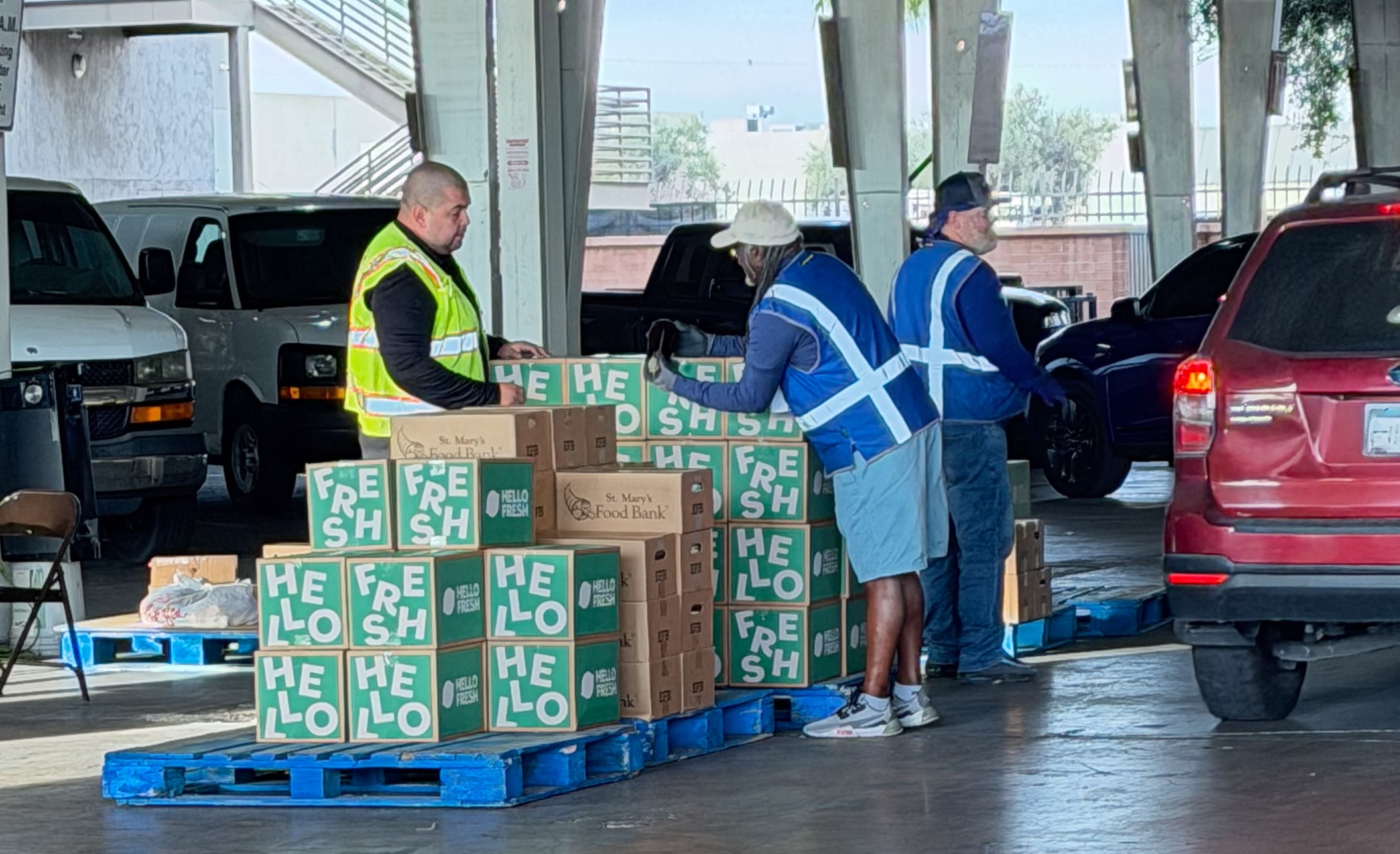
St. Mary’s Food Bank in Arizona may be shy of running the nation’s largest home delivery program, but it gets credit for having an ongoing and growing commitment to home delivery that began well before most food banks even considered offering the service.
Way before Covid, which is the time when many food banks got started in home delivery, St. Mary’s was already well-established, making about 900 or so deliveries a month. During Covid, that number quickly doubled, and now the food bank is up to about 7,000 deliveries a month.

That number is only expected to grow. Lauren Handwerk, who runs the St. Mary’s program as the food bank’s Director of Direct Distributions, views home delivery as essential for reaching the most in-need community members. “Home delivery is tough. It’s different from anything we’ve ever done in the food banking realm, but it meets the most vulnerable population, so it’s ultimately worth it,” she said.
With well over ten years of doing home delivery, St. Mary’s has evolved its program over time and welcomes the opportunity to share its experiences with other food banks. Handwerk in fact runs a national group open to all Feeding America and non-Feeding America food banks, as well as pantries, that meets quarterly to share information about home delivery. The group is also hosting a National Home Delivery Summit this month (see more here).
While St. Mary’s used some volunteers early on, its program now runs with the help of a constellation of third-party delivery companies that help it fully cover three of the nine counties it serves, plus some additional areas. Reaching its current volume required St. Mary’s to grow intentionally and with consideration for the needs of the drivers.
St. Mary’s started small, initially making bulk deliveries to low-income senior-housing apartment complexes in the Phoenix area. Covid brought funding that allowed it to expand into making deliveries to individual homes, but also put pressure on a volunteer corps that needed to shelter at home. That’s when St. Mary’s started working with third-party drivers, and it has never looked back. “Being able to use third-party delivery companies helped us really focus on how to handle the influx of people requesting home delivery,” Handwerk said.
St. Mary’s first turned to a local delivery company that helped with setting routes, securing drivers and providing a fleet. “They were really vital to handling the next to last mile, and getting to the door, and we still use them to this day,” Handwerk said. St.Mary’s then became one of the first food banks to work with DoorDash, which currently handles about 45% of all its deliveries. The food bank also uses a company called Hungry Last Mile, which can accommodate longer-distance refrigerated deliveries. In addition, two staffers help make deliveries. At the moment, the food bank does not work with Amazon because of specific rules in Arizona that require drivers to get signatures from delivery recipients, which Amazon cannot accommodate.
Being able to support so many deliveries required St. Mary’s to take into consideration the needs of the drivers. For example, it schedules most DoorDash deliveries for the morning so they don’t interfere with lunch and dinner rush-times, when drivers can find other deliveries. Between 100 to 150 DoorDash drivers show up in a two-hour window each morning, and St. Mary’s works to make sure they get through the line efficiently. In addition, each delivery route can be completed within about 45 minutes, allowing drivers to move onto other work or come back to get a second round. “We don’t want to compete with their bread and butter,” Handwerk said.
In some cases, the food bank deliveries are part of a driver’s bread and butter, allowing them to add more hours onto a day that would otherwise be limited to the lunch and dinner rush hours. Drivers get the same rate of pay as for other deliveries, Handwerk noted. “It’s been kind of a boon for the DoorDash drivers,” she added.
Deliveries not executed by DoorDash go out in refrigerated vehicles that can be on the road for eight to ten hours a day. Those drivers pick up 30 to 50 deliveries at a time and get started between six and seven in the morning. All deliveries consist of about 30 pounds of food, including a non-perishable box and ten to 15 pounds of produce.
Last year, St. Mary’s made about 90,000 deliveries, a 21% increase over the previous year and about 10,000 more than expected. Yet its overall budget went down. One way it has saved money is by taking advantage of cost-effective DoorDash deliveries, which typically are executed within a seven-mile radius. Increasingly, the food bank is identifying new hubs where DoorDash drivers can pick up, extending its reach throughout the area. Current volumes “would have been totally not doable without DoorDash,” Handwerk noted.
Handwerk oversees a staff of nine, including three who handle customer service and five who do logistics. She noted that the customer service aspect is important. “What we have found is that people like to call us. They like to ask questions. They don’t want to talk to our AI chatbot to see where their delivery is,” she said.
St. Mary’s does not have a waiting list for home delivery, though it does have a waiting period of about six days from the time anyone calls or registers until the first delivery. People qualify for delivery in three ways, including having a mental or physical disability, a chronic illness, or a lack of reliable transportation.
The food bank hopes to eventually expand its program to include tribal communities, though such areas present numerous challenges, including the fact that they don’t have addresses. In general, Handwerk wants to continue expanding the program in an efficient way. “We’ve decided that this is going to be a core competency for us as a food bank, just to be able to do it.” – Chris Costanzo
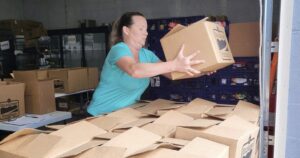
PHOTO, TOP: Food boxes getting loaded into DoorDash delivery cars at St. Mary’s Food Bank.
Like what you’re reading?
Support Food Bank News
This article was made possible by the readers who support Food Bank News, a national, editorially independent, nonprofit media organization. Food Bank News is not funded by any government agencies, nor is it part of a larger association or corporation. Your support helps ensure our continued solutions-oriented coverage of best practices in hunger relief. Thank you!