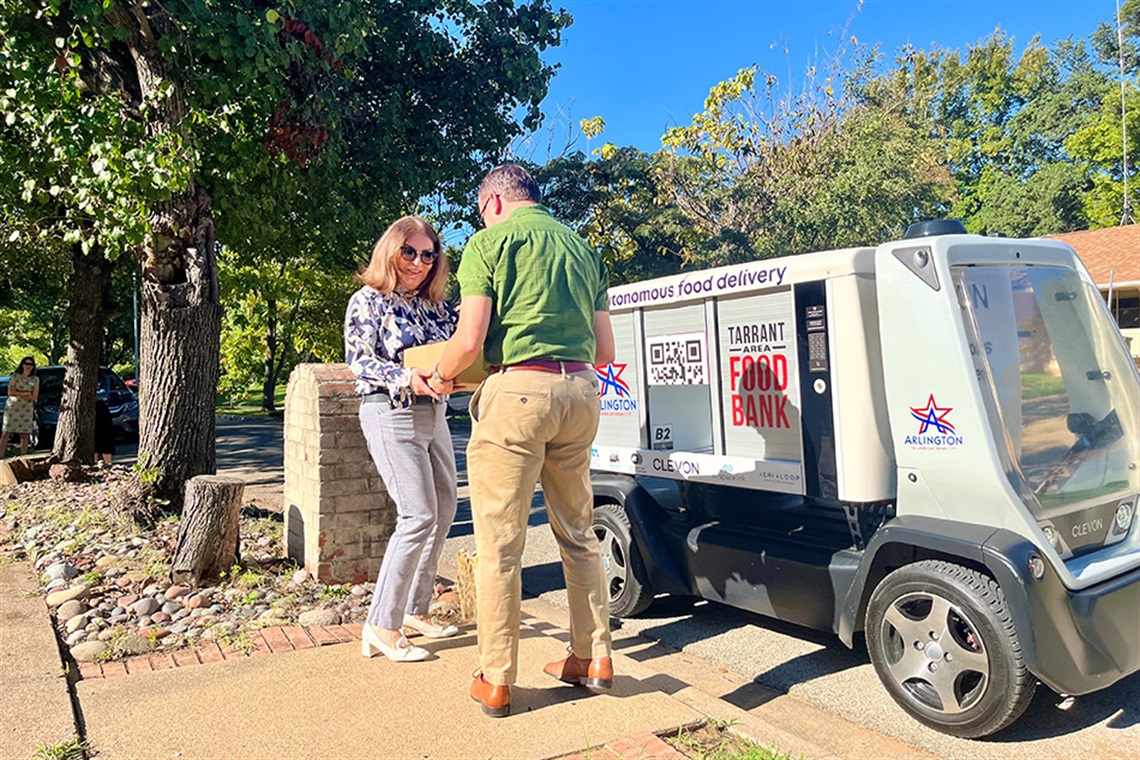
Tarrant Area Food Bank put a high-tech twist on home deliveries in an experiment that tested the ability of both aerial and terrestrial drones to get food to people.
Working with the city of Arlington and the University of Texas in Arlington, the food bank ferried boxes of non-perishable food along journeys that combined both air and land drones. Funded by a grant from the U.S. Department of Energy, the two-year research project aimed to demonstrate whether electric delivery vehicles could reduce greenhouse gas emissions while serving residents in need.

In all, about 300 households received food packages through two demonstration pilots conducted in September 2024 and May 2025. “It was all just a remarkable success,” said Stephen Raeside, Chief External Affairs Officer at Tarrant Area Food Bank. “The clients were thrilled to participate in something so innovative and cool, and it worked really well from a technical aspect.”
The deliveries began at Tarrant Area Food Bank’s distribution center, where boxes of about nine pounds of food each (to accommodate the weight restrictions of the aerial drones) were assembled. Sticking to airspace over city parks, the aerial drones flew the boxes about a mile to a second staging area, where they met up with a terrestrial drone outfitted with a dozen or so small lockers.
Once loaded with food, the land drones ambled their way to residential homes, sending texts upon approach. Residents were instructed via text to punch a code into the drone’s keypad to extract their food from one of its lockers. “It was a demonstration to show that food could be delivered utilizing both air and land drones,” Raeside said.
Deliveries included rice, beans and some canned goods, with the food bank’s pantry partners selecting which households would receive the items. The six-foot-long, battery-powered aircraft were provided by Aerialoop, while the last-mile deliveries by land were executed by drones from Clevon and Mozee.
While the experiment combined both air and land drones into single journeys, Raeside sees different applications for each mode of transport. Land drones work well for densely populated areas, including low-income apartment buildings, while air drones can better serve rural populations. “I can see those aerial drones operating almost 24/7, just distributing food to those rural populations that aren’t close to a pantry,” he said.
Despite various barriers, including Federal Aviation Administration regulations that make it difficult to fly private drones over multiple jurisdictions, Raeside is enthusiastic about the future of drones in home deliveries. “We have to think beyond our current pantry-based distribution model and drones are certainly part of that future,” he said.
The University of Texas in Arlington is expected to soon issue its evaluation of the project. – C.C.
Like what you’re reading?
Support Food Bank News