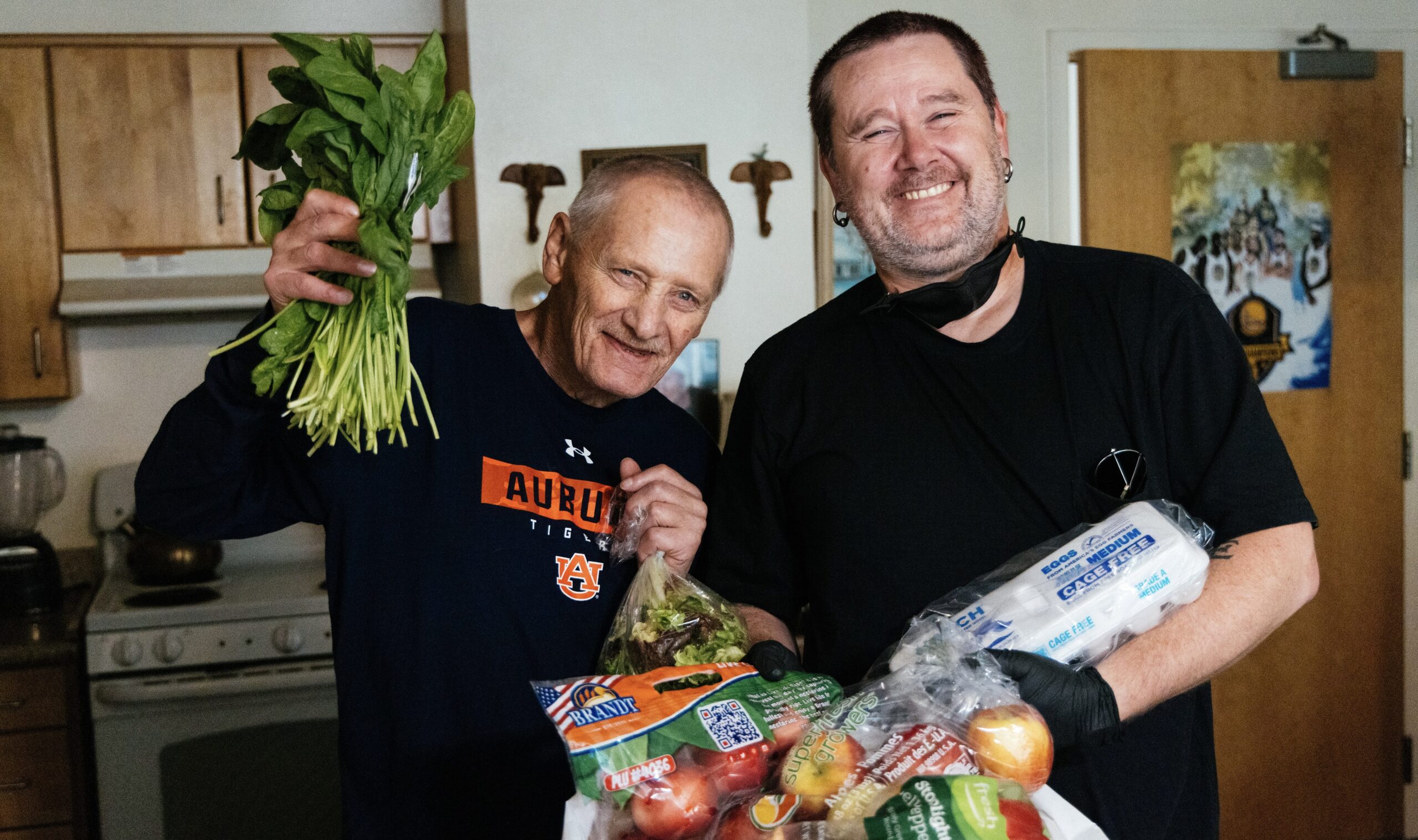
Food banks are getting creative as they seek to keep home deliveries going.
New distribution patterns, new sources of funding and new technologies are all part of the exploration into how to sustain home deliveries, now that the firehose of pandemic-era support for delivery has retreated. With funding uncertain and the depth of need remaining high, food banks are digging deeper for solutions.
“Our conundrum is the same as every other home delivered grocery program across the country,” said Seth Harris, Associate Director of Home-Delivered Groceries at San Francisco-Marin Food Bank. “We need to figure out how to fund the capacity and operations to continue to meet the need.”

Food banks give credit to third-party partners like Amazon and DoorDash for making it possible for them to keep home deliveries going for as long as they have, post-pandemic. While food banks would prefer to have longer-term agreements with these third parties, they readily acknowledge their vital contributions to keeping home delivery going through free or reduced-cost services. “They are critical components of the delivery infrastructure,” said Harris, noting that Amazon and DoorDash currently execute about 60% of his food bank’s deliveries. “The scale and the platforms and the networks that they bring allow us to meet the need in the way that we are.”
At the same time, food banks are preparing for the day when third-party support may not be as robust. San Francisco-Marin Food Bank is currently making about 7,500 grocery deliveries a week, down from around 12,000 during the pandemic, but up considerably from about 3,000 before the pandemic. In addition to Amazon and DoorDash, the food bank relies on community partners, volunteers and a government program known as In-Home Supportive Services to do deliveries.
In September, the food bank began a small Food is Medicine pilot that starts to lay the groundwork for a more sustainable way of getting groceries to people. Through a partnership with a healthcare clinic, the food bank is getting reimbursed for delivering healthy groceries to about 20 people who meet certain health criteria. The clinic handles details like referrals, eligibility, authorizations and billing, allowing the food bank to focus just on the deliveries.
Looking forward, the food bank hopes to also partner with a third-party organization that acts as an interface between healthcare and community service providers. In addition to handling all the administrative tasks, the third party would also address patient issues, such as transitioning people from home-delivered groceries to produce prescriptions, for example.
Harris recognizes that a Food is Medicine approach to home deliveries is not an exact solution, since Food is Medicine aims to improve health outcomes, often over limited timeframes, while home-delivered groceries addresses basic food insecurity. “But Food is Medicine is part of the puzzle and it’s a key part,” he said. “We feel prepared to be able to support as many people that would benefit from the program as possible.”
Working with healthcare is one of a number of strategies that Tarrant Area Food Bank is exploring as it prepares for the next phase of home delivery. Currently, it relies on both Amazon and DoorDash to support its program, which includes monthly deliveries to about 100 seniors, and twice-a-month deliveries to about 300 qualified people. “The program couldn’t operate without both those partners,” said Stephen Raeside, Chief External Affairs Officer. “They’ve been remarkable.”

In the coming weeks, Tarrant Area Food Bank will expand upon its current Food is Medicine program by delivering meals to about 400 patients of a local children’s hospital over one year as part of a prenatal health program. The food bank will deliver the meals without the aid of Amazon or DoorDash, instead using its own drivers and getting reimbursed by the hospital, which is hoping to reduce costs through preventative nutrition. Healthcare partnerships “are an untapped source of revenue,” Raeside noted. “We see a very bright future in all those partnerships involving significant funding.”
Also in a few weeks, Tarrant Area Food Bank will be ramping up a program with the help of Amazon that will help it get home deliveries into rural communities. The food bank will use its own fleet to carry home delivery boxes to Amazon distribution centers, which will then send the boxes out on Amazon’s regular delivery routes, to be dropped off along with all the other consumer goods being delivered. The system will remove geographic limitations to delivery, allowing the food bank to reach underserved rural populations.
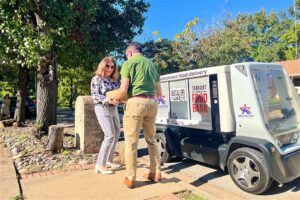
And in a truly futuristic view of home deliveries, Tarrant Area Food Bank has also participated in an experiment that used drones to deliver food (for more on that, see our story here).
In Delaware, the Delaware Food Bank is exploring ways of getting its pantry agencies more involved in home delivery. The food bank currently uses a mix of drivers from Amazon, DoorDash and a state entity to make monthly grocery deliveries to about 900 people statewide from the food bank’s two warehouse hubs.
In the future, it hopes to engage third-party drivers to make bulk deliveries to certain partner agencies, which would then handle the last-mile delivery to clients. Zachary Kellerman, Director of Food Acquisition, sees the strategy as a capacity building program for its partner agencies that would also move the home delivery program in a new direction. “It’s a way for the program to continue to grow,” he said.
Food banks agree that they would like to see home deliveries gain a permanent place in food banking. “We know that this program reaches a lot of folks who otherwise wouldn’t be getting access to services,” said Harris of San Francisco-Marin Food Bank. “We’re going to continue with it. I think the question will always be, at what scale.” – Chris Costanzo
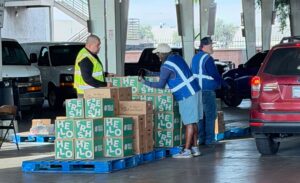
PHOTO, TOP: A home delivery from San Francisco-Marin Food Bank. (Photo courtesy of San Francisco-Marin Food Bank.)
Like what you’re reading?
Support Food Bank News