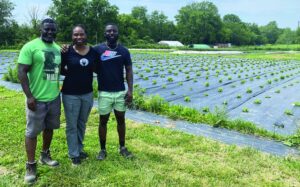
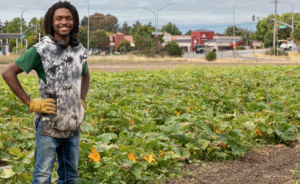
The Harvest Solutions Farm, a program of Second Harvest Food Bank of Orange County in California, had been growing steadily when it found out last year that its budget was going to be cut by almost two-thirds. Fortunately, the 40-acre farm was able to meet its new budget, as well as maintain a high rate of agricultural output, by relying on a robust set of carefully collected data.
Since the farm’s start in 2021, Agricultural Manager Hannah Ortiz had been gathering reams of data in a repository she called her “farm journal.” She didn’t really know what she was collecting the data for, but figured it was better to have the records than not. When it came time to manage the budget cut, “we ended up using almost every data point that we tracked,” she said, which included more than 3,000 rows of statistics kept in a spreadsheet.
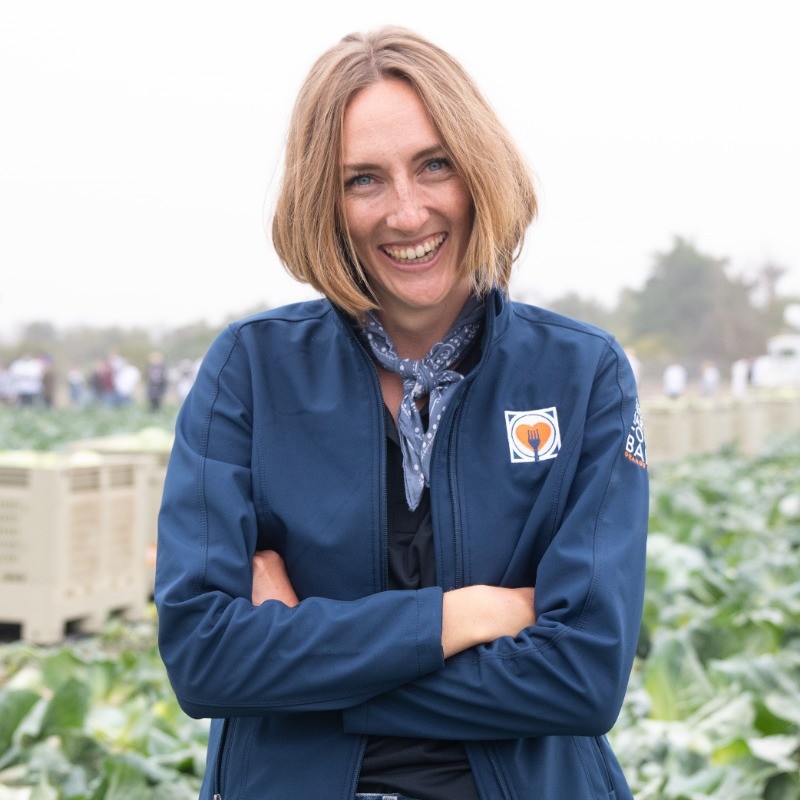
Over its five years, Harvest Solutions Farm has distributed more than 9.6 million pounds of produce to the community, with the help of about 8,500 volunteers annually. About half of the 43.3 million pounds of food Second Harvest distributes every year to 450,000 people a month is fresh produce, and 4% of its distribution comes from the farm. The farm is run in partnership with the University of California South Coast Research & Extension Center and Solutions for Urban Agriculture.
The budget pressures that emerged in October 2025 stemmed from a mix of federal funding and other budget cuts, leading the farm to reexamine its operations. “We really were re-evaluating not only what our budget was, but what was sustainable from a volunteer perspective, from a staff perspective?” Ortiz said.
As it looked into its data at the end of FY 2025, one outcome that became apparent was an alarming rise in costs, even as agricultural output plateaued. While the number of pounds harvested remained at about 2 million a year from FY 2023 through 2025, the costs per pound rose 63% to 44 cents, up from 27 cents in FY 2022. The farm, working with its partner, Solutions for Urban Agriculture, zeroed in on labor costs as a big factor, given that they accounted for 68% of all costs.
Ortiz and Ryan Yamauchi, Executive Director at Solutions for Urban Agriculture, described how the farm addressed the labor-cost problem during Inter-Faith Food Shuttle’s annual Agricultural Conference held the first week of November.
The farm turned to professional labor whenever it did not have enough volunteers for tasks like planting or weeding, or when it needed certain jobs done, like running heavy machinery. With Ortiz’s data, Harvest Solutions could drill into its labor costs and identify which types of jobs were more expensive to outsource. “Now I had a better idea of where we needed to start adjusting to reduce a particular type of labor,” Ortiz said.
Related to the rising labor costs was Harvest Solutions’ emphasis on growing a wide variety of crops to promote greater nutrient diversity. Again using Ortiz’s data, it became evident that the growing crop list “was really the key factor in what was driving costs,” said Yamauchi of Solutions for Urban Agriculture. With that knowledge, the farm could now explore the data to find out which crops were the most productive, while still contributing to nutrient diversity. Among the questions Harvest Solutions asked of its data: Which crops produce the most (and the least) pounds per acre? Which work best with volunteers? Which demand the least paid labor? Which are easiest to harvest and handle? Which are easily stored until distribution?
All of these questions led to a final question: Which portfolio of crops maximizes the impact? Ortiz and Yamauchi first identified the crops that were most productive by acre, giving them a list of the heaviest crops. Then they factored in the crops that paired best with volunteers, yielding a new list. Then they considered costs relative to professional labor, as well as neighbor preferences, leading to a different list yet again. In the end, they came up with a “crop list optimized for cost, yield and volunteer involvement,” Ortiz said.
Generally speaking, the smaller the crop, the more labor-intensive it is. “Green beans are a prime example of a crop that everybody loves, but doesn’t yield a ton, and it’s very hard to work with,” Yamauchi said. “Another one would be tomatoes, which just take a ton of pruning, and trellising, and it’s very difficult to teach a volunteer how to do that properly.” Meanwhile, crops like cabbage, cauliflower and broccoli hit all the criteria of being productive, easy for volunteers to work with, and lower cost.
In just the first quarter of working with its new crop list, which includes about ten crops overall, down from 18, Harvest Solutions has seen “incredible success with the optimization of our crops and staying well within our budget,” Ortiz said. Keeping in mind that volunteers supply the bulk of its labor, Harvest Solutions also pulled back on its amount of planted acreage, which had reached as high as 60 acres at one point. At the same time, its pounds per acreage is more efficient than ever.
The pullback in acreage and professional labor helped it bring costs to 24 cents per pound during the most recent quarter, down from 44 cents per pound previously. The farm tapped professional labor outside of heavy equipment operation only about six times this calendar year. “It just really shows that with this new crop list we can use volunteers in a different manner than we had previously,” Yamauchi said.
Ortiz summarized, “Our pounds per acre is more efficient than any year previously. We’re more efficient. We’re getting more pounds out of each acre.” – Chris Costanzo
Like what you’re reading?
Support Food Bank News
This article was made possible by the readers who support Food Bank News, a national, editorially independent, nonprofit media organization. Food Bank News is not funded by any government agencies, nor is it part of a larger association or corporation. Your support helps ensure our continued solutions-oriented coverage of best practices in hunger relief. Thank you!