After only one year of having a nutrition policy, Ferndale Food Bank of Washington state can’t imagine operating without one.
Getting a nutrition policy in place went hand in hand with maturing from a very small operation into one that now serves nearly 300 people a week. As demand grew, so did the pantry’s food purchasing budget – and its desire to ensure its dollars were being spent purposefully on healthy food.
Ferndale, which purchases about 60% of the food it distributes, is not alone among hunger relief agencies in meeting ever-rising demand through purchased food. The pantry’s food budget is now about $25,000 a month, up from only $6,000 a month in 2023, an increase that came with a growing sense of responsibility.
“There’s a power dynamic at play as we’re the ones deciding the food that we bring in here,” said Sierra Crook, the former director of Ferndale Food Bank. “We have a responsibility for the impact that that food has on people’s lives.” (Crook spoke with Food Bank News at the end of February, just days before a family move led her to transition out of her position.)
Ferndale’s move toward a nutrition policy came at the same time that it was looking to formalize its systems and policies. Handily, the nutrition policy that was put into place in January 2025 helped reinforce a strategic plan initiated in June 2025. “There were goals in that nutrition policy – like local purchasing and produce purchasing – that got worked into our strategic plan in a really cohesive way,” Crook noted.
Working with the Washington Food Coalition, the three-employee food pantry took about six months to develop its nutrition policy. A big help was a survey of nearly 200 people that identified its patrons’ food priorities. Sixty-six percent, for example, said they wanted food that was good for them (compared to food that they liked, or that came in large quantities). They also overwhelmingly wanted fresh food.
Further, the finding that 46% of patrons had a pre-existing health condition underscored the importance of having a nutrition policy in the first place. “We were able to get that feedback, and then build the nutrition policy from there, recognizing that what they needed from us was high-quality, healthy food,” Crook said.
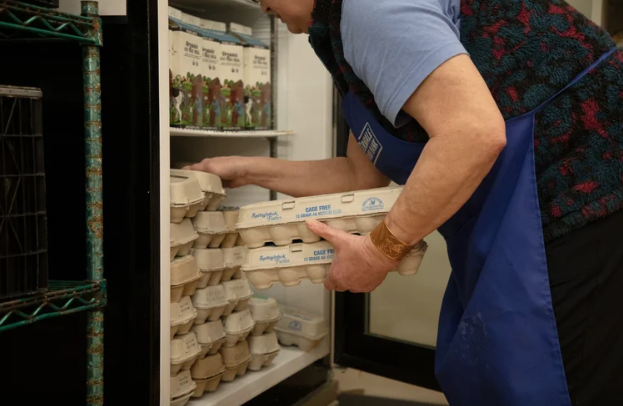
Ferndale framed its policy into four tiers of food. The first – lean proteins, eggs, dairy, and fresh produce – is now available at every distribution. Tier 2, including cooking staples and whole grains, is available 75% of the time, while a third, including canned goods, is at 50% of distributions. Tier 4 food, which includes desserts, candy, processed snacks, and drinks, is a low priority, with Ferndale pledging not to purchase or seek it out.
Ferndale used the HER nutritional guidelines to assess its inventory and help it make purchasing decisions on an ongoing basis. Assessing its food against the standard highlighted the pantry’s weak spots, as well as the ease of correcting them through small tweaks. “For a lot of the stuff that we were purchasing, if we just asked for the low sodium version, then we were back within range,” Crook noted.
Crook has welcomed the accountability that comes with having responsible guidelines for purchasing food. “This is shopper-informed and grounded in health data,” she said. “It feels like it’s honoring the shopper’s experience at our food bank in a much more responsible way than how we were operating before.” – Chris Costanzo
PHOTO, TOP: Ferndale Food Bank’s nutrition policy dictates that it will always have eggs at its distributions.
Like what you’re reading?
Support Food Bank News