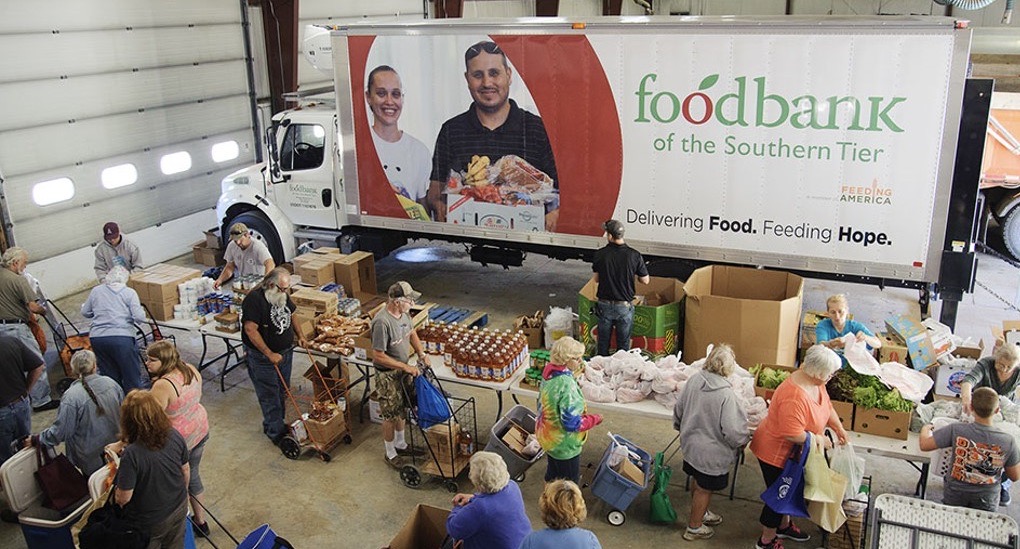
GUEST POST FROM SINA ANSARI OF DePAUL UNIVERSITY — On a typical day, food banks match warehouse inventory to partner agency requests and dispatch drivers along a planned route. While agencies submit their requests in advance, final deliveries often differ as real-time inventory fluctuates. At each stop, teams unload to meet the agency’s request as much as possible, and then move to the next stop.
Within that rhythm sits a constant trade-off: give generously to early stops and risk coming up short later, or hold back inventory for fairness and risk leaving food unused? Think of this operation as a sequence of decisions as a truck moves from one agency to the next. How many items should be released now, given that several agencies remain, and future demand is uncertain?
Our new study, published in Transportation Research Part E: Logistics and Transportation Review, offers a practical approach to making data-driven decisions, so food is shared more equitably across communities, while waste remains low. Working with data from the Food Bank of the Southern Tier in New York, we built and tested an approach that learns each agency’s typical demand and then recommends how much to allocate at each stop in real time. It pursues the dual goals of keeping end-of-day leftovers low and ensuring later stops do not consistently receive less food relative to need.
Imagine a food bank has 20,000 items of a shelf-stable product to divide among five agencies. A simple rule might split the load evenly or in proportion to recent orders. Our approach monitors orders and adjusts in real time. If past data shows that later agencies often request more than expected, the model reserves a small buffer rather than sending everything early. The method learns from many simulated what-if runs of the route and converges to a rule that balances fairness and waste.
Here is an example that reflects the kinds of shifts we observed in our study. Before: A truck carrying 20,000 items visits five agencies in order. Using a simple proportional rule, Pantry A gets 7,000 items, Pantry B 3,400, Pantry C 2,400, Pantry D 3,700, and Pantry E 2,500. The truck returned with 1,000 items remaining because later demand was lower than expected, but Pantries C and D experienced a shortfall earlier in the day.
With the model: The system trims early allocations and holds a small reserve. Pantry A receives 6,800 items instead of 7,000, Pantry B 3,300 instead of 3,400, Pantry C 3,100 instead of 2,400, Pantry D 4,300 instead of 3,700, and Pantry E 2,500. The truck returns empty, shortfalls are reduced, and fill rates are more even.
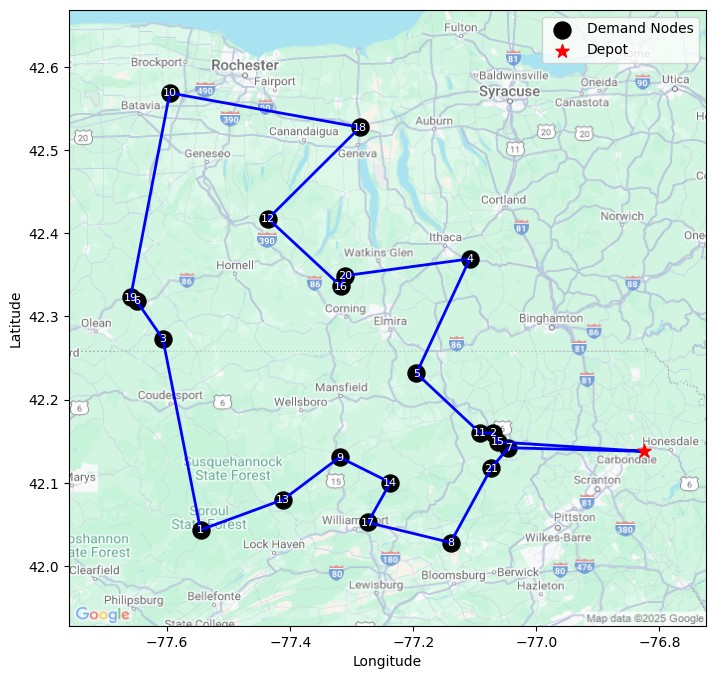
Using Food Bank of the Southern Tier data, we modeled a single-truck route across Steuben County, one of five counties served in the food bank’s 4,000-square-mile region. Annually, Food Bank of the Southern Tier distributes more than 17.6 million pounds to more than 80 sites. We mapped a feasible one-day route of about 212 miles with realistic stop times, then applied the learned allocation rule at each stop.
In this case, our proposed allocation policy resulted in about 78% of orders being filled, with fulfillment occurring in an equitable way. We employed the Gini coefficient, a widely used measure that describes perfect equality as 0 and perfect inequality as 1. Our Gini measure of 0.19 indicated a near-perfect distribution across agencies, and ultimately an optimal trade-off between fill rate and equity.
This method works because it considers the two pitfalls that drive inequity and waste. Front-loading meets early requests in full but starves later sites. Over-saving holds too much just in case and leaves food undistributed. The model navigates between these extremes by learning patterns of uncertainty. When downstream demand is likely to be large, it reduces early allocations. When downstream demand is likely to be small, it allows fuller early allocations. Over multiple days, this yields more even fill rates, while keeping leftovers to a minimum.
Implementing this method requires historical orders and fills, agency capacity and schedules, plus policy guardrails, such as minimum fill rates and maximum distribution amounts for any single agency. The model applies a threshold rule at each stop: if the request is at or below the threshold (the adjusted available supply, computed in real time by the model for each agency), then fill it fully. Otherwise, allocate the threshold amount and hold the remainder for later stops.
Start simple and grow only if it helps. Think of a three-level maturity path.
Level 1: Spreadsheet pilot. In Excel or Google Sheets, load six months of orders and fulfilled quantities. Estimate each agency’s weekly demand, set fairness guardrails (a minimum per stop, a cap per stop, and a target fill-rate to keep service balanced), and build a simple calculator that proposes an initial split plus a modest reserve, which is released as later orders appear. A staff member or volunteer can set this up within a few days.
Level 2: Light automation. Move the logic to a small Python script or Colab notebook (a simple, point-and-click software tool that runs on a computer or in a web browser) that reads order exports and makes recommended allocations on delivery days. A part-time analyst or university partner can keep inputs clean, check guardrails, and flag exceptions like agency closures.
Level 3: System integration. Embed the rules in your order or warehouse management software system, so it automatically generates recommended allocations whenever a new purchase order is received. Staff can accept the recommendations, adapt them to local conditions, and record reasoning to inform future runs.
Food banks cannot eliminate uncertainty, but they can reduce its costs. A data-guided adjustment to the amount released at each stop can prevent late-route shortfalls without increasing waste. Start with a spreadsheet, tune it monthly, and grow from there. With clear guardrails and a few hours of time from an analyst – ideally someone fluent in Excel and basic statistics, and preferably familiar with Python programming – better data can lead to more effective food allocations for the communities that need them most. – Sina Ansari
Sina Ansari is Assistant Professor of Management and Entrepreneurship at Driehaus College of Business at DePaul University.
Like what you’re reading?
Support Food Bank News