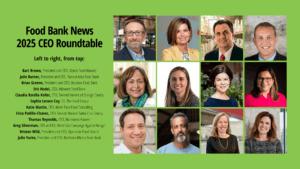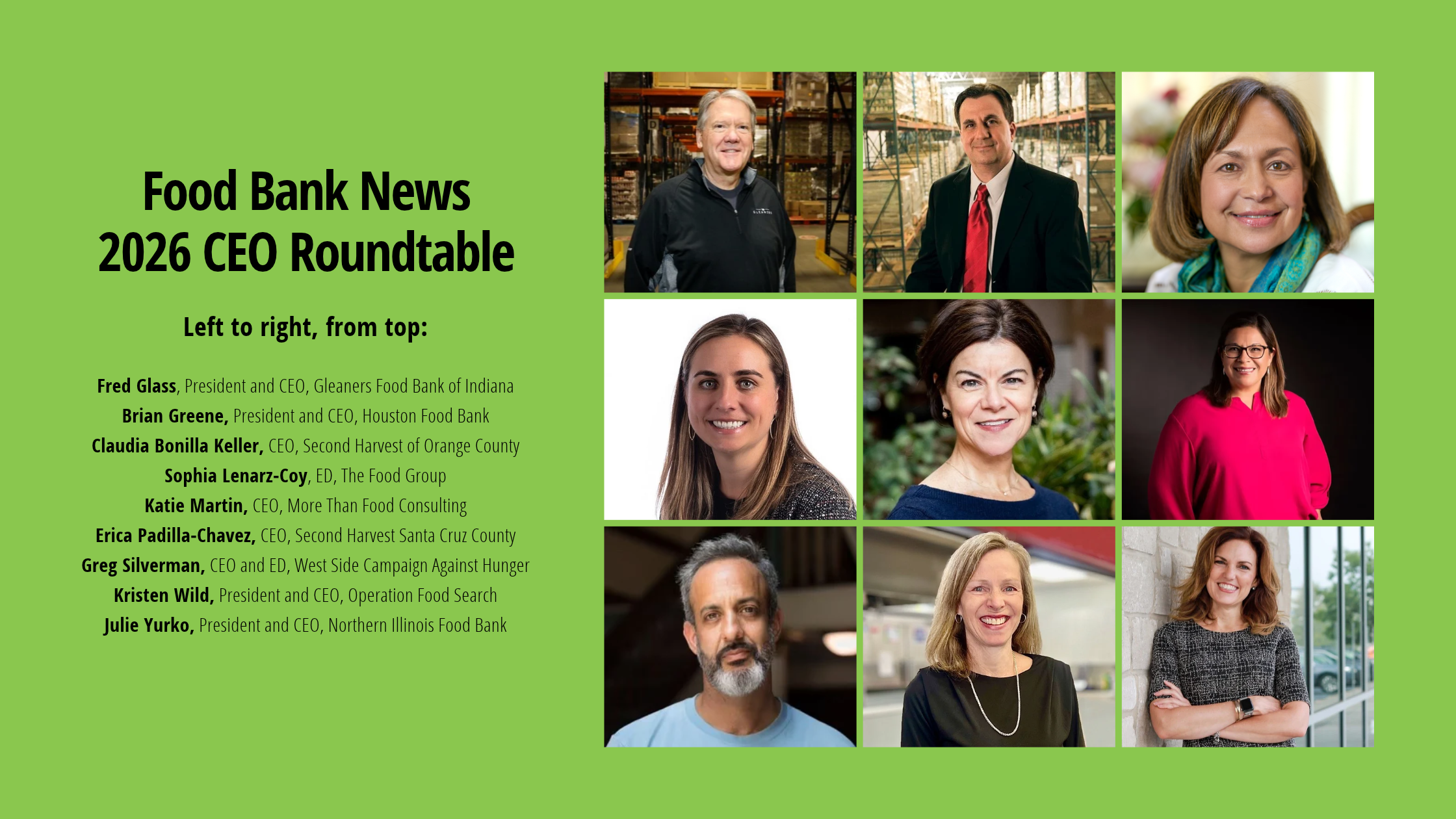
Our CEO Roundtable this year covered a lot of ground, from artificial intelligence to Food is Medicine to the midterm elections (see our story here). Of all the topics, the concept of food justice emerged as the most difficult to pin down.
Traditionally, food banks have been likely to describe what they do as food distribution, rather than anything having to do with food justice. At the same time, most would likely buy into the basic idea of food justice, which is that healthy, affordable food is a basic human right, not a privilege.
In our Roundtable, many of the CEOs articulated strategies that fit into a food justice framework, even if they were not formally called that. All of the CEOs who participated in our Roundtable are members of our Editorial Advisory Board. (See here for the full list of members.)
Erica Padilla-Chavez, CEO of Second Harvest Food Bank of Santa Cruz County, described her food bank as having the goal of helping people lead fulfilling lives. While providing nourishment is a big part of that goal, the strategy also includes collaborating with community partners on issues that don’t primarily have to do with food. One specific initiative the food bank is involved in, for example, seeks to advance outcomes in economic prosperity, health and well-being, and civic engagement. “We are leaning in with our partners in the economic development space,” she said.
Food justice can also be about food quality. Gleaners Food Bank of Indiana recently undertook an initiative to underscore the high regard it has for its neighbors by focusing on the quality of the food it distributes, even instituting a guarantee of satisfaction. “I think that’s food justice at its essence,” said Fred Glass, President and CEO. “That the people we serve, the marginalized, are entitled to nutritious food – not the leftovers, not the good enough, not the dig-through stuff. And that’s been very, very well received in our service territory.”
Food justice may be about doing advocacy work. Every food bank should be having conversations about how much of their budget they put toward advocacy, including engaging the community as part of that advocacy, said Greg Silverman, CEO and Executive Director of West Side Campaign Against Hunger in New York City. “If the percentage isn’t high enough, then I don’t think people are doing food justice,” he noted.
If food justice has to do with advocacy, then what should the advocacy be focused on? Brian Greene, President and CEO of Houston Food Bank, acknowledged the ongoing need to fight for SNAP, but also noted that the economy is changing dramatically with the advent of artificial intelligence. In ten or 20 years, individual income could be severely restricted by AI, creating a scenario where the impact of food banks could be “insignificant compared to the disaster we’re going to see.” Greene added, “The bigger changes afoot are so much larger that we have got to shift how we think of advocacy.”
Food justice is hard to define, and also can be hard to embrace, even for a progressive food bank like The Food Group, based in Minneapolis. “How we do programming that is aligned with food justice is something I think about a lot,” said Sophia Lenarz-Coy, Executive Director. “But it’s been a term that I have at least felt not able to give ourselves or to brand our work because some of our corporate partnerships might be inherently linked to some of the root problems that are creating systems of oppression in the food system to begin with,” she said, concluding that there is “a lot of nuance” in the concept of food justice.
Katie Martin, CEO of More Than Food Consulting, who next year will be publishing a book with food justice as one of its themes, acknowledged that “there are so many different ways to think about justice and how we’re playing in that field.” But one simple way is to recognize that “it is unjust that millions of Americans, millions of our neighbors, have to struggle to get enough food.” She added, “It can be about advocacy and all those other things, but the core of it is recognizing that there are injustices at play.”
On the topic of artificial intelligence, food banks said they are developing policies around the technology, even though they remain far from widely implementing it. Operation Food Search in St. Louis has an AI committee and has developed a preliminary AI policy that endorses the use of AI but does not require anyone to use it. While some team members have expressed deep concern about the technology’s impact on society, most staffers view it as a tool that should be used at the risk of falling behind. To that end, Operation Food Search has determined it will have a coordinated approach to “enterprise AI” based on Claude, which would prohibit anyone from using a different type of AI.
Some team members fear that AI could remove a human element of food banking, said Kristen Wild, President and CEO. “We’re saying that this isn’t going to replace human interaction. It just means that AI can help you with some of your administrative duties to free you up to spend more time on human relationship and interaction.” But, she acknowledged, “It’s not landing 100% with everybody.”
Julie Yurko, President and CEO of Northern Illinois Food Bank, agreed with the importance of working with the team to create an AI philosophy. “You need to allow for folks to talk about how they feel about AI because there are a lot of feelings,” she said. At the same time, it’s critical to develop an AI policy to keep the organization from risk. With that foundation in hand, Northern Illinois Food Bank has now formed a cohort to identify how it could use AI in various ways to promote efficiencies.
West Side Campaign Against Hunger came up with a simple one-pager of its AI philosophy and shared it, along with its fellow members of The Roundtable, which is a collective of hunger relief agencies in New York. The ten members of The Roundtable already use AI to find pricing efficiencies between them, an initiative that fosters lower prices and also helps to put AI in a positive light. “Finding these ‘AI for good’ stories I think is really important,” Silverman said.
When it comes to Food is Medicine, food banks are hopeful about its ability to reach new clients and improve public health, but are frustrated by uneven funding. Padilla-Chavez of Second Harvest Food Bank of Santa Cruz County called its partnership with a managed care plan to deliver medically tailored groceries “wildly successful” in terms of building new connections with the community and healthcare partners, as well as in terms of diversifying its revenue streams. “But the Medicaid changes and the threats imposed in H.R. 1 could make or break this very successful program,” Padilla-Chavez said. “One of my hopes is that with the change of the guard, that there’s a recommitment to this level of upstream work.”
Operation Food Search is well aware of the ups and downs of Food is Medicine funding. The pharmaceutical company Bayer had been a major funder of its program focused on pregnant women and their families, but just pulled back in terms of how much it’s willing to fund. Operation Food Search managed to secure a four-year federal grant to replace the Bayer funding, but is still hoping for more consistent support. “We always thought, ‘Oh, by the time the Bayer funding runs out, this is going to be more widely accepted,’ and we would be working with Medicaid managed care organizations, and the funding would be there, and it still isn’t in the state of Missouri,” Wild said.
Yurko noted the “amazing” ability of Food is Medicine to decrease hospitalization rates and emergency room visits, but lamented that food banks in many states are not yet able to work with managed care organizations to get a reimbursement model going. “I hope a lot of us are staying in the game,” she said. “It can really show impact, show care, and change lives for the better.” – Chris Costanzo
Like what you’re reading?
Support Food Bank News
This article was made possible by the readers who support Food Bank News, a national, editorially independent, nonprofit media organization. Food Bank News is not funded by any government agencies, nor is it part of a larger association or corporation. Your support helps ensure our continued solutions-oriented coverage of best practices in hunger relief. Thank you!