Hunger relief leaders in New York City lent positive but guarded support for an unusual plan by the city’s new mayor to bring down the cost of groceries.
Elected in November on a platform of affordability, Mayor Zohran Mamdani wants to open five city-owned grocery stores that would sell food at discount prices. The first would open next year in a high-poverty neighborhood in the South Bronx.
The idea is not completely novel – Atlanta already has a municipal grocery store, for example – but in a city of more than 8 million residents with a poverty rate almost twice the national average, the mayor’s attempt may become the most watched yet.
Food bank and pantry leaders welcomed the initiative as another component to solving a complex, multifaceted problem. “The municipal grocery stores really should be viewed as part of a larger universe of approaches around food access,” said Leslie Gordon, President and CEO of Food Bank for New York City, at a recent forum about closing the food-access gap in the city. At the same time, she cautioned that the success of the plan “is going to be around good, solid execution.”
Taina Rodriguez, Associate Director of Food and Dignity Programs at Part of the Solution (POTS), a large pantry in the Bronx, had a similar sentiment, noting that POTS is in favor of any initiative that leads to more affordable food. “It gets us one step closer to solving what we need to,” she said. Yet she had concerns about details, such as where the stores would be located. “How many of our community members are going to be able to make it to where this location is?” she asked.
Mark Chatarpal, Executive Director of the NYC Food Policy Center at the Hunter School of Health Professionals, complimented the mayor’s office for its “aspirational” endeavor, but also questioned “whether five stores can really move prices in the city.” He wondered about the procurement process and which groups would be involved in getting consistent supplies to the grocery stores. “It circles back to the fundamental point of where this food is going to be procured from, and how do we make sure that the funds coming from hardworking taxpayers are actually being circled back into the city,” he said.
Gordon of the Food Bank for New York City called it an “absolute imperative” to make sure people with lived experience of hunger were included in developing the plan. “Often, the best solutions come from people who are experiencing the problem themselves,” she said. “Data only takes you so far.”
The panelists touched on other ways to get food to people, including using SNAP cards to order food online through Instacart, which makes access easier for people with mobility or transportation issues, while also removing any stigma. Instacart has also found that people are ordering more fresh fruits and vegetables through the online system, said Thomas McNeil, Senior Manager of Government Affairs at Instacart. He added that the company would also like to be able to accept online WIC payments, calling that “a game-changer,” he said.
Despite the wide variety of efforts, the best way to help people, Rodriguez of POTS said, is through traditional benefits like SNAP. “We’ve seen a lot of tremendous success stories behind people who have been on public benefits, and we’ve seen them thrive and move on and matter,” she said. “So I think that’s where the focus should be.”
A huge wave of need is about to course through the city’s vulnerable populations as the SNAP cuts kick in. “I’ve been in this for 20 years, I must say I’ve never seen the need signal as high as it is now,” Gordon said. “We’re about to see a tsunami wave of new people on our lines that we can’t even begin to imagine. I hate to be the bearer of bad news, but that’s a reality that’s about to happen.” – Chris Costanzo
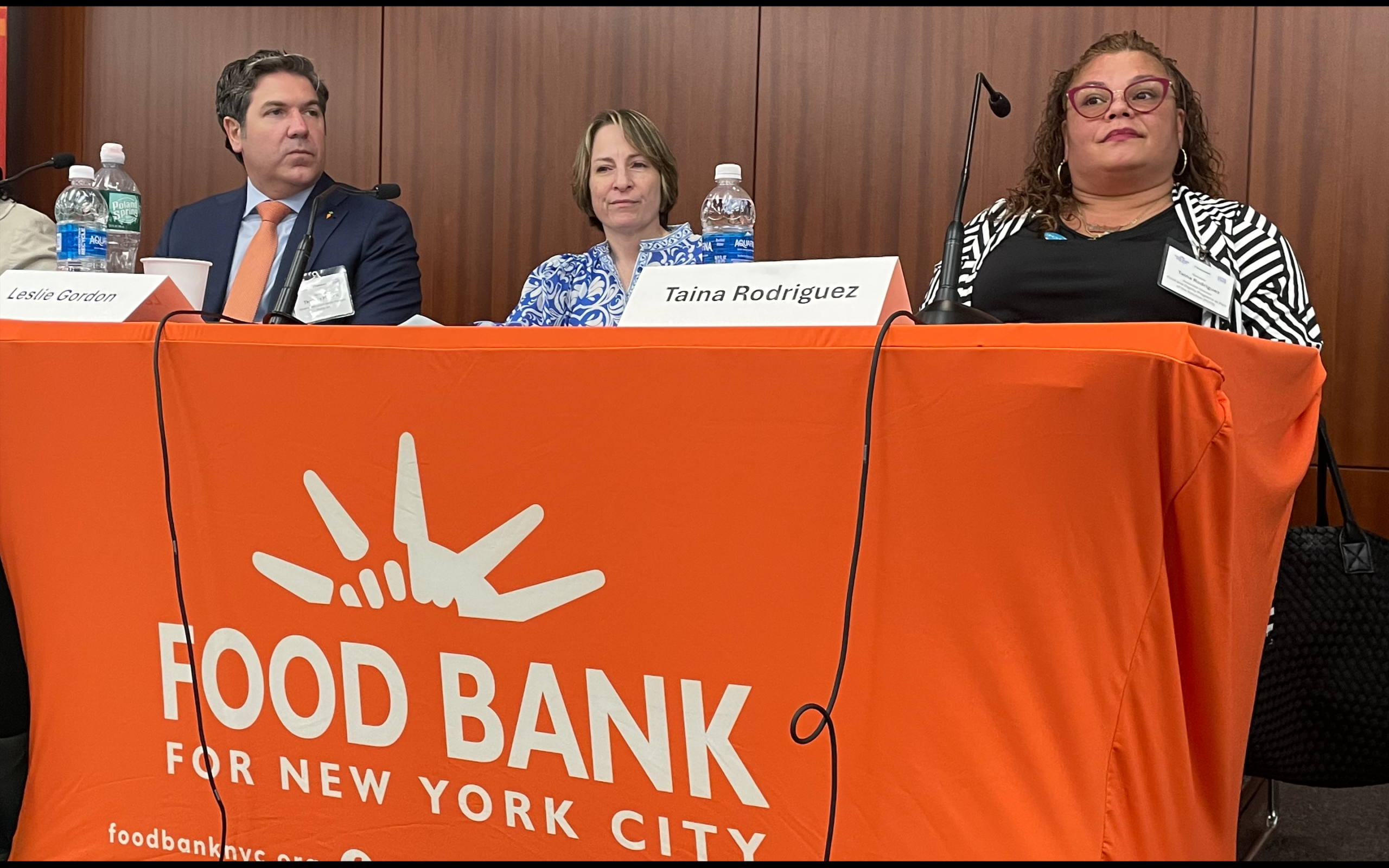
CAPTION FOR PHOTO, TOP: Thomas McNeil of Instacart, Leslie Gordon of Food Bank for New York City, and Taina Rodriguez of Part of the Solution at a food access event in New York City last week.
Like what you’re reading?
Support Food Bank News
This article was made possible by the readers who support Food Bank News, a national, editorially independent, nonprofit media organization. Food Bank News is not funded by any government agencies, nor is it part of a larger association or corporation. Your support helps ensure our continued solutions-oriented coverage of best practices in hunger relief. Thank you!