GUEST POST FROM ANDREA WILLIAMS, PRESIDENT OF OREGON FOOD BANK – My great-grandmother Francisca grew food her entire life. However, at times, even she didn’t have enough to eat.
I have thought about that contradiction for as long as I can remember. A woman whose hands fed others went to bed hungry herself. At some point, I stopped calling it a contradiction and started calling it what it is. A choice that someone else made about whose labor matters and whose hunger counts. A story that someone wrote for my great-grandmother.
I run a food bank now. And I want to tell you something that might be uncomfortable to hear.
We have been telling the wrong story about hunger. And it is costing us.
For 50 years, the story has gone like this: some people have, some people do not, and the generous ones in the middle make up the difference. It is a story about charity. About goodness. About showing up on a Saturday morning to sort cans for strangers. It is a feel-good story. And it has carried us far.
But it is an incomplete story. And incomplete stories produce incomplete solutions.
The story we have not told, or not told loudly enough, is this: hunger is not a personal condition. It is a political outcome. Hunger does not happen to people just because of who they are or how hard they work. It happens to people because of decisions made far from their dinner tables, by people who make policy choices.
When we tell only the story of charity, we make the policy decisions invisible. We make the people who made them comfortable. And we make permanent what was always meant to be temporary.
Here is what I have learned, leading one of the largest food banks in the country: the most powerful thing we can do is to change what people believe about why anyone is hungry at all.
Lately, we’ve been hearing stories like Anita’s from Vale, Oregon. After an injury left her unable to work consistently, she found herself struggling to afford groceries despite having spent years supporting herself as a nurse. She was doing everything she was “supposed” to do. Her story is like many others’, how stability can disappear when wages, healthcare and housing costs collide. Instead of framing her experience as personal failure, we need to present it as evidence that hunger is often the result of systems that leave people vulnerable long before they ever visit a food pantry.
Our stories make up a narrative that does not just describe reality. Narratives shape what people think is possible.
We know this because we have seen it work elsewhere. The story we told about smoking changed, and millions of lives were saved. The story we told about marriage equality changed, and the law followed. In every case, the narrative moved first. The policy came after. What people believed determined what they demanded. And what they demanded determined what became possible.
Hunger deserves the same shift.
That’s why we are leading Rethink Hunger, a long-term effort to strengthen the anti-hunger movement by changing how people understand hunger and what solutions they believe are possible.
But narrative change only works when the right people are telling the story. Not about communities. With them. Not interpreting their experience. Amplifying their voice. There is a profound difference between being the subject of a story and being its author. The communities most affected by hunger are not waiting to be described. They are waiting to be heard. And when we tell their own stories, something shifts. The story stops being about need and starts being about power. About what was taken. About what is owed. About what is possible.
That is what we are building with Rethink Hunger. Not a campaign. A different story. One told by the people living inside it, grounded in shared human values, and aimed not at sympathy but at solidarity.
We are asking people to make the shift from feeling generous, to feeling responsible. We are asking someone who sees a hungry family not to see them as a tragedy to respond, but instead as an injustice to prevent. Those are not the same ask. And they do not lead to the same place.
As a mother, I think about what story my children will inherit about hunger. Whether they will grow up believing it is something that happens to some people, or something that all of us are responsible for preventing. That distinction is everything.
My great-grandmother never told her own story. It was told for her, if it was told at all, in the language of hardship and resilience and quiet endurance. What I want, what Rethink Hunger is reaching for, is a world where no one’s hunger is someone else’s story to tell.
We are not stepping back from feeding people. We will never do that. But we are done being quiet about why they are hungry.
Hunger is a policy choice. And the story we tell about it is ours to change.
Andrea Williams has served as the President of Oregon Food Bank since 2024. Previously, she served as the Executive Director of a leading immigrant rights organization in the state and also led One Oregon, a coalition of over 100 organizations to pass policy that changed many Oregonians’ lives.
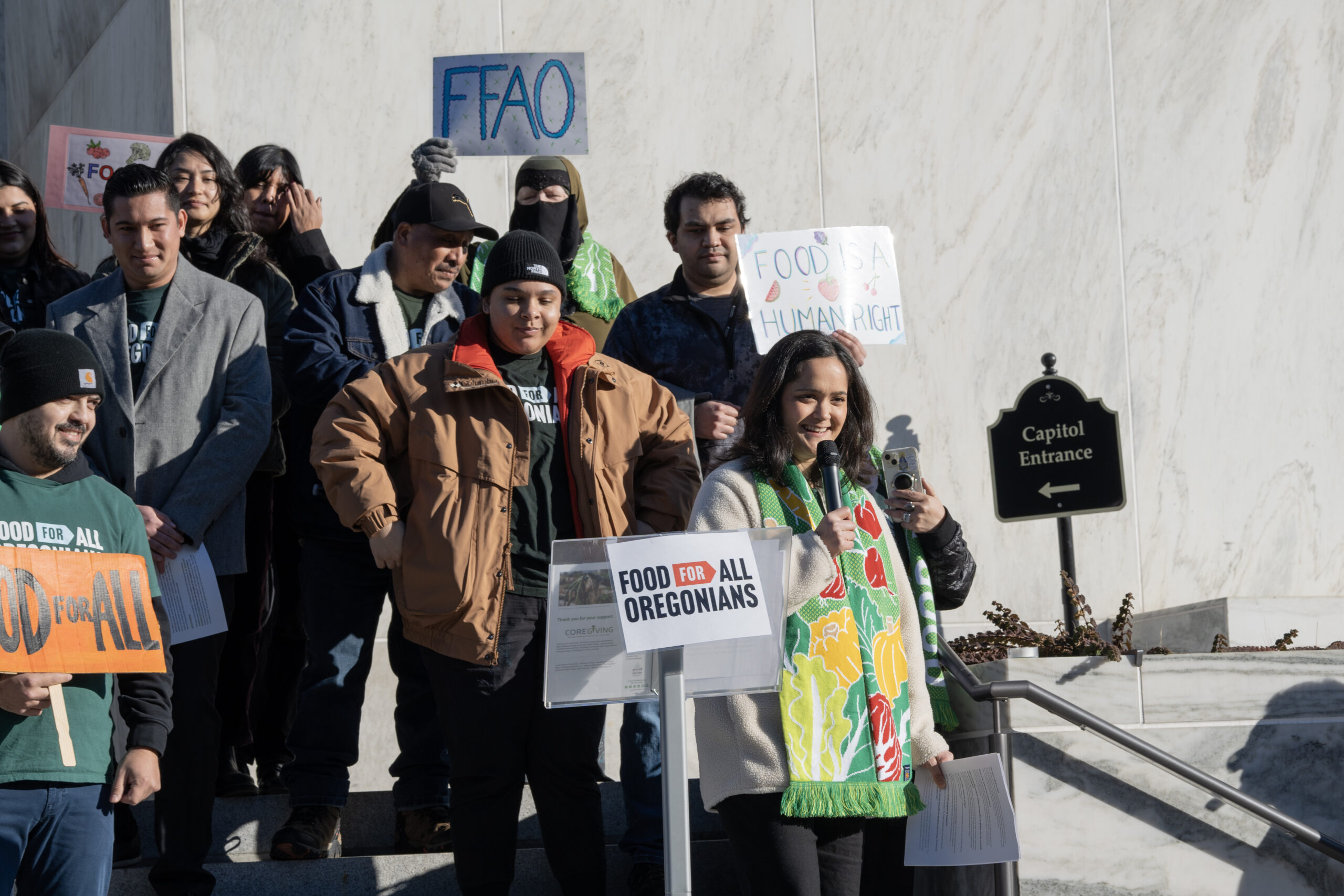
PHOTO, TOP: Andrea Williams, in scarf, leading a Food For All Oregonians press conference in 2025.
Like what you’re reading?
Support Food Bank News
This article was made possible by the readers who support Food Bank News, a national, editorially independent, nonprofit media organization. Food Bank News is not funded by any government agencies, nor is it part of a larger association or corporation. Your support helps ensure our continued solutions-oriented coverage of best practices in hunger relief. Thank you!