The five major food banks of New Jersey recently achieved a major goal in their aim to build up more resilient local food systems in their state.
The food banks are now sourcing upwards of 50% of the produce they distribute from local farms, an increase from about 35% previously. The produce gets delivered on a just-in-time basis in quantities and mixtures that can be easily handled even by smaller food banks.
To reach the goal, the food banks looped in a NJ-based nonprofit farm, as well as a produce cooperative affiliated with Feeding America. They were also helped by the state’s food security office, which has made strong local food systems one of the goals of its strategic plan.

“This is what fierce innovation looks like,” said Mark Dinglasan, Executive Director of the NJ Office of the Food Security Advocate, which operates out of the Governor’s office, the highest level of state government.
To keep more local produce in the state, the food banks had to be able to solve the problem of smaller food banks not being able to take in and repack large volumes of produce. Small food banks just do not have the volunteers or equipment to handle say, a truckload of cucumbers all at once.
That’s where MARC comes in. The Mid-Atlantic Regional Cooperative, one of 11 Feeding America-affiliated produce providers throughout the country, has been steadily adding greater flexibility into its offerings – food banks have been able to order mixed produce by the truckload, by the pallet, or by the ten- to 20-pound box. Through a pilot recently conducted with the New Jersey food banks, MARC confirmed its ability to provide even smaller quantities of pre-packaged produce, down to sizes of three- to five-pound bags.
“The food banks were able to accept so much more product this year because it was repacked and sent to them,” said Beth Hamilton, Executive Director of MARC.
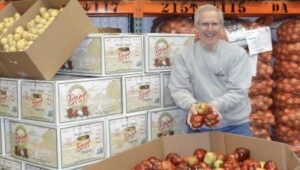
The produce in the pilot came from America’s Grow-A-Row, a 423-acre nonprofit farm based in Pittstown, NJ, which distributes free fresh produce in 24 states, mostly through food banks. Started in 2002 as a “daddy-daughter” garden project, the farm harvests and distributes about 4 million pounds of free produce a year, said Chip Paillex, President and Founder.
In addition to repacking the produce into manageable sizes, MARC also tested its last-mile delivery chops during the pilot. It delivered produce directly to some of the food banks’ larger partner agencies, saving the food banks the time and effort of having to do so. “We were making deliveries to up to 24 agencies per week,” Hamilton said.
Once MARC completes a consolidation of its operations into a single facility in New Jersey by the end of November, it will be able to offer its new repacking and direct-delivery services to all of its 31 members, Hamilton said. “We hope to build on some of these offerings that we’ve learned through this pilot,” she noted.
The Community Food Bank of New Jersey, the state’s largest food bank, is already the biggest distributor of produce from America’s Grow-A-Row, at more than 800,000 pounds in 2024. By working with the state’s other food banks through MARC, it is helping to get even more produce out to all corners of the state. “We’re doing it together,” said Elizabeth McCarthy, President and CEO, noting, “Our neighbors don’t care where we are supposed to serve.” – Chris Costanzo
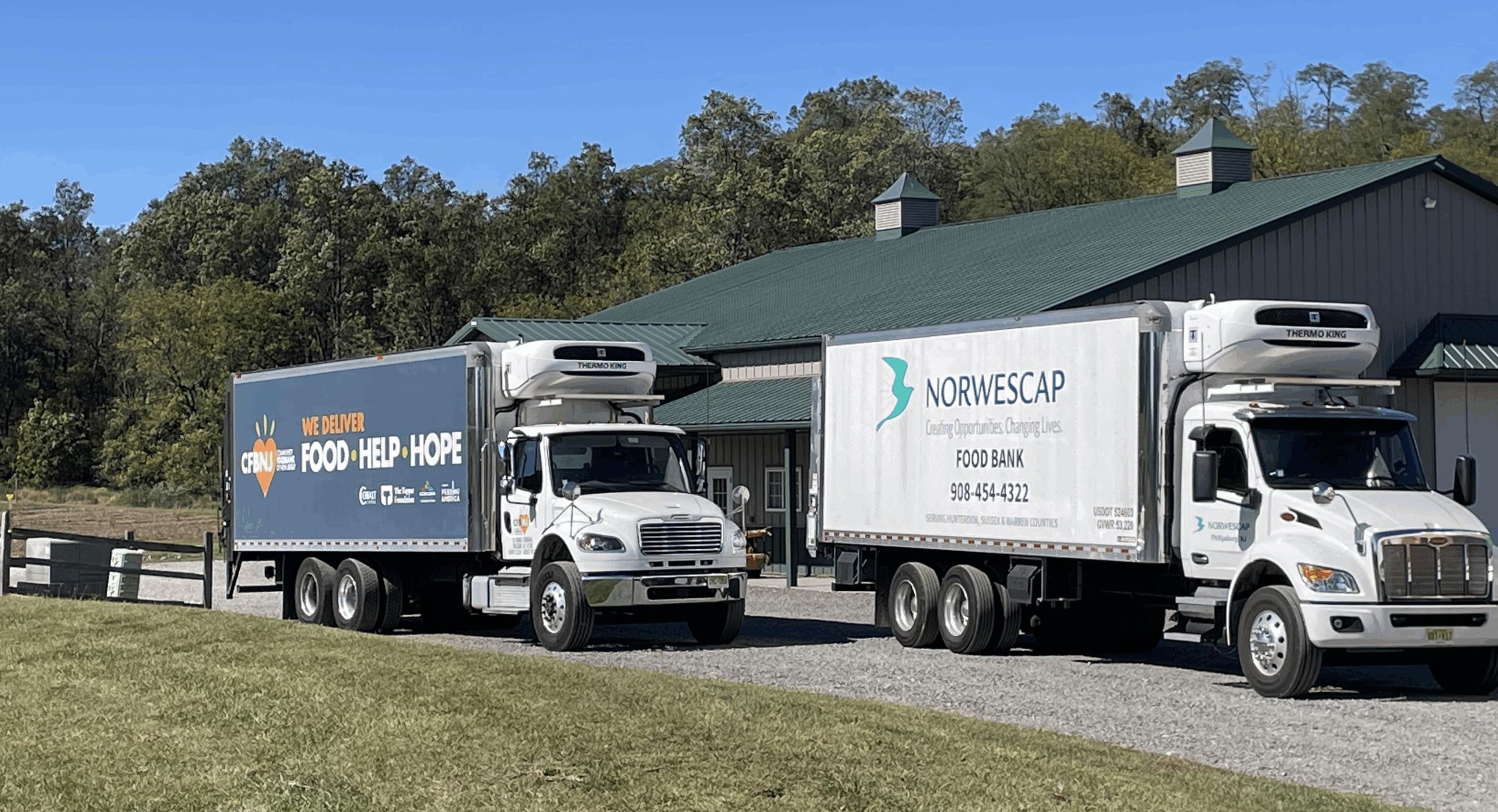
PHOTO, TOP: Two New Jersey food-bank trucks ready to take delivery of produce from America’s Grow-A-Row.
Like what you’re reading?
Support Food Bank News