Food bankers often say that when you’ve seen one food bank, you’ve seen one food bank. The same could be said for mobile markets.
All mobile markets have the goal of addressing food insecurity in communities with limited access to fresh, affordable food, but they may differ in the details of how they source and distribute their food. In a recent webinar sponsored by Farmers’ Truck, two organizations – FeedMore WNY in Buffalo, NY and Arlington Community Food Bank in Washington – discussed the ins and outs of their approach to mobile markets.
In Washington, Arlington Community Food Bank relies largely on grant funding and volunteer staff to supply food for free through its refrigerated mobile food truck, which serves about 80 people per stop. The truck visits various locations, such as apartment complexes and a fire station, twice a month.
At the heart of its program are community ties to local farms, as well as grocery rescues and donations. “We made a conscious decision to invest in our local community, small businesses and farms because those same people were in our food lines,” said Carla Rankin, Executive Director. “If we could stimulate the local economy and feed people at the same time, we’re really getting at the root cause of hunger.”
Rankin, who secured her mobile market truck in 2021, was inspired by a bookmobile she used as a child. When neighbors mentioned they couldn’t afford gas money or reach their local pantry, she decided to bring produce and resources to them.
The market got rolling with the help of local support, including from an area high school and the city. A grant from the Washington State Department of Agriculture supports purchases of fresh produce. Rankin and her team continue to secure grants and funding by getting feedback from customers, including names of customers, whether they’re returning customers, and how many are in the household.
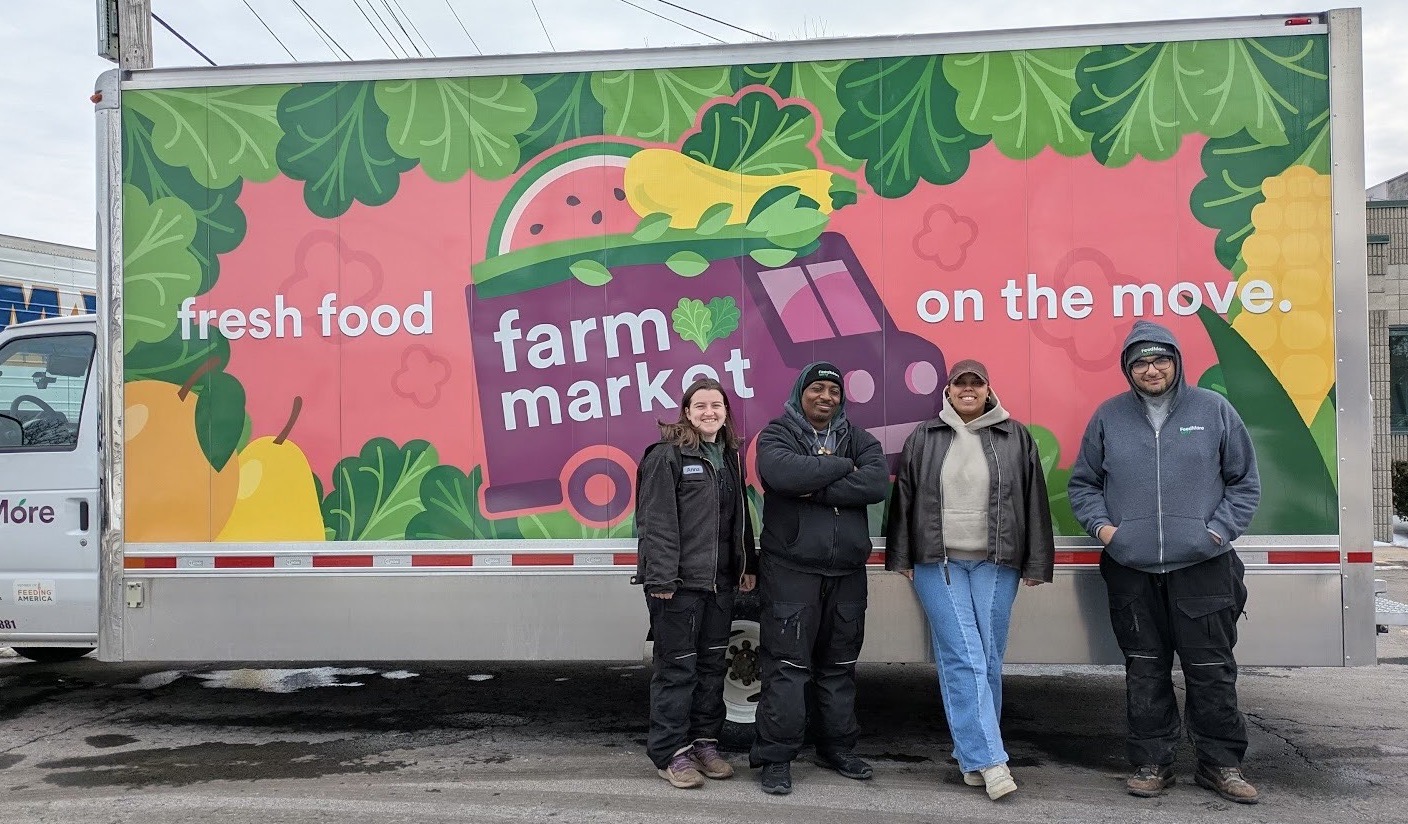
FeedMore WNY’s bigger operation runs three trucks across four counties over five days of the week to reach 30 sites. The program relies on funding from the food bank as well as grants to purchase between $5,000 to $6,000 of local farm produce at wholesale prices. Items are then sold for $5 or less, though guests paying with SNAP benefits automatically receive a 50% discount.
While there’s a payment model in place, the mobile market aims to break even, making little to no profit, given the terms of a grant it received. “At the end of the day, we pretty much do net out what we purchase versus what we sell,” said Amber Thiel, Retail Partnership Coordinator.
Using broccoli as an example, Thiel said the truck may sell two heads of broccoli for $1, and end up losing $7 per fleet purchased. To keep the broccoli cheaper, it may boost the price of another item on the truck to recuperate the $7 broccoli loss. “Very rarely do we ever make a profit. But that’s not really our goal with the program,” Thiel explained.

To determine where to go, the FeedMore WNY staff has an application process for community organizations and members to pitch why they need a mobile market. Such an approach overcomes the limitations of relying on data like census information or household income, which may not relay the full picture of need.
Thiel emphasized the importance of community input. “They’re going to be the ones that can tell us the most about why the community needs us,” she said. “Versus us looking at data and being like, ‘It looks like you might be needed or not,’ but we can’t really tell just off of data alone.”
With each stop their mobile trucks make, Rankin and Thiel aim to boost food nutrition education. Through an initiative called Just Say Yes to Fruits and Vegetables (JSY), FeedMore shares on-site nutrition education classes, healthy recipes and tutorials like how to cut a pineapple.
Arlington Community Food Bank hosts nutritionists on its truck, as well as staff to take blood pressure checks and other experts who have knowledge on what could benefit customers and their health needs.
Enthusiasm from the people operating the truck is also important. Hiring community locals who are eager to engage a crowd is key to the operations of Farmers’ Truck and keeps community members coming back for more, said Fredéric Laforge, Founder and CEO. “We’ve made the conscious effort to remember all the stories of the farmers we work with,” said Laforge. “That’s how an apple gets so much better – when you know the people who worked behind it and it comes from your community. It just tastes better.”
Thiel’s final word of advice was to always be prepared for unexpected events, from cuts in funding to truck malfunctions. “Always have a backup plan, whether it’s funding, whether it comes to logistics, produce, purchasing, all of it, backup plans are so important,” she said. – Gabriela Flores
Gabriela Flores is a graduate student at the Craig Newmark Graduate School of Journalism at CUNY. She is interning at Food Bank News for the summer and has previously reported for Mott Haven Herald.
PHOTO, TOP: One of FeedMore WNY’s mobile markets, with staff members (left to right) Anna Gardner, H Riley, Arrika Bley and Jawad Shehadeh.
Like what you’re reading?
Support Food Bank News