A framework for hunger relief pioneered in Canada is slowly making its way into the United States.
Gather, a Portsmouth, N.H.-based nonprofit founded in 1816 to support the families of fishermen, has become only the second organization in the U.S. to adopt Canada’s Community Food Center model, which uses a four-step plan to harness the power of food to build stronger, healthier communities.
The model evolved out of the observation that traditional hunger relief (distributing bags of often low-quality, donated food) was undignified and failed to address the root causes of hunger (poverty, housing, and social isolation). Unveiled in 2012 by co-founders Nick Saul and Kathryn Scharf who had long operated The Stop, one of Canada’s first food banks, the model has spread to include 17 Community Food Centers in Canada, an outpost in Idaho and, as of October, Gather’s new 18,000-square-foot Community Food Center.
“The more I looked into it, the more I thought it was an incredible model, focused on ensuring that everyone in the community has access to healthy food,” said Anne Hayes, Executive Director of Gather. “Over the past few years, as we looked for a space to build a CFC, I consulted with Kathryn Scharf, who helped Nick Saul create the CFC model. She provided a sounding board for us as we moved forward with the plan.” (For more on the evolution of the Community Food Center model, see Saul’s book, The Stop.)

Hayes first discovered the model in 2020. Intrigued by its focus on dignity and systemic change, she visited The Stop in Toronto, as well as two community food centers in Montreal. What she found was a framework built on four essential pillars: Grow, Cook, Share, and Advocate.
“The CFC model envisions a place for food in every community — similar to having a library in every community,” said Hayes. Unlike traditional food pantries, a community food center is designed to be a “one-stop shop” for access to healthy food, education, and social connection.
While the Canadian organization has undergone a major rebrand, changing its name in September 2025 from Community Food Centres Canada to Right to Food, spreading the concept of the community food center still remains a core goal.
The other center in the U.S. based on the Canadian model is the Bloom Community Food Center, the 13,000-square-foot flagship campus of The Hunger Coalition, located in Bellevue, Idaho. Opened in 2021, the center fosters a “fierce sense of community” through programs that promote food sovereignty and community connection, anchored by a community kitchen, gardens, and a next-generation food pantry.
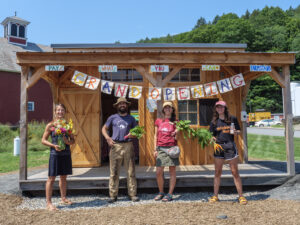
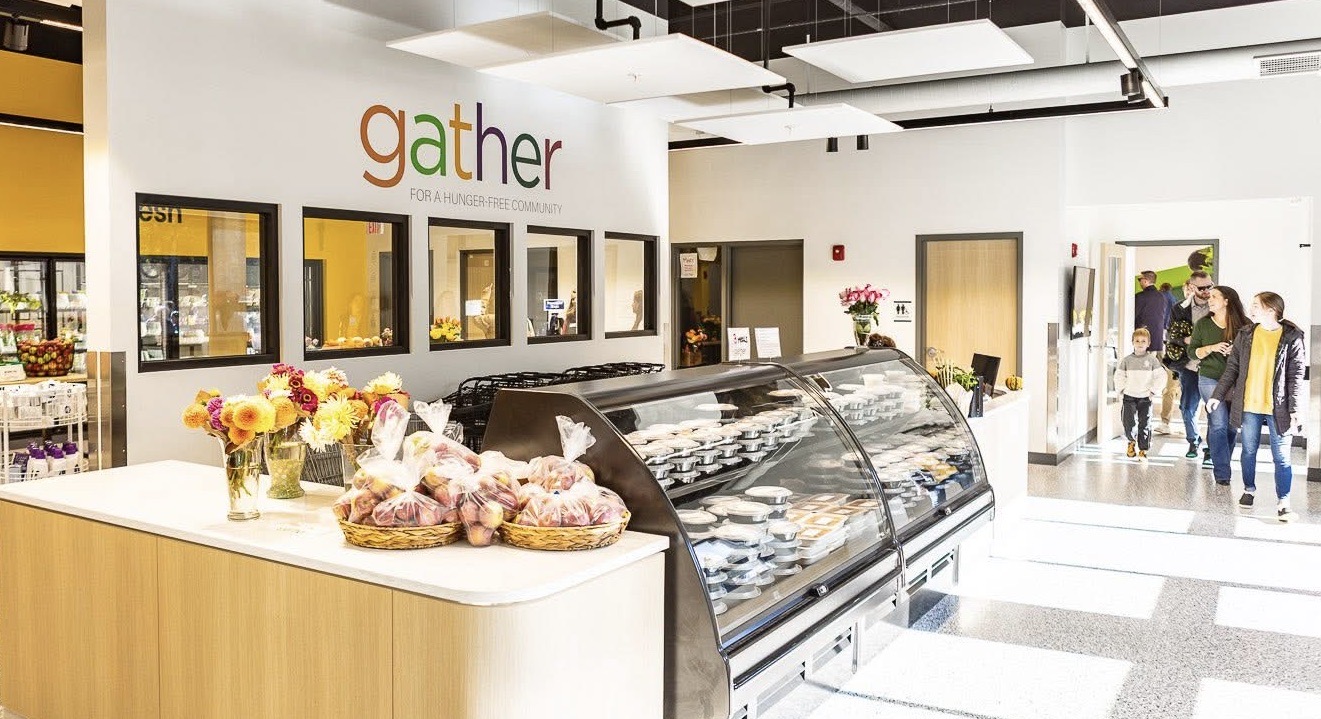
In New Hampshire, Gather is working across all of the four pillars of the community food center model. The space features a bright, spacious market that looks like a modern grocery store, a large teaching kitchen, a production kitchen, and a community gathering space capable of seating 100 people. The organization will build demonstration gardens on site this summer.
By creating a space that is “welcoming and dignified,” Gather is actively dismantling the stigma often associated with food insecurity. “It doesn’t feel like you’re lining up outside waiting for your box of food,” Hayes explained. “People can come in, sit and chat in the sunny, indoor waiting area. It’s a place that anyone in the community would feel comfortable coming to.”
To raise the money for the center, Hayes said the organization did a capital campaign, raising $4 million for construction, $2 million for a maintenance reserve, and $2 million for program innovation. She added that they also got $500,000 in state tax credits and three larger grants (two at $500,000 and one at $150,000), while the remaining money came from individual donors.
The new Gather is making a difference in the community. Just over a decade ago, Hayes said, “we were located in a small room in City Hall, and we distributed standard boxes of nonperishable food by appointment only to about 300 people a month. We now serve over 7,500 people each month with fresh, healthy food, prepared meals, education, and workforce training.”
At the new facility, the emphasis on dignity extends to the plate. Gather’s Cooking 4 Community program repurposes donated, nutritious, surplus food from partners, including restaurants and caterers, to create more than 150,000 prepared, to-go meals annually. This compares to 100,000 meals prior, and Hayes says the organization is on track to do 200,000 annually.
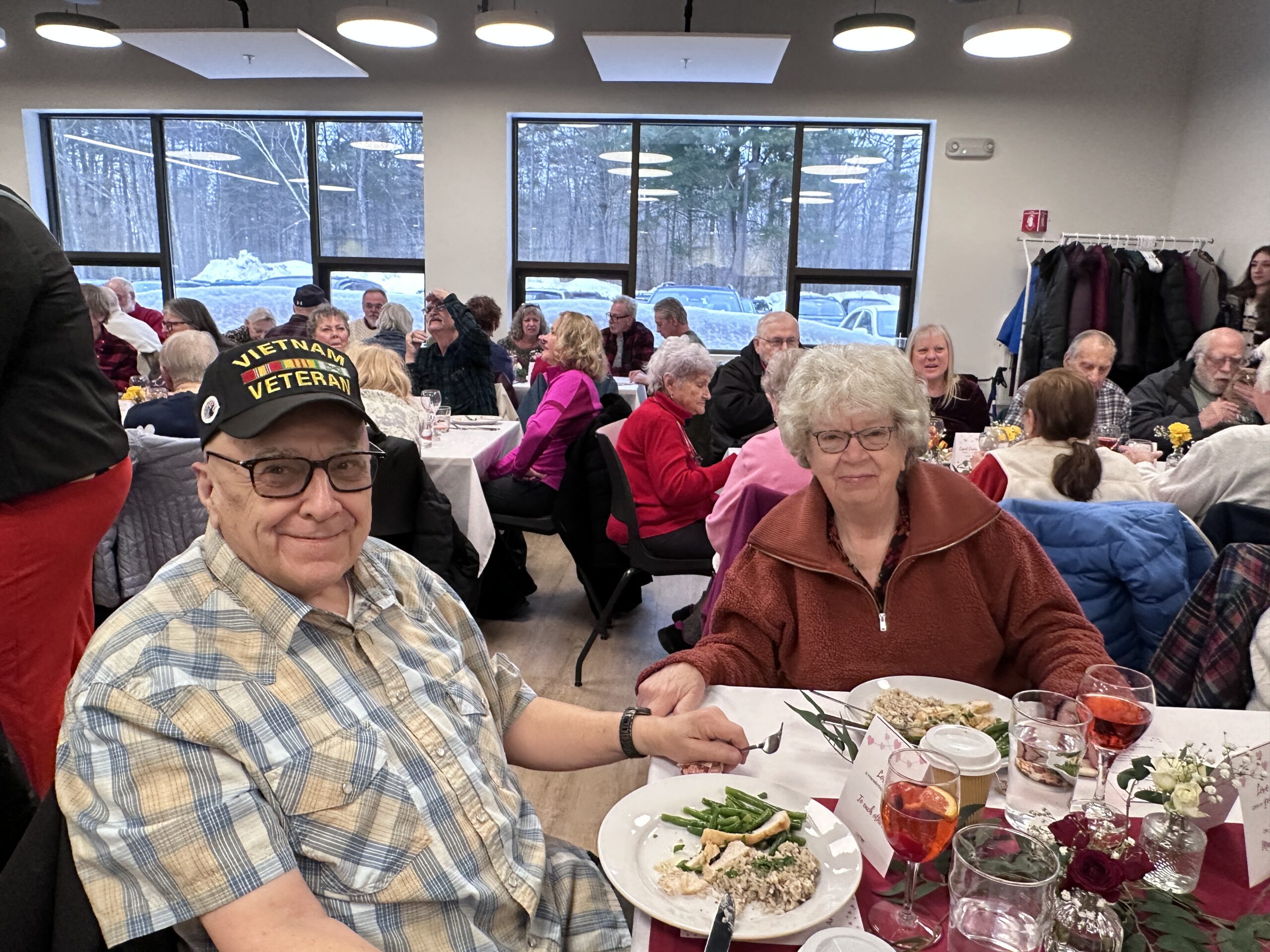
Gather’s community dinners for seniors are not “soup kitchen” affairs; they are three-course, sit-down meals served with care. “Attacking social isolation is critically important for our older population,” Hayes noted. “For seniors on a fixed income, this isn’t just about the food, it’s also about getting out of the house and making new friends.”
While New Hampshire boasts one of the lower food insecurity rates in the country at 10.7% (roughly one in nine families) according to Feeding America, Hayes knows that the numbers only tell part of the story. To truly solve hunger, Gather is moving “upstream” to address the economic factors that keep people in the pantry line.
One of the most ambitious additions to the Gather model is Fresh Start, a culinary workforce training program. By providing structured training for those facing significant barriers to employment, Gather is helping members secure sustainable jobs in the seacoast’s vibrant hospitality sector.
“The model emphasizes not just short-term solutions, but also longer-term solutions addressing the root cause of hunger and poverty,” said Hayes. This includes bringing in partners to offer “wraparound support” such as fuel assistance, housing aid, legal help, and even volunteer tax preparation.
Scaling to meet the needs of 7,500 clients requires a massive logistical effort. Gather operates 40 to 45 mobile markets each month to reach those with transportation barriers and runs the Gather Café at Great Bay Community College, where two-thirds of students experience food insecurity.
The engine behind this effort is a dedicated army of volunteers. Gather maintains a database of over 700 active volunteers, with approximately 60 showing up every day. “The main focus of our volunteer training is to ensure that our members are treated with utmost respect,” Hayes said. “What we hear is that there is a lot of joy here. People can feel how happy our volunteers are to be there.”
The facility also houses a 1,100-square-foot walk-in cooler, allowing Gather to accept significantly more fresh produce, proteins, and dairy from their food rescue partners. “It’s not all boxes of pasta and peanut butter,” Hayes emphasized. “We’re focused on making sure we have lots of produce, milk, and eggs.”
Hayes’s journey to Gather was anything but linear. With a background in strategy consulting and consumer products marketing at companies like Clorox and Welch’s, she brings a corporate rigor to the nonprofit sector. It was her time in Harvard Business School’s alumni consulting program that first sparked her passion for nonprofit work, leading her to roles at Trinity Boston Connects and The Food Project before joining Gather.
Now, she is looking to the future. With the need for food assistance continuing to grow despite the expanded space, Hayes is focused on collaboration. Through the Seacoast Impact Collaborative, Gather is convening mission-aligned organizations to streamline access to resources for families across the region.
Her advice to other organizations looking to move beyond the traditional food bank model is simple: “Please come and visit us!” She added, “We believe there should be a CFC in every community. It takes a community that is done with saying that a small room, open just a few hours a week, is what people deserve.” – Arthur Zaczkiewicz
Arthur Zaczkiewicz is a freelance journalist based in New York and is a co-founder of the Kingston Land Trust.
Like what you’re reading?
Support Food Bank News