For the third year in a row, the top 300 food banks in the United States collectively generated more revenue than the year before. This year, the 300 largest food banks by revenue generated a combined $18.3 billion, surpassing their revenue of $17.9 billion a year ago.
See our full Top 300 Food Banks ranking here.
The strong showing is a testament to healthy levels of food sourcing and charitable giving, even as federal support has waned. The latest two years of growth come after a post-pandemic lull in 2023 and 2024, when revenue fell to around $16 billion for two consecutive years, following a $19 billion pandemic-era high.

Revenue for food banks comes mostly in the form of food donations, with a smaller portion coming from government and foundation support, as well as individual donations. Revenue, in other words, is an indicator of how much food (and cash for food) that food banks take in to distribute out to their community. It’s a measure of how much good a food bank can do.
During fiscal year 2025, government support for food banks receded when the USDA pulled back $500 million from TEFAP, a staple of federal food bank funding, and another $500 million from LFPA, the hugely popular federal program that supported farm-to-food-bank purchases. Food banks responded by pulling all the levers at their disposal, beefing up their food recovery efforts and soliciting extra support from state and local governments, as well as individual donors.
While the food banking sector has managed to maintain healthy revenue, it faces outsized burdens in the coming year as regulatory changes make millions of people newly ineligible for SNAP, the nation’s most effective and far-reaching hunger relief program. Food banks report feeling increasing pressure from the shrinking of SNAP, which provides roughly nine meals for every one provided by the food banking sector.
Our review of food bank revenue, which comes from the most recently reported fiscal year revenue information on IRS Form 990s on ProPublica’s Nonprofit Explorer, found that food banks in general are getting bigger. This year, the threshold to qualify for the Top 300 list rose to $7 million, up from $5 million only three years ago. Among the food banks that grew, the average revenue increase was $6 million.
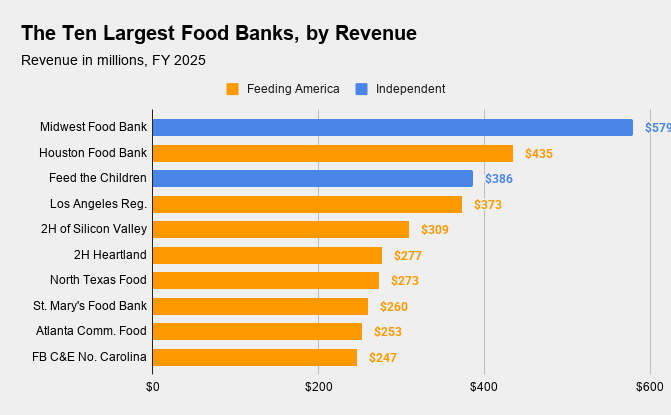
Some food banks made tremendous gains in 2025, with ten increasing revenue by at least $20 million, including Midwest Food Bank, the only food bank with revenue exceeding $500 million. Los Angeles Regional Food Bank saw the largest annual increase – of nearly $100 million – placing it at No. 4 on the list. That increase alone eclipsed the revenue of 82% of the food banks on this list.
Unlike the Feeding America food banks, which operate within strict geographic areas, the independent Midwest Food Bank, headquartered in Normal, Ill., operates widely across the U.S., contributing to its revenue of $579 million. That was followed by Houston Food Bank, with $435 million, and Feed the Children in Oklahoma City, another nationwide independent food bank, with $386 million.
While overall revenue rose across the industry, 38% of food banks in the top 300 lost revenue since their last Form 990 filing. For those who saw a decrease in revenue, the average decline was by $6.6 million and the most dramatic individual decrease was 76%.
While food banks with revenue of $100 million or more represent only 17% of the top 300 food banks, they account for 53% of the revenue. Most food banks remain on the smaller side. The largest segment (55%) has between $10 million and $50 million in revenue.
Most of the financial information for this report came from fiscal year 2025 IRS Form 990s. In about one-third of the cases, the most recently available data was on 2024 returns. In the rare instance when data was not available for 2024 nor 2025, we indicated the use of 2023 data with an asterisk.
Food Bank News is always on the lookout for food banks to add to the list. This year’s list includes 12 that were not on last year’s list, either because we did not know about them, or they were too small to qualify.
For more insights into the top 300 food banks, see our interactive Tableau dashboard, which displays food banks by state, affiliation, geography, and other factors. With this research, Food Bank News aims to advance knowledge and understanding of the various stakeholders working to address food insecurity in America. — Zachary Smith
Zachary Smith, a former Food Bank News intern, is a reporter for Crain’s Cleveland Business covering real estate and economic development. He also has words in STAT News, VICE, Everyday Health, cleveland.com and The Plain Dealer.
Like what you’re reading?
Support Food Bank News
This article was made possible by the readers who support Food Bank News, a national, editorially independent, nonprofit media organization. Food Bank News is not funded by any government agencies, nor is it part of a larger association or corporation. Your support helps ensure our continued solutions-oriented coverage of best practices in hunger relief. Thank you!