Hunger relief advocates are starting to move beyond their dismay that the USDA will no longer be publishing its annual survey tracking food insecurity, and are starting to consider the various tools that might replace it.
The USDA’s Household Food Security Report, thought by many to be a state-of-the-art measure for understanding trends in food insecurity, has been published annually since 1997. It is derived from the Current Population Survey, a joint project of the U.S. Census Bureau and the U.S. Bureau of Labor Statistics, which samples up to 60,000 households each month through a combination of telephone and in-person interviews. Every December, up to 18 supplemental questions about food security are added to the CPS to create the food security report. And because the USDA report is based on the CPS, it costs relatively little to produce (less than $1 million), though it informs more than $100 billion of SNAP funding.
“It’s the gold standard,” said Craig Gundersen, Professor at Baylor University and a well-known SNAP researcher. “It’s the leading indicator of well-being for vulnerable Americans in the United States.”
The rigor, scope and depth of the USDA survey complicates efforts to build a report of similar quality. While about ten other national surveys that asked something about food insecurity have existed in the past, only two are currently in operation. One is the National Health and Nutrition Examination Survey, which surveys about 5,000 individuals a year, and the other is the National Health Interview Survey, which collects data from about 27,000 adults. Even if the two reports were merged, it would take several years to get a data set as comprehensive as the USDA report, said Ronette Briefel, Senior Fellow at Mathematica Policy Research. “There’s just not another data set that’s readily available,” she noted.
Feeding America produces a wide variety of research, but acknowledged that losing the USDA survey will create information gaps. It plans to do what it can to fill the gaps through partnerships. “We are inviting researchers, we are inviting economists, and we want to work with the government as well to make sure that we can fill that gap,” said Monica Lopez Gonzalez, Chief Marketing and Communications Officer at Feeding America. “This is something that we cannot do alone, so we are open to partnering.”
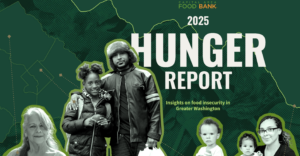
Reports that track food insecurity on a statewide or regional level are likely to become more important with the demise of the USDA report. Many food banks already publish such reports, including Capital Area Food Bank, which last month issued its 2025 Hunger Report, and Greater Boston Food Bank, which in June put out its fifth annual Statewide Food Access Report. Feeding America is also engaging in local efforts, including with Arkansas food banks to study statewide food needs and with California’s Bay Area food banks to refine local food insecurity estimates.
Later this month, officials from eight states will be meeting with the New Jersey Office of the Food Security Advocate to find out more about how New Jersey created its Statewide Food Insecurity Index, said Mark Dinglasan, Executive Director. Released in June, the interactive tool lets users compare food insecurity rates at the census block level, the smallest unit by which the U.S. Census reports demographic statistics.
Users of the NJ index can also overlay various segments, such as areas of SNAP under-utilization or rates of single-parent households, to build more targeted hunger relief strategies. In places with high levels of single parenthood, for example, organizations may want to focus on co-locating pantries at schools or libraries. One New Jersey county has already benefited from such insights, leading it to signing up 140 families for free and reduced lunch in just one month.
For now, historical USDA food insecurity data going back to the mid-1990s is expected to remain available. And the final USDA report covering 2024 is expected to be released later this month. Even so, the sting of losing such a singular report remains. “It’s a big deal to lose this from my perspective,” Gundersen said. – Chris Costanzo
PHOTO, TOP: Data from the 2024 USDA Household Food Security report.
Like what you’re reading?
Support Food Bank News