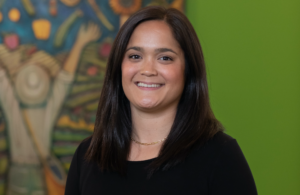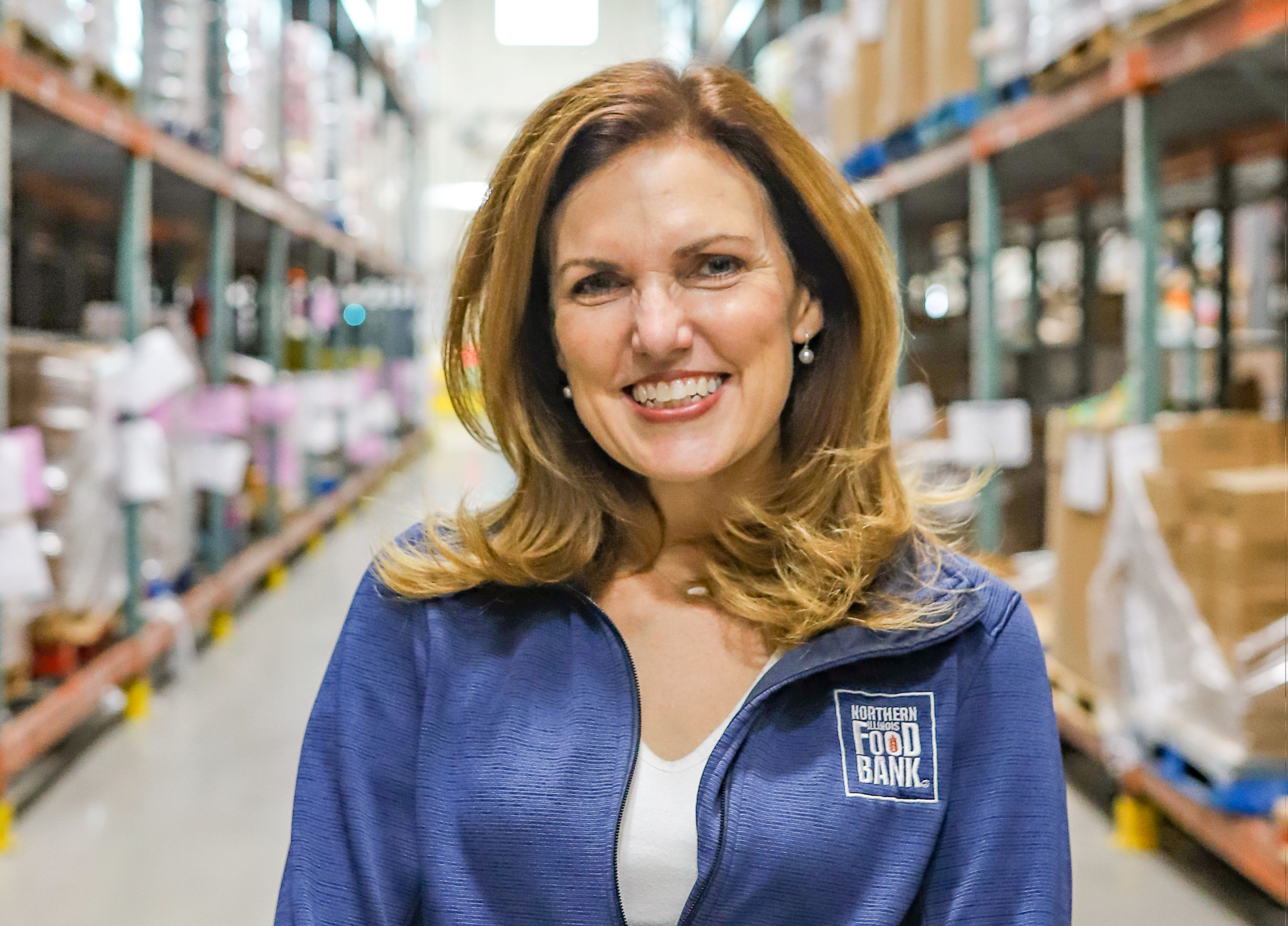
Julie Yurko would like to warn you in advance. She is going to swear. She is going to swear because she really means it and she wants you to feel it. Here goes:
Yurko is building a “kick-ass charitable food system.”
A lot goes into that goal, starting with the premise that the neighbors who use the system are the ultimate authorities on how it should work. Yurko’s quest to put neighbors at the center of everything at Northern Illinois Food Bank, where she has served as President and CEO for nearly 12 years, has earned Yurko our Food Bank Leader of the Year award for 2025.
How we did it: We received more than 160 nominations for Food Bank Leader of the Year, after putting out a call to all of our subscribers. A single nomination qualified a nominee for consideration. Our editors chose our 2025 Food Bank Leader of the Year after careful consideration of all the nominees.
Yurko comes by her mandate simply. “It comes from a respect that I have for the people we serve,” she said. “I care more about their approval than necessarily anybody else’s.”
That respect has led Yurko and her food bank down paths that few other food banks have traveled. Notably, Yurko has consistently taken cues from the for-profit world, drawing inspiration from online shopping sites, for example, to introduce a visionary online food pantry model that expands the ways in which neighbors can access food.
More recently, Yurko and her team have become students of the Net Promoter Score, a measure of customer loyalty and satisfaction widely used by companies that sell consumer goods and services, but not commonly embraced by nonprofits. Considered a gold-standard metric, the Net Promoter Score measures loyalty by asking people whether they are likely to recommend a given good or service to others.
Nonprofits typically don’t think to ask such a question, assuming that neighbors getting free goods and services are automatically satisfied with what they’re receiving. Yurko doesn’t see it that way, viewing hospitality and customer satisfaction as the next frontier for the food bank. “We need to serve people well,” she said. “How do we understand what keeps them from coming to us? How do we know we’re actually doing a good job?”
In its first three years of working with Net Promoter Score, Northern Illinois Food Bank queried over 6,500 people about their experience with different services of the food bank. In 2023 and 2024, its score ranged from 70% to 77%, putting it in a category that approaches world-class and up from 55% in 2022. Its most recent survey, taken in Fall 2025, netted 7,000 responses and covers almost all of the food bank’s services. It’s the culmination of everything the food bank has learned about Net Promoter Score over the past three years, and Yurko expects it to be the food bank’s most qualified and trustworthy survey to date. Its results will be available in January.
The food bank’s constant iteration on how it does things has led it to make some unexpected decisions, like taking out newspaper ads in a local Polish newspaper to better reach that population. The overall theme is to get the basics right. “We want to make it the very, very best we can make it,” Yurko said. “The core work has to be exceptional.”
Yurko’s own experience of relying on public benefits as a mom with four young children during a short period of unemployment years ago plays a big role in her current approach to hunger relief. Going to a food pantry at that time was not an option, as Yurko didn’t know that a charitable food system even existed. “If I would have known that, that would have been great,” she said. Especially if it were a convenient, stigma-free, welcoming system like the one she is working to build. “I understand the fear that people have when they don’t have enough, and that’s why I care so deeply about representing well and providing a system that serves them well,” she added.
Adopting a neighbor-centered approach has required changing things up organizationally. One initiative has been the creation of research and advisory councils, made up of representative groups of neighbors who are compensated, usually in gift cards, to lend their expertise to designing new programs and/or resolving issues at the food bank. Driving a lot of this engagement is the innovation team, created four years ago and now numbering four people, who are tasked with using empathy to understand neighbors, their needs, the barriers they’re facing, and to draw upon those insights to drive change and action. In addition to the innovation team, the food bank also has an innovation task force on its board. “Innovation is a core value,” Yurko said.
To track its progress in neighbor-centricity, Northern Illinois Food Bank is incorporating new metrics that go beyond the standard measure of pounds of food distributed. While it continues to report pounds, it also tracks whether it is distributing meals and serving neighbors equitably based on need. The third measure is its Net Promoter Score. Finally, it seeks to provide high nutritional value, particularly in the food it purchases. “We’e always going to tell you how many pounds we’re distributing,” Yurko said. “But for us, we’re hitting our targets when we’re distributing meals accurately. We’re reaching everybody. We’re reaching them with high satisfaction, and we’re providing nutritious food.”
A final metric that resonates with Yurko is the fact that 40% of the food bank’s board and more than one-third of its team has lived experience with food insecurity. “It shows me that we must be doing something right,” she said, “because people who have lived it see what we’re doing and they want to be a part of it.” – Chris Costanzo
Like what you’re reading?
Support Food Bank News