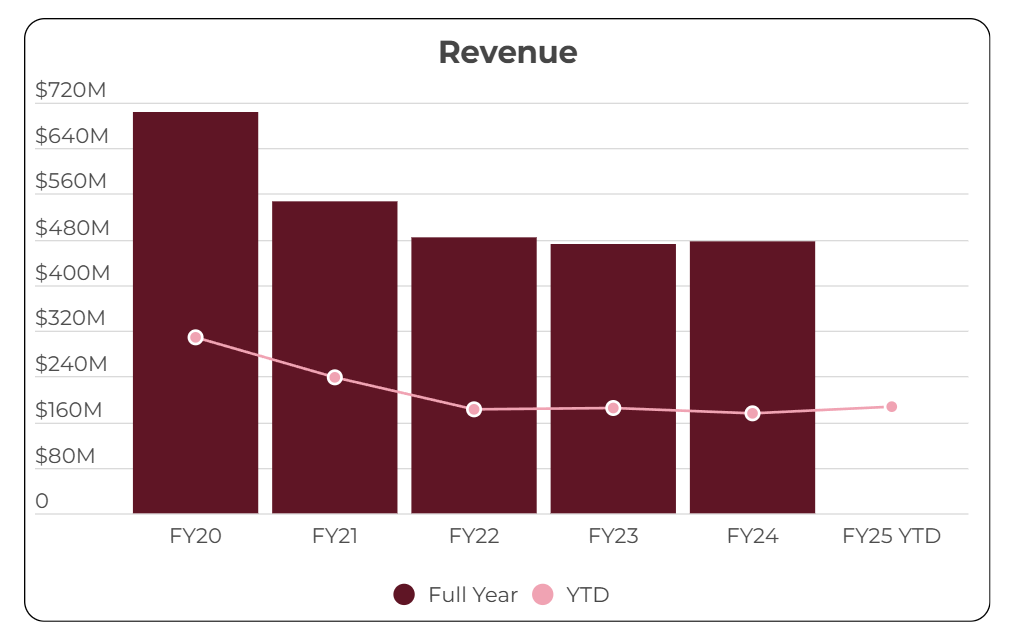
In a rare bit of good news, a report on food bank fundraising from RKD Group showed growth in individual giving across nearly every metric, setting the stage for what observers hope will be a strong holiday giving season.
Among the highlights: revenue is up 7% overall, and by 10.6% when gifts of $10,000 or more are included. New and reactivated donors jumped by 16.4%, while recurring revenue from monthly sustainers rose 12.4% and average gift size increased by 5.9%. And while the number of active donors (those who’ve given in the last 12 months) rose by a modest 1.7%, the revenue per active donor climbed 5.2%.
These findings, which reflect giving at 83 food banks from mid-2024 to mid-2025, show food banks outperforming their nonprofit peers. Food banks were the only sector among the five that RKD studied (including animal care, hospitals, rescue missions and humanitarian aid) that demonstrated year over year growth in active donors. And while not an apples-to-apples comparison, the sector’s 7% revenue growth outpaced a 6.3% increase in overall 2024 charitable giving reported by Giving USA.
“Food banks are well positioned right now, going into uncertain times,” said Eddy Camas, RKD’s Senior Vice President, Client Partnership.

That cautious optimism is evident among some food banks. Anne Arundel County Food Bank, for example, which operates in the Washington D.C. area, had been nervous that job losses among community members working at nearby federal government offices would crimp its fundraising efforts. Its summer appeal, however, had lots of momentum, achieving about 150% of the food bank’s goal. “I think through some of the messaging we’ve done locally, we’ve inspired several folks who have the means to give to really go above and beyond,” said Leah Paley, CEO.
At the same time, there’s an awareness that even healthy amounts of fundraising will likely not be nearly enough to meet the impact of federal funding cuts, combined with new restrictions on SNAP usage. Anne Arundel County Food Bank has benefitted from $1.5 million in funding from its county in recent years, but may not be able to count on that funding in future years. “Those cuts at the federal level are trickling down to the states, and then it’s going to trickle down to the county,” Paley said. There’s just a lot of speculation on what the direct impact will look like at the local level.”
While predictions are difficult given the current federal landscape, Camas said that mid-year revenue growth of 7% leads him to expect comparable results for the near future. Some factors, such as the impact of the government shutdown, could spark donors to open their wallets. And if the impacts from SNAP cutbacks take effect sooner than expected, he added, donors are likely to respond again. Still, Camas cautioned, “There’s just so many things right now that could really change that landscape.”
Compared to before the pandemic, RKD’s data reflects a new, higher level of giving. “Everybody remains above pre-pandemic levels,” Camas said. “They may have come down a bit [from pandemic-era levels] … but giving overall for food banks remains higher than it was.”
The only decline RKD found was in gift frequency, which fell by 0.7%. Camas doesn’t see this as cause for concern, however, noting that it is consistent with anecdotal reports that some donors are giving less frequently as the pandemic fades from view.
The report offers three recommendations for keeping the giving going: prioritizing stewardship, nurturing monthly giving, and deepening mid- and major-donor relationships. Camas also emphasized the importance of monthly donors, as consumers gravitate toward a “subscription economy.” He said, “Donors are consumers, just like you and I. While we don’t want to call it a subscription, it is the same behavior. You’re making a monthly commitment.”
Camas also urged food banks to grow their digital capabilities. “We are seeing a lot of growth and a lot of new donors coming in through digital channels.”
For major gifts, Camas recommended targeting potential donors with specific, tangible offers, such as funding a new stove for a community kitchen or a delivery truck for local distribution. “We try to rally around necessities food banks have that will resonate with donors.”
In the near term, the strong showing of donor engagement on all levels of giving heading into the fourth quarter is “super, super encouraging,” Camas said. “Donors will continue to support food banks. They’ve shown, historically, over the last twenty years, that they always stick with food banks. A lot of other nonprofits can’t say that.” – Amanda Jaffe
Amanda Jaffe is a writer and former attorney with a deep interest in organizations and mechanisms that address food insecurity. In addition to writing articles for Food Bank News, she publishes humorous essays on her Substack, Age of Enlightenment (https://amandajaffewrites.substack.com/). You can find more of her writing at www.amandajaffewrites.com.
Like what you’re reading?
Support Food Bank News