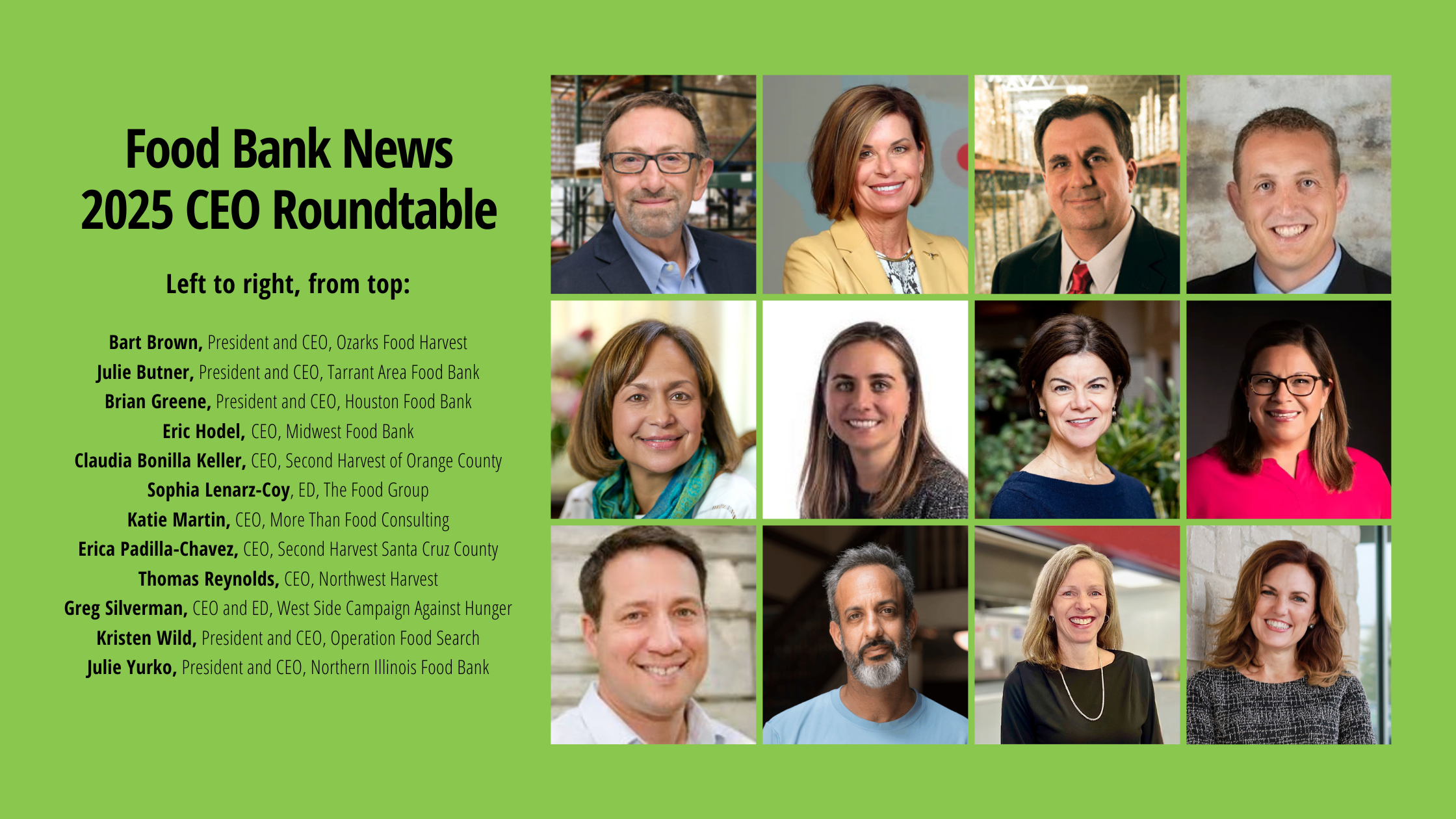
Our CEO Roundtable this year took place literally hours after the government shutdown that suspended SNAP payments to millions of Americans had ended. But relief was not one of the emotions expressed by the 12 food bank leaders on the call.
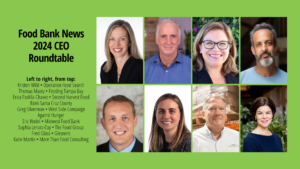
Every November, members of our Editorial Advisory Board gather to participate in our CEO Roundtable. See here for the full list of our Editorial Advisory Board members.
Talk of silver linings intermingled with a heavier feeling of uncertainty toward what the future might bring. Food bank leaders acknowledged that they were able to meet the moment from an operational standpoint, but were less clear about how to build on some of the positive energy generated by the SNAP interruption, while also gearing up for the possibility of ongoing instability.
The suspension resulted in some favorable outcomes, they noted. “The positives have been around our capacity, our learnings from Covid, and being able to respond in crisis,” said Julie Yurko, President and CEO of Northern Illinois Food Bank. “We know what works and we can launch into that, which has been terrific.”
Much in the same way that Covid put a spotlight on the work of food banks, the government shutdown highlighted the reach of SNAP. With so much news coverage, the general public is now much more aware of the value of SNAP, even in places like right-leaning Missouri. “We had our elected officials in Missouri literally copying and pasting Feeding America’s talking points about the SNAP program,” said Bart Brown, President and CEO at Ozarks Food Harvest. “So that’s the message people are hearing from some of these very conservative officials.”
The outpouring of support from volunteers and local communities was another bright spot. “The thing I probably saw the most in the last month and a half is the surge in energy from our volunteers,” said Eric Hodel, CEO of Illinois-based Midwest Food Bank. “We had people helping people.”
Kristen Wild, President and CEO of Operation Food Search in St. Louis, Mo., agreed about the high level of community support, noting her food bank is benefitting from 40 active food drives and had a record number of online donations in a single day leading up to the shutdown. “I would certainly rather not have had a SNAP shutdown, but that is one small positive that has come of it,” she said.
But there was also a harsh irony to the fact that the nation’s growing understanding of SNAP’s impact comes at the same time that cuts to the program are being implemented. “People are stepping up in this beautiful way,” noted Sophia Lenarz-Coy, Executive Director of Minnesota-based The Food Group. “But what we’re really saying is that the federal safety net needs investment at the same time it’s being cut.”
Yurko used the word “heartbreaking” to describe the disconnect between the uplifting of people who need assistance and the cuts to federal assistance, which is expected to be reduced by $186 billion over the next ten years under the administration’s H.R. 1 budget bill.
Claudia Bonilla Keller, CEO of Second Harvest Food Bank of Orange County, painting a stark picture of the future, described this month’s SNAP suspension as a dress rehearsal. “We are going into a year when the effects of H.R. 1 will start to roll,” she said. “I hate to say, ‘Brace for impact,’ but that’s what we’re feeling. This is turbulence now and we’re going to go into a year with a lot of turbulence.”
Katie Martin, CEO of More Than Food Consulting, agreed that November’s SNAP interruption was a “test drive” for the cuts that are coming. “I don’t think people realize the implications of what that’s going to look like and how many people are going to be hurting,” she said.
The leaders offered a range of strategies for navigating fallout from the SNAP cuts, which began to go into effect Nov. 1. One is to maintain the momentum of talking about the importance of SNAP, especially as the national conversation keeps turning back to healthcare, said Erica Padilla-Chavez, CEO of Second Harvest Food Bank of Santa Cruz County. “We should be talking about all the programs that impact the individuals that we’re serving, whether it’s healthcare or food,” she said.
Padilla-Chavez also emphasized the value of working with local leaders after she saw agencies that do not normally engage in food insecurity come together during the SNAP suspension. “What I’m learning from this moment in my county is how important it is for me to be in continuous conversation with the local leaders who are having policy conversations with national and statewide sectors and associations,” she said. “There’s something to be said about us starting at home and then elevating that effort through our local jurisdictions.”
Julie Butner, President and CEO of Tarrant Area Food Bank in Texas, pointed to the ability of food banks to change public opinion, especially in the face of misinformation about SNAP. “We have an 80% favorability rating,” Butner said. “And we can help get the message out about what’s true and what isn’t true. We can help change public opinion.”
Butner also encouraged food banks to push for more innovation in how people access food. For example, the Double Up Food Bucks program, which gives incentives for SNAP recipients to purchase more fruits and vegetables, could be expanded to include WIC recipients and seniors. “We have to be thinking about innovation,” she said.
Thomas Reynolds, CEO at Northwest Harvest, imagining worse-case scenarios, said food banks need to go beyond thinking about how to fill the gap if federal aid withers. “What’s more important to think about is how do we solidify and codify accountability mechanisms to ensure the government fulfills its duties as it relates to food, and if they don’t, there are ways to sue the government to fulfill its duties.” While it may be tempting to pour more effort into distributing food, he said, the “smarter dollars” would go to ensuring the government does its job.
Now is also the time for more SNAP advocacy, said Brian Greene, President and CEO of Houston Food Bank, given the greater understanding and sympathy of the general population toward SNAP. “We might make a lot of gains for the people we serve if we push heavily on that message over the coming year,” he said.
Greg Silverman, CEO and Executive Director at West Side Campaign Against Hunger in New York City, said he expects everyday people to carry the day when it comes to advocating for SNAP. He doesn’t see elected officials coming through unless under immense pressure. “The customers that we serve everyday are who I have faith in,” he said, noting that people working en masse are more powerful than those on Capitol Hill and big donors. “People-power works over money and we have to lean into that,” he said. – Chris Costanzo
Like what you’re reading?
Support Food Bank News