GUEST POST FROM ARTIFICIAL INTELLIGENCE – Artificial intelligence is no longer a distant promise for the charitable food system. It is arriving now — in donor segmentation tools, demand forecasting pilots, automated grant drafting, and logistics optimization experiments across food banks of every size. But what does the next three to five years actually look like for the sector? And what should food bank leaders be doing right now to prepare?
To find out, we posed the same set of questions to three of the leading AI models available today: OpenAI’s ChatGPT, Google’s Gemini, and Anthropic’s Claude. We asked each of them three things: How will AI affect food banks in the next three to five years? How can food banks prepare? And what are three to five specific actions food banks can take right now to get ready?
The results were instructive. All three models converged on several core themes, but each brought a distinct emphasis and set of priorities to the table. Below, we synthesize the key points of agreement and divergence.
Data Readiness Is the Single Biggest Prerequisite. Every model identified data quality and infrastructure as the foundational issue. ChatGPT framed it as standardizing product categories, donor records, and reporting definitions. Gemini urged food banks to build a centralized data architecture. Claude described it as an audit of every system where critical data lives, from client intake to financials. The consensus is unambiguous: food banks that cannot get their data into clean, structured, accessible formats will struggle to benefit from any AI tool, no matter how sophisticated.
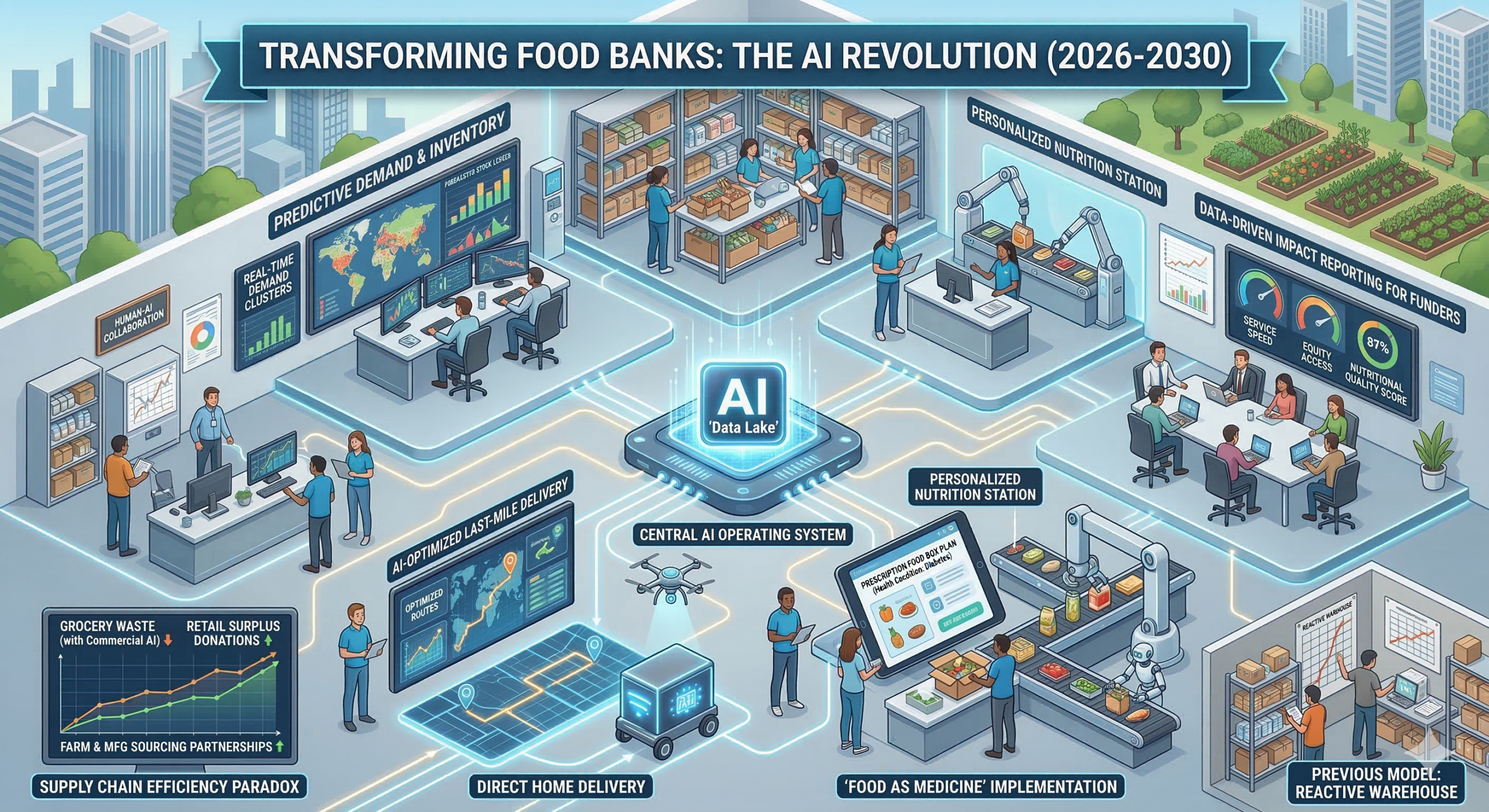
Operations Will Become Predictive. All three models described a shift from reactive to predictive operations. Demand forecasting, inventory management, logistics routing, and resource allocation will increasingly be driven by AI models that integrate economic indicators, weather data, benefit cycles, and historical patterns. The days of planning by intuition and spreadsheets are numbered — not because the tools don’t work, but because the organizations that adopt predictive systems will operate with visibly better efficiency, and funders will notice.
Funders Will Demand Data-Driven Impact Reporting. ChatGPT, Gemini, and Claude all flagged the rising expectations from donors, foundations, and government funders for sharper proof of impact. The ability to demonstrate outcomes — not just pounds distributed but nutritional quality, speed of service, equity of access, and cost efficiency — will increasingly separate food banks that attract investment from those that do not. Claude noted that this creates a virtuous cycle: food banks that start telling data stories now build the organizational muscle that makes future AI adoption easier.
Start Small, Start Now. None of the three models recommended that food banks pursue a sweeping AI strategy. All three said to pick a bounded, low-risk pilot project and learn from it. ChatGPT suggested a 90-day pilot with predefined success metrics. Claude recommended choosing a specific pain point — donor communications, volunteer scheduling, or demand analysis for a single product category — and testing an existing tool against it. Gemini pointed to generative AI for fundraising copy as an immediate, low-stakes starting point.
All three models were explicit that AI will not replace the core mission of food banks. Community trust, client dignity, relationship-building with donors and partner agencies, and judgment about fairness and access remain fundamentally human work. The strongest framing, shared across all three responses, is that AI makes human work more effective — it does not substitute for it.
Despite broad agreement on fundamentals, each model brought a different lens to the question, and the differences are revealing.
ChatGPT was the most research-grounded response, citing specific studies and sector reports from Feeding America, the Global FoodBanking Network, PubMed Central, and NTEN. It was the only model to raise governance, privacy, and algorithmic bias as serious near-term issues for food banks working with vulnerable populations. It also offered the most nuanced view of how commercial AI adoption in the food supply chain could change the mix and volume of donated food — a strategic consideration the other models did not address.
Gemini was the most forward-looking and aspirational, painting a picture of food banks evolving into “predictive community health hubs.” It was the only model to explicitly describe the “efficiency paradox” — the idea that as grocery retailers use AI to reduce waste, traditional surplus donations may decline, forcing food banks to find new sourcing strategies. Gemini also went furthest on the healthcare integration angle, describing AI-powered “Prescription Food Boxes” tailored to client health conditions.
Claude was the most operationally pragmatic, focusing on internal organizational readiness rather than external technology trends. It emphasized the cultural barrier to AI adoption — staff skepticism born of past software rollouts that created more work than they saved — and the importance of building trust through small, demonstrated wins. Claude was also the only model to explicitly recommend strengthening peer networks and collective purchasing power across food bank networks, and to frame data storytelling to funders as an action item that pays dividends even before any AI tool is purchased.
The three leading AI models, built by three competing companies with different architectures and training approaches, arrived at a remarkably consistent set of conclusions. AI will not replace the mission of food banks, but it will increasingly separate the operationally excellent from the operationally adequate. The food banks that start building data foundations and organizational readiness now — even with modest resources — will be the ones best positioned to serve their communities when these tools mature.
The advice from all three models can be distilled to a single imperative: do not wait for the perfect AI strategy. Clean your data. Try one tool. Learn from it. Build from there.
Disclosure: This article was produced by AI tools. Our Board Chair, Patrick O’Neill, a close observer of AI trends who believes AI will be transformational for the charitable food system, gave the three AI models identical prompts. Their responses were synthesized and lightly edited for publication by Food Bank News.
GRAPHIC, TOP: This graphic was generated by Google’s Gemini AI tool.
Like what you’re reading?
Support Food Bank News
This article was made possible by the readers who support Food Bank News, a national, editorially independent, nonprofit media organization. Food Bank News is not funded by any government agencies, nor is it part of a larger association or corporation. Your support helps ensure our continued solutions-oriented coverage of best practices in hunger relief. Thank you!