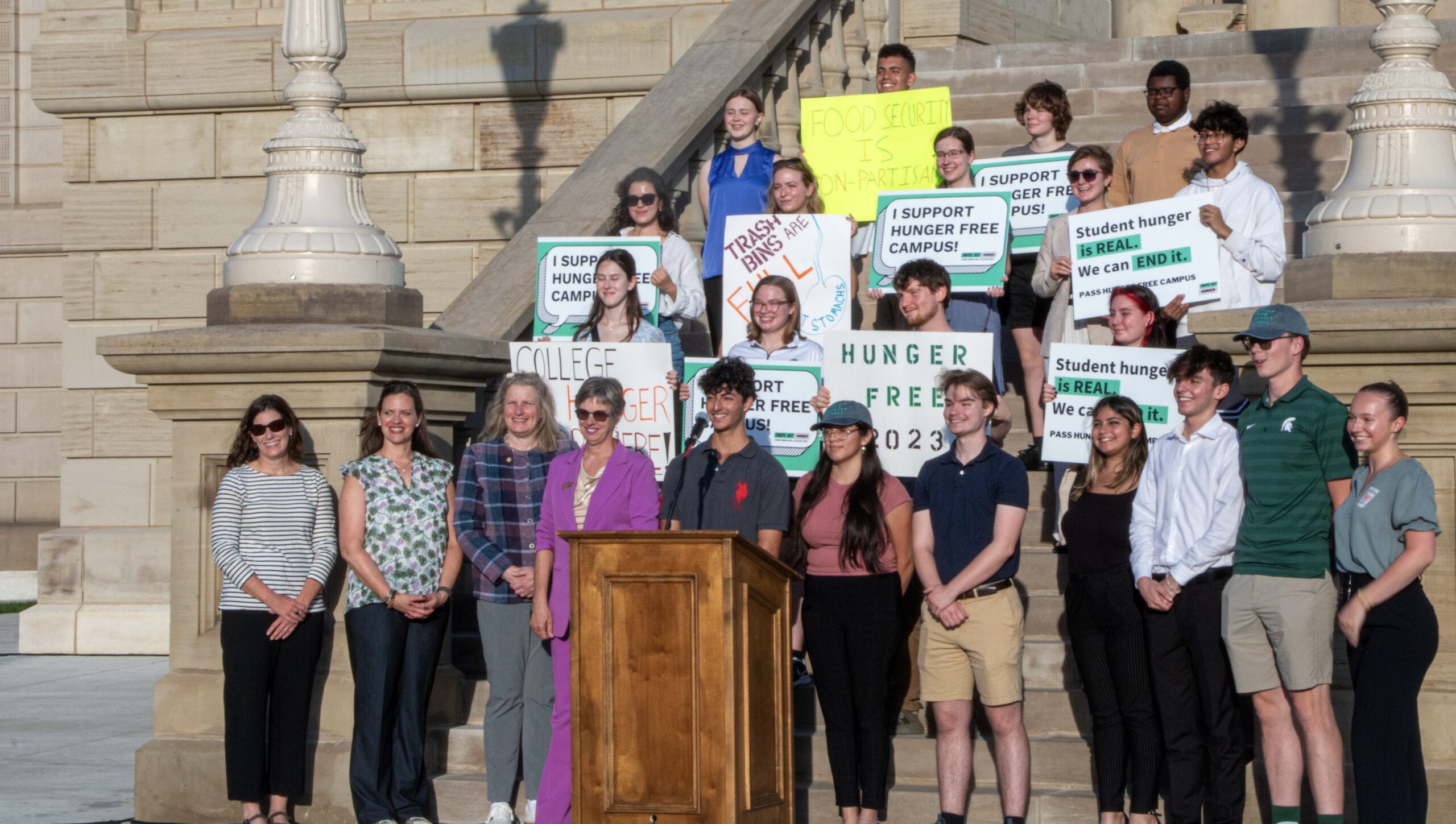
Students who succeeded in securing a total of $1 million in the Michigan state budget to address college food insecurity achieved their goal in part by placing their fellow students’ stories at the center of their campaign.
In 2024, Michigan State University’s Spartan Food Security Council secured a $500,000 line item in the state budget to fund a pilot program supporting food security infrastructure on four Michigan campuses. The next year, they secured another $500,000 and expanded the program to more campuses across the state.
A partnership with Swipe Out Hunger, the national nonprofit that seeks to end college student hunger, provided critical support for the students’ advocacy campaign. But centering student narratives was at the heart of SFSC’s strategy. “Our whole mission . . . was really just focusing on student voice and utilizing that and emphasizing that in our advocacy work,” said Aditi Kulkarni, a co-founder of SFSC, along with Spencer Good.

Kulkarni and Good met as first-year students during the pandemic, in an online course on international food insecurity. In the course, they bonded over their mutual recognition that the issues they were studying also existed among students in the United States. When they arrived on campus as sophomores, they brought their curiosity about student hunger and that fall, in October 2021, they started SFSC.
Their first step was to listen. “We didn’t want to do something that wasn’t going to be helpful for students,” Kulkarni said. “It required us to step back and listen to students, listen to community members, educate ourselves on what food insecurity really is and what that means for our campus.”
What they heard helped them understand the unique challenges of college food insecurity. “College food insecurity, as we learned, is its own animal,” Good explained. Many students are too busy to work, those who can’t work aren’t SNAP-eligible, and many areas on and around campus are essentially a food desert, he said. In addition, “There’s an unfortunate misconception that college students just make it on ramen noodles for four years. It’s really the only demographic, if we think about it, that has a glorified bad diet.”
While SFSC’s core pillars include advocacy, education, and service, the advocacy agenda quickly came to the fore. Early conversations with administrators were positive, but as Kulkarni and Good gained experience, they decided to broaden their base and shift their focus to the state legislature.
At this point, they decided to team up with Swipe Out Hunger. The nonprofit, which had never worked in Michigan, offered resources that the newly minted student advocates needed, while SFSC offered Swipe Out Hunger “boots on the ground” to get the work done. It was, Good said, “the perfect partnership.” At the same time, he added, “it was a totally student-led initiative, down to our advocacy strategy.”
Key to emphasizing the student voice was training students, many of whom were “totally daunted” at the prospect of meeting with state legislators, to tell their stories, Good said. That training produced powerful messaging, Kulkarni said, including one postcard sent to a legislator that simply said, “I’ve been living off rice for several days. I don’t have access to any other food.”

Building a broad coalition amplified the impact of their message, Good emphasized. SFSC assembled student voices that crossed academic disciplines, political perspectives, and geography, from community colleges to universities. “We were bringing students from every corner of Michigan to the table to share their lived experience and advocate with elected leaders.”
The learning curve, Kulkarni noted, was steep. “We were essentially assembling the plane as we were flying it.” Every step – from learning which legislators to meet with, to how to schedule meetings, to how to run a postcard campaign, to testifying in committee – was an opportunity to learn.
The experience also taught Kulkarni and Good the importance of flexibility. SFSC’s original goal was to pass a standalone Hunger Free Campus bill, creating a “hunger-free” designation for eligible state universities. Funding, Good noted, would be attached after the fact. While SFSC succeeded in getting the bill through the committee process, it died in a lame duck session. With Swipe Out Hunger’s backing, SFSC pivoted to focus on securing the budget line item.
“It was hard not to feel disappointed that we didn’t pass the Hunger Free Campus bill into law,” Good said, “but that [line item] win was no less significant. In some ways, it was probably exactly what colleges and universities needed in Michigan.” It was particularly satisfying, he said, to inform MSU that it was going to receive $125,000 of the $500,000 appropriation.
While SFSC continues to have “a great working relationship” with MSU, Kulkarni and Good have graduated. Kulkarni is now the Food Access Coordinator at Community Action House in Holland, Mich., and Good is a legislative director in the Michigan House of Representatives. A third former SFSC member, Jay Lyon, is an advocacy organizer for Swipe Out Hunger.
They may be distanced from the day-to-day, but Kulkarni and Good remain close to SFSC and the lessons they learned. As Kulkarni noted, “If you’re going to talk about college food insecurity, college students need to be at the heart of the issue.” –Amanda Jaffe
Amanda Jaffe is a writer and former attorney with a deep interest in organizations and mechanisms that address food insecurity. In addition to writing articles for Food Bank News, she publishes humorous essays on her Substack, Age of Enlightenment (https://amandajaffewrites.substack.com/). You can find more of her writing at www.amandajaffewrites.com.