When Daily Bread Food Pantry in Danbury, Conn., relocated earlier this year to a new space ten times its original size, President Peter Kent suddenly had a huge need to get the pantry’s 370 volunteers up to speed on a host of new protocols.
In addition to expanding its days and hours of operation, Daily Bread had implemented a client-choice model of shopping after years of “grab-and-go” distribution, and added several new technology systems, including the Smart Choice online ordering platform and volunteer management software.
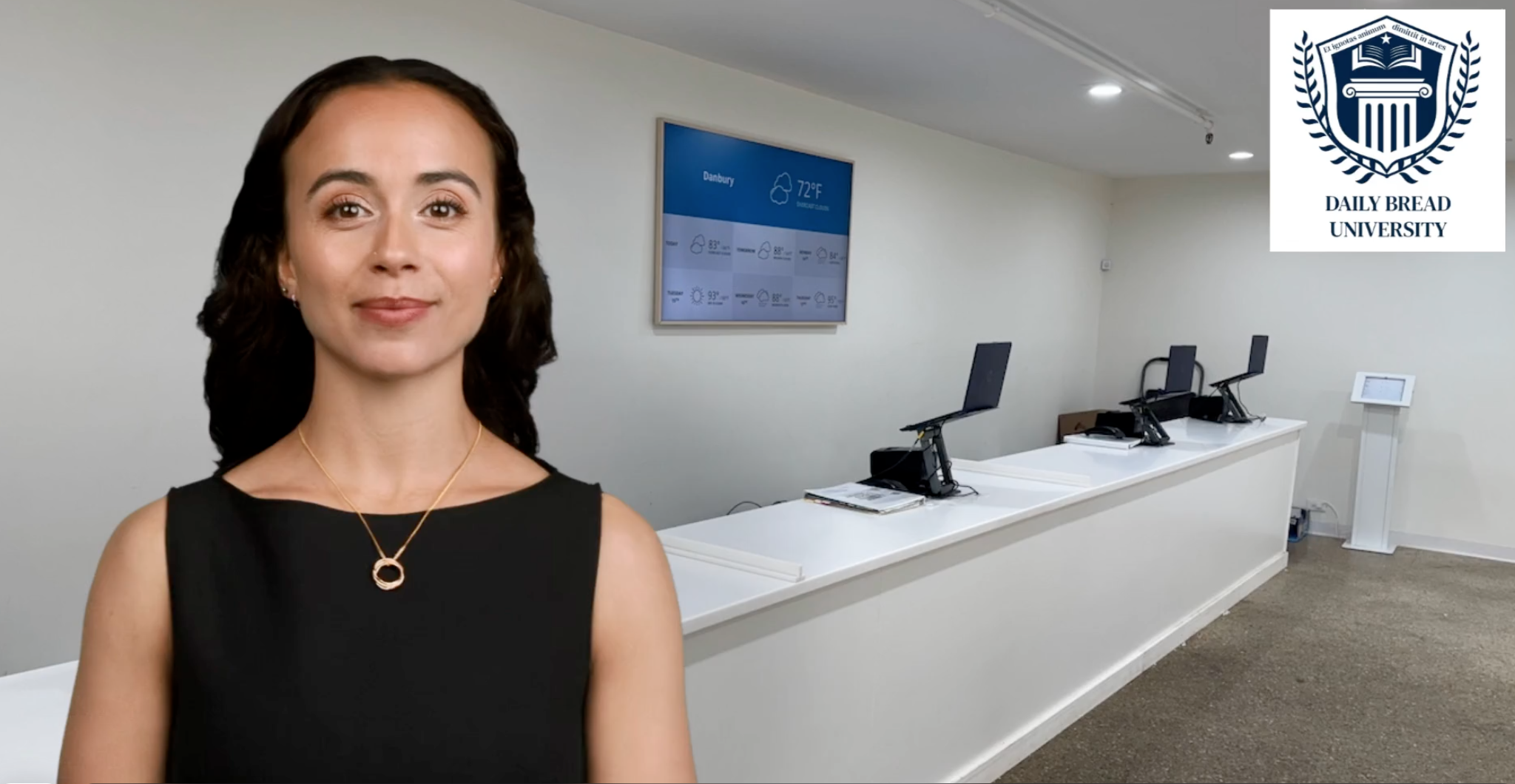
Kent knew that online training videos would let him reach more people more flexibly than in-person training sessions, but was wary of all the time and effort it would take to actually make the videos. Before long, he had shifted his focus to videos created by artificial intelligence, after coming across an ad for Synthesia, an AI-based video platform.
“Within a few hours, I had what I thought was a pretty professional looking video to roll out,” Kent said. “That simply wouldn’t have been possible if it’s a live video.”
The simplicity of creating training videos and the quality of the results are far superior to live-action, which are “very time consuming,” he said, adding, “If you’ve got any kind of professionalism aspiration, the results are often a little disappointing.”
Creating a video with AI isn’t that different from creating a PowerPoint, said Kent. “They call them scenes, but you can effectively describe them as slides.” Kent typed in his script, supplied screenshots for illustration, and selected an avatar. No video production experience is necessary, he emphasized. “All you really need is some fairly basic PowerPoint skills and you’re off to the races.”
With AI, it’s also easy to update a video when procedures and processes change. “You don’t have to start from scratch again like you do with a traditional video,” Kent explained. “You can make very small adjustments very, very quickly and deploy them immediately.” The pantry is also able to download the completed videos, which allows Kent to post them wherever he feels is most appropriate for its needs.
While Synthesia offers different levels of service, Kent opted for a basic level costing about $100 per month. Balanced against Daily Bread’s overall budget, Kent noted, “It’s not quite a drop in the bucket, but it’s not much more than that.” While there’s no real out-of-pocket savings since Daily Bread has always created its own training materials, the return on investment is well worth the cost, Kent said, freeing him for other critical needs, such as fundraising.
Training serves several purposes at an organization like Daily Bread, Kent explained. “Most importantly, it improves the quality and consistency of the service that we provide our guests,” he said. It also ensures consistent messaging and builds shared values across a large, diverse volunteer base.
And for those volunteers who want to understand better how the pantry operates, it’s more efficient than answering one question at a time. “I’m very keen on making sure that volunteers feel enabled to make decisions themselves, but by the same token it’s important that we give them the tools to make those choices intelligently,” Kent said. Finally, the training addresses compliance, ranging from food safety to civil rights training.

Reactions to the videos, which cover topics ranging from technology to first-day expectations, have been largely favorable. While a few volunteers have an instinctive dislike of AI avatars, most aren’t even aware the videos are AI-generated, Kent said. “I think the degree of receptivity is much higher than expected.”
Kent is thinking of additional ways to deploy the technology, including training videos for guests to explain how Daily Bread’s choice system works, possibly in several languages, which is another benefit of using AI. Kent is branding the full range of Daily Bread’s training materials, which also includes manuals and PowerPoint decks, on its website under the name “Daily Bread University.”
Kent advises pantries interested in AI to create training videos to think first about whether it’s a good fit for their operations. “If you’re running a relatively small pantry with a relatively simple operating model with a relatively small number of volunteers, this might be overkill,” he noted. He also emphasizes the importance of finding someone interested in the technology to take on the project. “If someone’s going to view it as just one more darn thing to do, then it probably isn’t something that is worthwhile,” he said.
For Daily Bread, though, Kent sees nothing but upside. “You can really meet the volunteers where they are, the more tools and platforms you have available. Especially if they’re easy to manage.” – Amanda Jaffe
Amanda Jaffe is a writer and former attorney with a deep interest in organizations and mechanisms that address food insecurity. In addition to writing articles for Food Bank News, she publishes humorous essays on her Substack, Age of Enlightenment (https://amandajaffewrites.substack.com/). You can find more of her writing at www.amandajaffewrites.com.
Like what you’re reading?
Support Food Bank News